Some crafts are bought. Yuki tsumugi is commissioned. The silk cloth of Yuki City in Ibaraki — spun by hand from cocoons, patterned in the yarn and woven on a loom the weaver braces with her own body — carries both a national designation and a UNESCO inscription, and a single bolt of it can take the better part of a year. It gives Ibaraki its third story in this collection.
Two thousand years on one river
The Ibaraki prefectural guide calls Yuki-tsumugi the oldest silk-weaving craft in Japan, handed down for more than two thousand years in the area that is now Yuki City, along the Kinugawa river where Ibaraki meets Tochigi. Sericulture suited the river plain, and the cloth that came off its looms was already famous — and already expensive — in the Edo period: the guide preserves a plea from Edo's great fabric merchants asking Yuki's artisans to lower their prices, and being refused by the arithmetic of the work itself.
The designations came in the twentieth century. In 1956 the Japanese government made the technique an Important Intangible Cultural Property — a designation of the skill in people's hands, not of any single cloth. In 2010 UNESCO inscribed the Yuki-tsumugi silk fabric production techniques on its Representative List of the Intangible Cultural Heritage of Humanity. About 130 craftsmen still practise the craft in Yuki and Oyama, in the count carried by the craft's records.
Thirty kilometres of yarn, pinched by hand
What the designations protect is a way of working that refuses every shortcut. A bolt of Yuki tsumugi — about 40 centimetres wide and 12.8 metres long — needs roughly 30,000 to 35,000 metres of yarn, and every metre of it is hand-spun: floss silk drawn from some 2,000 cocoons, pinched off and twisted by fingers. A maker in the trade puts the spinning alone at a minimum of two months for one bolt. Both warp and weft are this hand-spun yarn, with nothing machine-spun substituted.
Then the pattern is worked into the yarn itself before weaving — the kasuri method — and the cloth is woven on the jibata, the old backstrap loom in which the weaver's body supplies the tension. Counted end to end, the craft runs to about forty processes, all done by hand, and depending on the pattern a bolt takes from several months to more than a year. That is why the authentic jibata-woven cloth is produced at only several hundred bolts a year.
How Yuki tsumugi is bought
Do not look for a ready-made Yuki kimono on a rail — the prefectural guide is explicit that you will rarely find one. The custom is to buy a roll of tsumugi cloth and have it made into a kimono or an obi sash to the wearer's own size. A roll usually costs several hundred thousand yen, the guide states, and the cloth is worn as prized informal dress: the most expensive casual wear in the wardrobe, by design and by arithmetic.
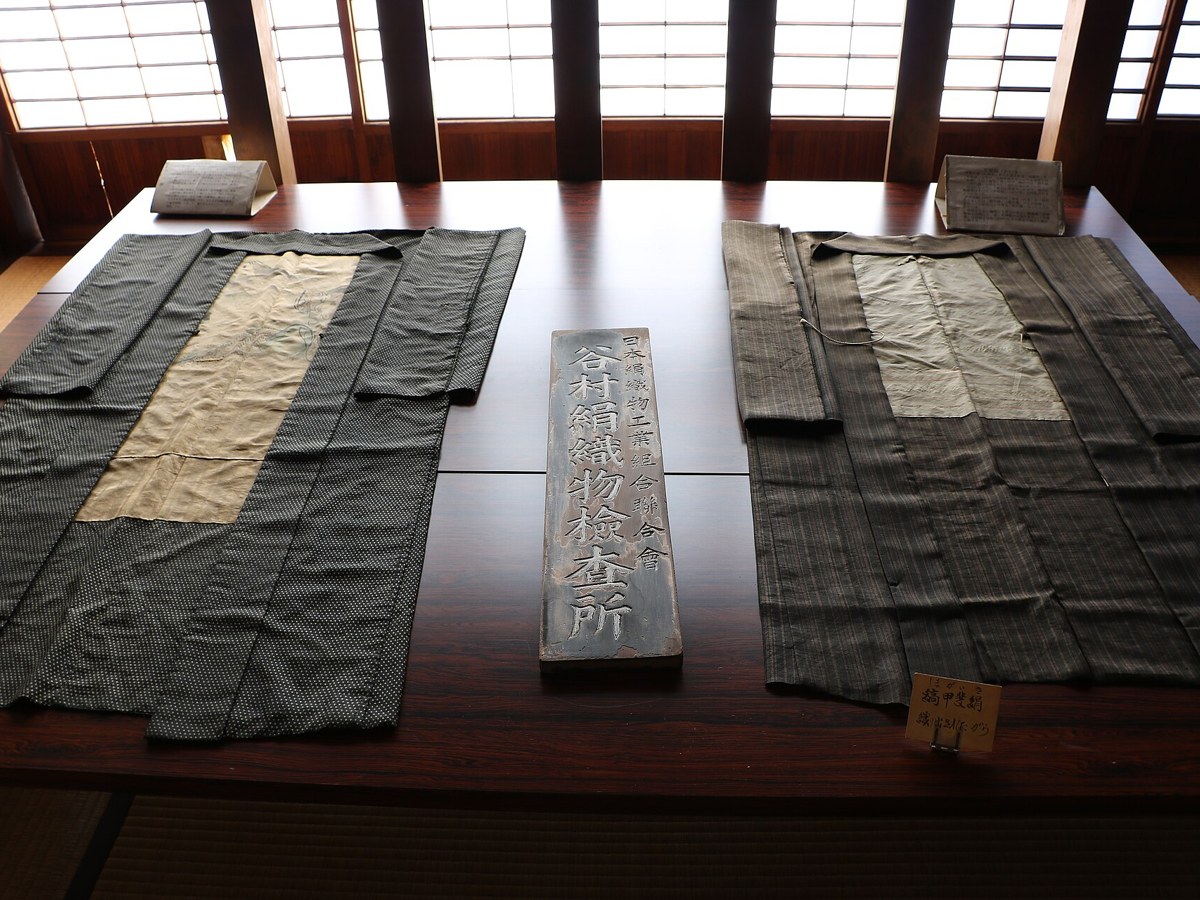
The place to see the range is Tsumugi no Yakata, the museum complex established in 2006 by Okujun, a Yuki-tsumugi wholesale house founded in 1907: its gallery holds around 200 rolls of tsumugi on display and for sale, with looms and spinning to watch. The prefectural guide lists a weaving workshop there at ¥2,200; checked visitor accounts price the hands-on pieces — a woven coaster at ¥930 to ¥1,500, a table runner at ¥4,000, a shawl from ¥5,000 — as the realistic way to take the technique home.
What to check before you buy
Because the name carries the price, the designation is the buyer's protection: genuine Yuki-tsumugi is the designated technique, hand-spun floss silk throughout and jibata-woven, and the several-hundred-bolts-a-year supply is the reason a suspiciously cheap 'Yuki' bolt should prompt questions. The visitor pieces at the museum and the city's traditional crafts centre are the honest small end of the same system — woven in Yuki, by the same family of techniques, at souvenir scale.
Plan the visit around the two sites: the Tsumugi no Yakata complex for the rolls, the looms and the workshops, and the Yuki City Traditional Crafts Center for the technique's history, with a kimono rental from the city information centre (¥2,000 for women and ¥2,500 for men in the checked guide) if you want to wear the cloth before you judge it. Yuki is about an hour north of Tokyo by train, which makes this the closest UNESCO craft to the capital in this collection.
Sources — checked 10 November 2026
- Ibaraki official guide (Visit Ibaraki): Yuki silk fabrics, a world heritage craft
- MATCHA: Yuki Tsumugi silk fabrics, a UNESCO intangible heritage
- Hirota Tsumugi (maker): Yuki tsumugi's silk handspinning
- Wikipedia: Yuki-tsumugi
Original prose and official links only; no source text or maker media reproduced. Photos are credited Creative Commons works, not product photographs.
Editorial review 2026-11-10