Kyoto paints its silk with gold. Kanazawa paints its silk with truth. Kaga Yuzen, the hand-painted dyeing of Kanazawa in Ishikawa, works in just five deep tones and spends them on flowers and plants drawn as they actually are — petals shaded darker at the edge, leaves honestly nibbled by insects. It is the quieter of Japan's two great yuzen schools, and on the checked craft account it may be the more exacting: eleven processes, all by hand, between a blank bolt of silk and a kimono.
Five colours, no gold
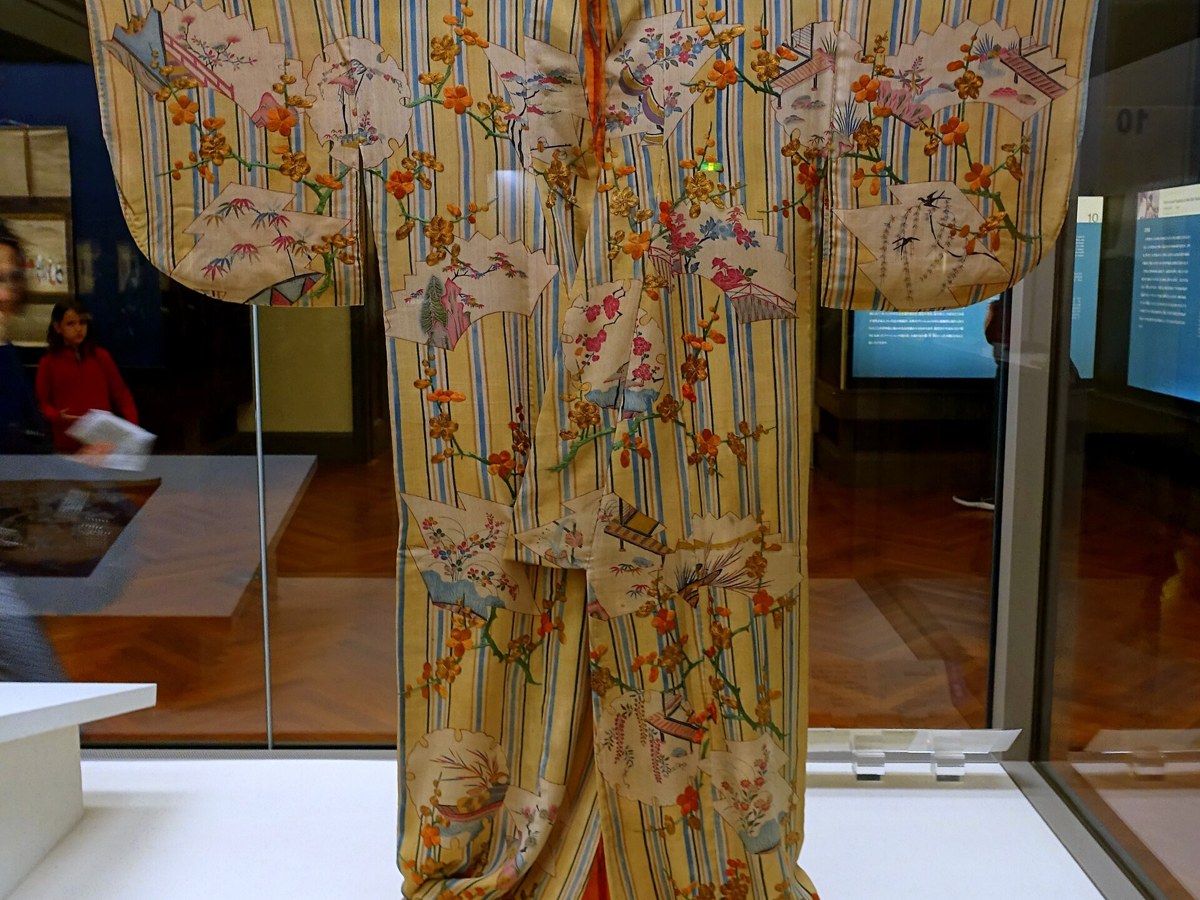
The KOGEI JAPAN account fixes the palette first. Kaga Textiles are noteworthy for their use of five underlying tones — indigo, khaki, green, dark reddish purple and deep red — the set called the Kaga gosai; the city's own travel guide names the same five as indigo, dark crimson, yellow ochre, grass green and ancient purple. Kyoto and Kaga are often compared, and the account draws the line plainly: Kyoto textiles carry design patterns with gold leaves and embroidery, while Kaga features classical deep tones centring on reddish colours and floral designs representing the natural beauty of Kanazawa.
Within those five tones, two techniques carry the Kaga signature. The delicate patterns are enhanced by gradation from the edges to the centre of each motif — the soto-bokashi shading the city's guide also names — and by designs that depict mushi-kui, the worm-eaten leaf, adding a realism no idealised school would allow. And the drawing itself is held apart by glue: the itome nori technique creates patterns with dye-resistant paste laid in fine threads, washed out after dyeing, leaving beautiful white borders that set off every coloured shape.
Eleven steps from sketch to river
The craft account walks the whole making, and it is worth following because almost nothing in it has been mechanised. The design comes first, drawn for a pictured wearer, her age and the final look of the piece. Undyed silk — high quality silk crepe among it — is cut into kimono sections and basted; the sketch is transferred in aobana, dayflower sap that disappears in a later washing; the outlines are masked with itome-nori, a resist paste made from rice, squeezed from a cylindrical tool in threads.
Then the colour: an undercoat of soybean broth or seaweed glue firms the paste; dyes based on the five Kaga gosai tones are brushed in; the painted motifs are covered with glutinous-rice paste so the ground can be dyed around them with a large flat brush; steaming fixes everything. The tenth step gave Kanazawa a spectacle — washing the finished fabric in natural flowing river water to remove paste and excess dye, the famous yuzen nagashi; today the washing mostly happens in artificial watercourses at the dyeing complex, and finishing touches close the eleventh step.
A million-koku patron and a 1975 designation
The lineage is long even by Kanazawa's standards. Scholars believe the plum dyeing called ume zome, practised in Kaga around the mid-15th century, is the method's origin — Kaga was a silk and hemp region blessed with the rivers yuzen washing requires — and by the mid-17th century the region's dyeing techniques had been gathered together as the 'Kaga no okunizome'. The craft took its name from Yuzensai Miyazaki, the founder of yuzen dyeing, who began in Kyoto and spent his final years in Kanazawa; under his mentorship and the patronage of the wealthy Kaga domain, the techniques developed rapidly.
The Aoyama Square record gives the modern standing in registry form: main products kimono fabric, obi and accessories; main manufacturing area Kanazawa City; designated a traditional craft on 10 May 1975 — the KOGEI account adds registration by the Ministry of Economy, Trade and Industry that year, after a serious setback from the luxury-goods restrictions around World War II and a revival built around the dyeing complex cooperative. Its character note is the school's whole aesthetic in one line: painterly patterns of calm, realistic flowers and plants, reflecting the tastes of the Maeda 'Kaga Million Koku' family — refined samurai elegance inside an understated charm.
What the living craft costs
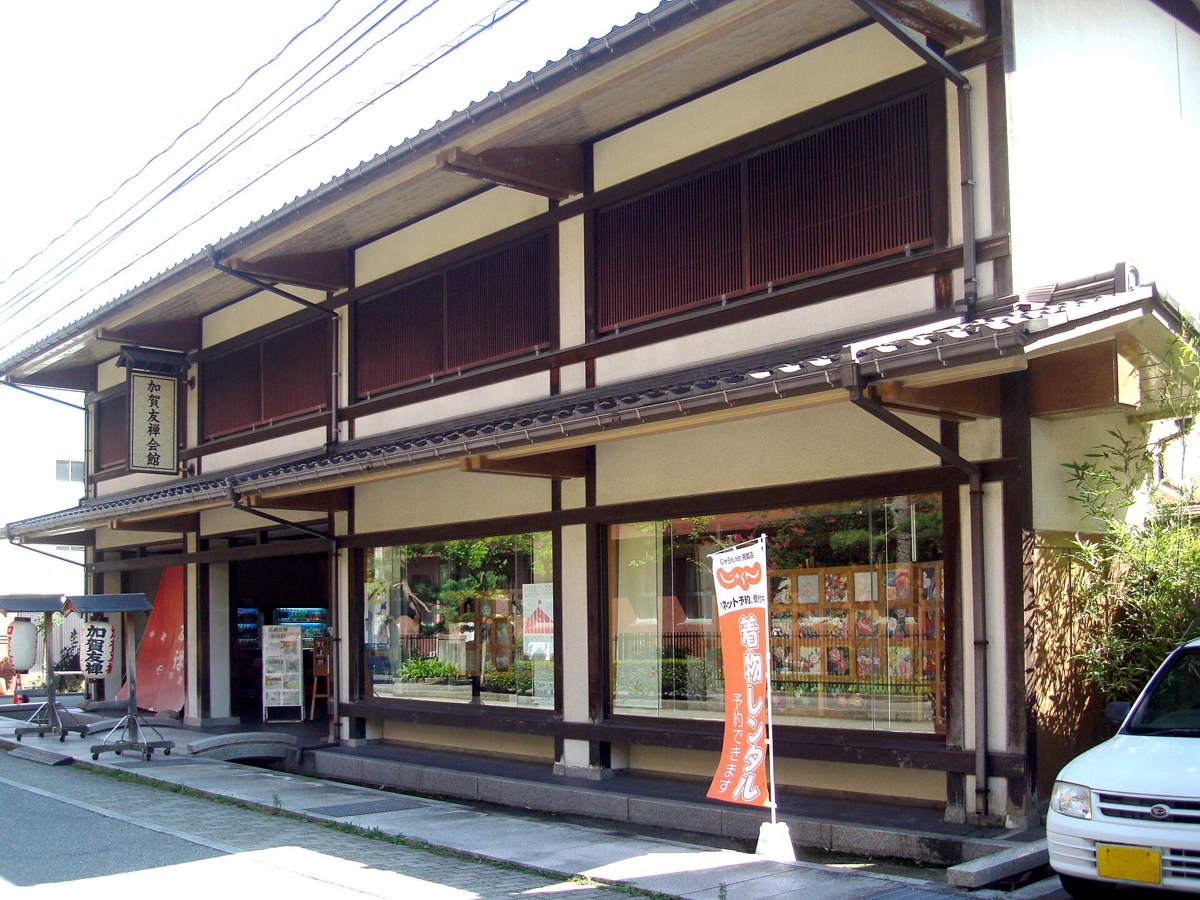
A finished Kaga Yuzen kimono is a commission, not a shelf item, so the honest price anchor is the craft's own doorway: the city's official travel guide lists hands-on Kaga Yuzen dyeing at Akaneya Archive Gallery — a house in business for more than a hundred years, a few minutes from the 21st Century Museum — at ¥1,000 to ¥3,500, dyeing stencil patterns in the five traditional colours onto bases from small tote bags to pouches. In Kanazawa itself, the KOGEI account's facility is the KAGA-YUZEN Kimono Center, where the school's kimonos are shown in the city that dyes them.
Ishikawa's standing stories are a pottery, a metal and a lacquer — Kutani's coloured ware, Kanazawa's gold leaf and Wajima's indestructible bowls. Kaga Yuzen is the prefecture's fourth and its first dyed textile: the softest thing in the prefecture's craft shelf, and the only one whose masterpiece is finished by being washed in a river. Between gold leaf beaten thinner than breath and silk painted leaf by leaf, Kanazawa's argument is complete — this city decorates everything it touches, at every scale, in every material.
Sources — checked 11 November 2026
- KOGEI JAPAN: Kaga Textiles (Kaga Yuzen) — description, history and production process (checked craft account)
- Traditional Crafts Aoyama Square: KAGA Yuzen (Dyeing) (checked official craft record)
- VISIT KANAZAWA, the city's official travel guide: Kaga Yuzen dyeing experience at Akaneya Archive Gallery (checked activity record)
Original prose and official links only; no source text or maker media reproduced. Photos are credited Creative Commons works, not product photographs.
Editorial review 2026-11-11