Before synthetic dye, Japan was blue — work clothes, curtains, festival coats, the whole country's everyday cloth in shades of indigo — and most of that blue began in one river basin in Tokushima. Awa-ai is not a colour name. It is a product: indigo leaf grown along the Yoshino River, fermented for months into sukumo, and shipped by merchant houses whose mansions still line the basin's towns. The vats are still warm. You can put your hands in one.
The home of ai
In May 2019, the storybook records, the story 'Awa — The Home of Ai' was recognised as a Japan Heritage — a joint application by nine cities and towns of the Yoshino River basin, with thirty-two cultural assets between them. The claims at its centre are measurable, and the council states them plainly: the basin of the Yoshino, flowing through northern Tokushima, produces the largest amount of indigo dye in Japan; 'Awa-Ai' names the sukumo produced in Tokushima; and the technique of Awa indigo production has been chosen by the state as a Selective Conservation Technique, preserved by craftspeople called ai-shi who continue the production today.
Sukumo is the key object. Where other indigo traditions dye from leaf or powder, Awa's masters compost the harvested leaf — watering, turning and fermenting it until it concentrates into dark, earthy cakes of dye. Those cakes were the basin's currency: indigo merchants, the ai-shōnin, distributed Awa-ai all over Japan, and their prosperity built the landscape the heritage story protects, from the wealthy farmers' walled estates on the plain to Wakimachi's gorgeous udatsu streetscape. The blue came first; the towns are its receipts.
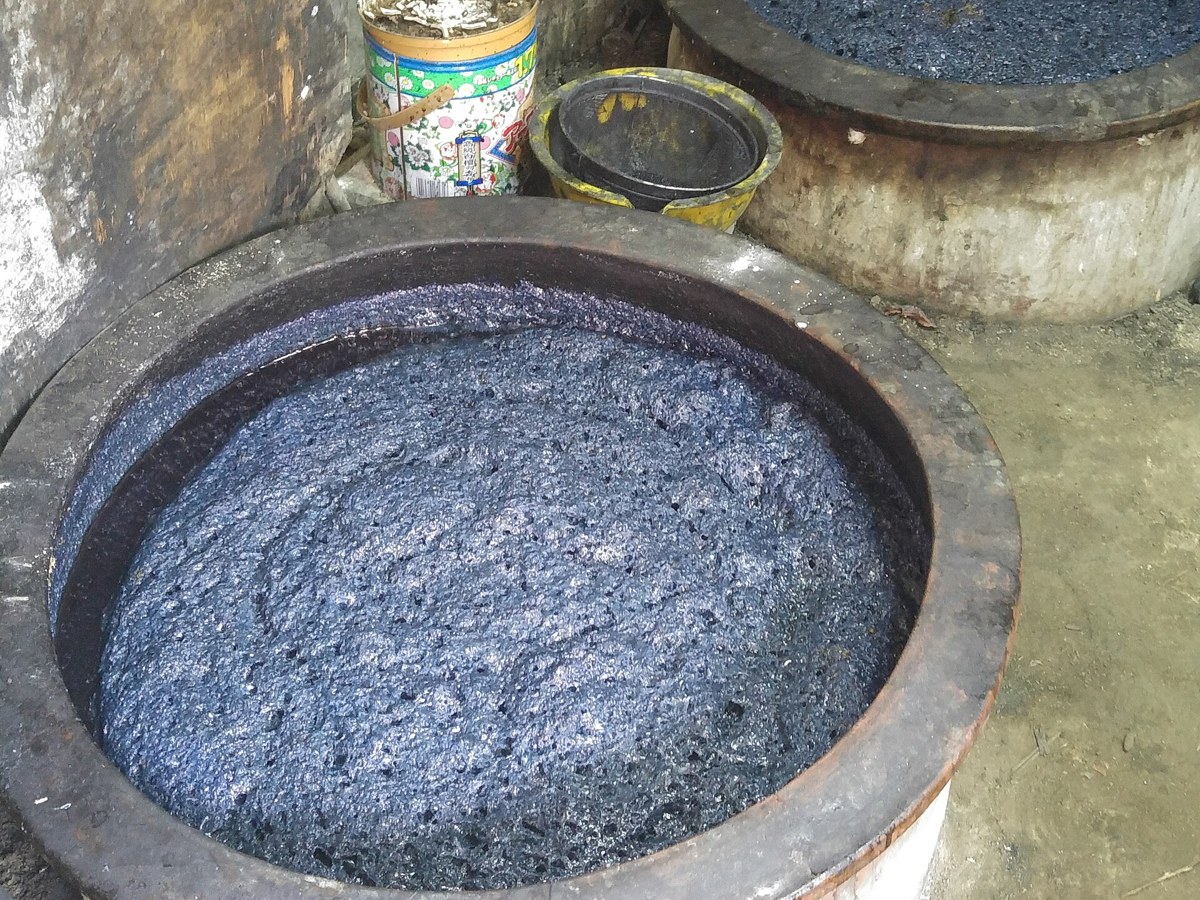
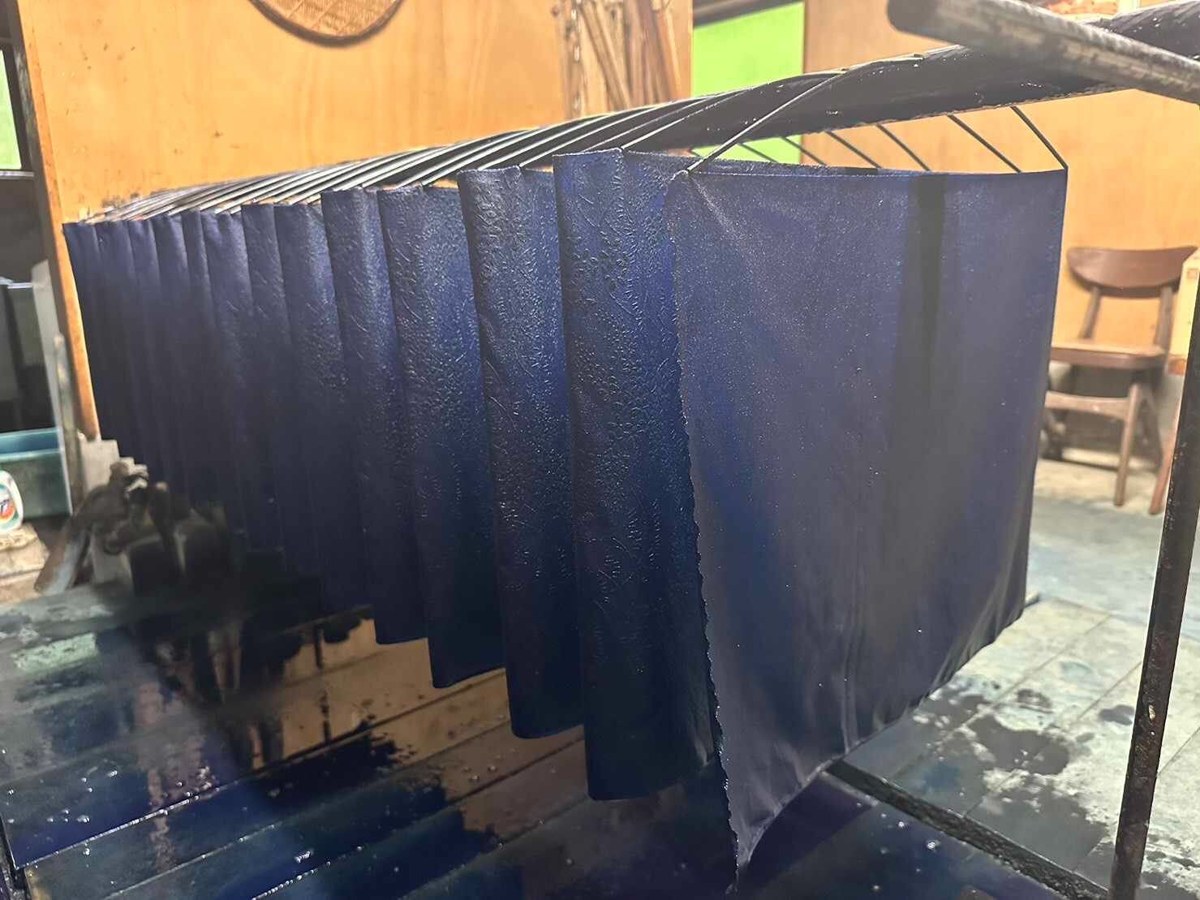
A merchant's estate, a working vat
The dyeing end of the story stands in Aizumi, at Ai-no-yakata — the former estate of the Okumura family, indigo merchants who prospered through the Edo period. The eleventh-generation head donated the residence to Aizumi Town in 1987; the complex holds thirteen historic buildings, the main residence built in 1808 with a second floor added in 1827, and the museum's collection of tools for growing and processing Awa indigo is designated an Important Tangible Folk Cultural Property. This is not a display about a vanished trade: the eastern workshop's vat is live.
The method is the traditional one, named in the museum's account as akuhaku-hakkōdate — a vat built by fermentation, alkalised with ash lye. Visitors choose a resist pattern with bands, folds and chopsticks, lower the cloth into the vat, and lift it out to oxidise in the air, watching the greenish cloth turn blue as it breathes; the dip-and-air cycle repeats three or four times to build the shade. Fermentation dyeing cannot be hurried or standardised, which is precisely the point the ai-shi have been making for centuries.
Three hundred yen in, one thousand to dye
The prices are municipal-museum prices, and they make this the cheapest master craft in this collection to touch. General admission is ¥300 (¥200 for junior and senior high school students, ¥150 for elementary children). The dyeing experience is priced by the cloth: a handkerchief at ¥1,000; hand towels, lace handkerchiefs and bandanas at ¥1,500; a small silk scarf at ¥2,000; a gauze scarf at ¥3,000; a large silk scarf at ¥3,500. Walk-in dyeing is accepted without reservation between 9:00 and 15:30 on the museum's current arrangements, and the work takes about forty minutes.
Tokushima's standing stories are a fine sugar, a ramen and a citrus — all things eaten or drunk in a day. Awa indigo is the prefecture's first craft, and the only one you take home still deepening in colour: dyed cloth keeps oxidising gently after the vat, so the handkerchief you fold into your bag in Aizumi is, in a small literal way, still being made by the basin that grew it.
Reading the blue before you dip
Aizome's shades have names and depths — the palest breath of blue after one dip, the near-black navy that only repeated dipping reaches — and the vat teaches the scale faster than any chart. Dip once for the colour of shallow water; keep going for the colour of the deep basin of the Yoshino itself. The resist pattern you tie is the design; the vat decides everything else, including the small irregularities that prove a fermentation, not a machine, did the work.
Come to Aizumi after Wakimachi if you can: the merchants' street first, then the merchant's estate, then the vat. That order is the industry's own biography — production, distribution, and the blue itself — compressed into one small corner of the basin that Japan Heritage now tells as a single story.
Sources — checked 11 November 2026
- Japan Heritage Storybook: Awa — The Home of Ai (Promotion Council's official book, hosted by Yoshinogawa City)
- Ai-no-yakata Indigo Museum, Aizumi (checked museum guide)
Original prose and official links only; no source text or maker media reproduced. Photos are credited Creative Commons works, not product photographs.
Editorial review 2026-11-11