Most pottery names describe a place or a glaze. Banko's describes a promise. Around 1736 the Kuwana merchant Nunami Rozan stamped his tea ware Banko Fueki — 'unchanged for generations' — and the ware that carries his seal-word now cooks dinner in most of Japan: on the prefecture's own interview, Yokkaichi's kilns hold 80% of the clay-pot market. Mie's fourth story is the pot that refused to change, and changed everything around it.
Rozan's seal, the Mori brothers' moulds
The craft account dates the ware to around 1736, in the middle of the Edo period. Nunami Rozan, a merchant and tea enthusiast from Kuwana, established a kiln in Obuke, in present-day Asahi, Mie, and began producing tea utensils and other ceramics, marking his works with the characters Banko or Banko Fueki to express his wish that they would endure unchanged for generations. The name Banko ware comes straight from that inscription.
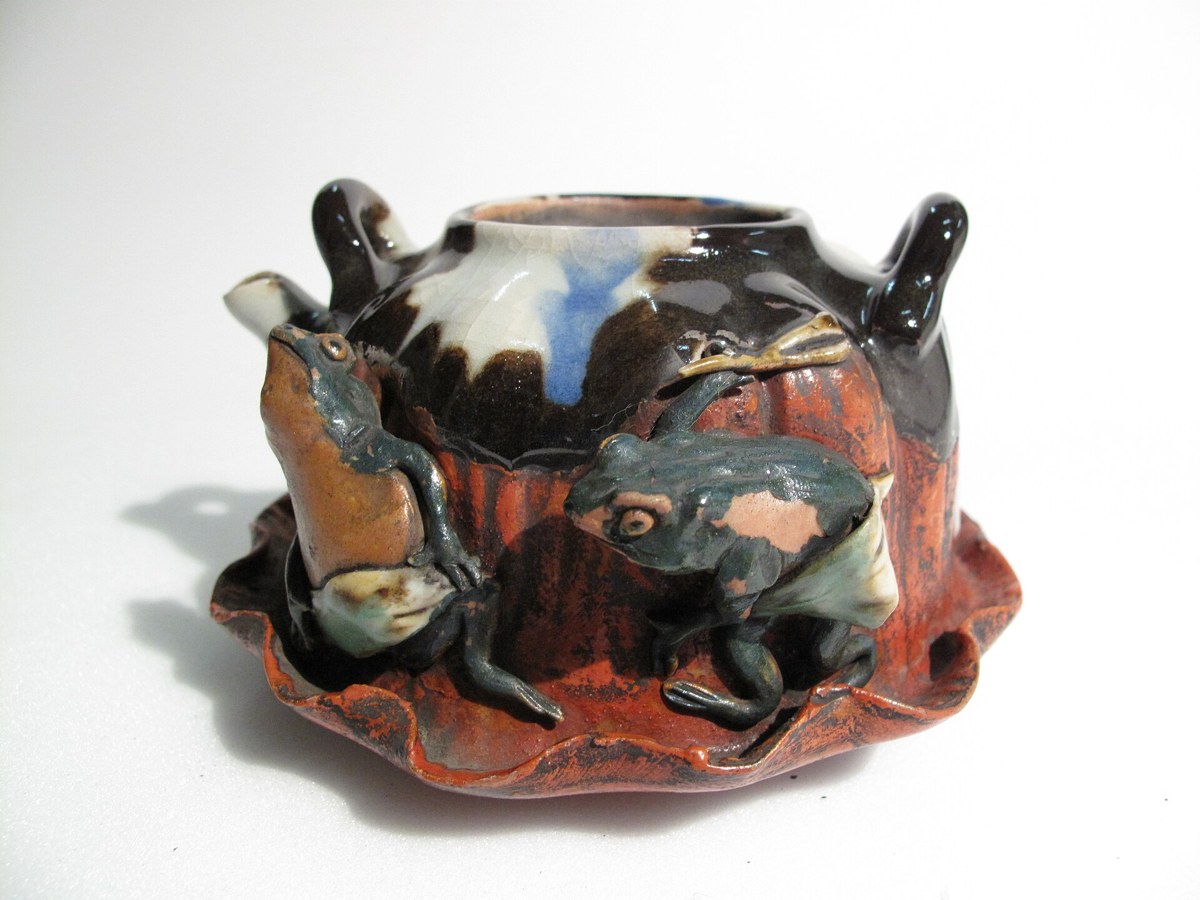
The promise nearly failed at once: after Rozan died in 1777, production temporarily ceased. In 1832 the brothers Mori Yusetsu and Mori Senshu revived Banko ware at Obuke, and Yusetsu added the invention that industrialised it — a sectional wooden mould, covered with a thin sheet of clay, then taken apart and removed from inside the formed vessel. The prefecture's interview calls it Kata Banko, shapes assembled like a puzzle, and notes that it was industrialised in Yokkaichi, producing thousands of ceramics with the same mould; it became particularly important, the craft account adds, for finely shaped teapots.
Two bodies: the pot that faces fire, the pot that pours tea
Modern Banko is two ceramics wearing one name. The first is the donabe, the earthenware cooking pot: its clay contains petalite, a lithium-bearing mineral that improves resistance to thermal shock by reducing thermal expansion after firing, a heat-resistant body developed in Yokkaichi in the late 1950s. The prefecture's interview gives the scale of the result in one line — 'We dominate 80% of the clay pots market' — and its emblem: the Hyaku-nin-nabe, a clay pot big enough to prepare food for about 100 people, created in 1959 at the Ceramics Research Institute of Mie Prefecture.
The second body is the shidei kyusu, the side-handled teapot of iron-rich clay, generally fired without glaze in a reducing atmosphere with limited oxygen, which produces the characteristic reddish-purple to purplish-brown colour; with continued use the surface gradually develops a deeper and more distinctive sheen. The interview sets the local rivalry in one sentence: in Tokoname the clay teapot is red, but Banko's is purple — and in Suizawa, in this same region, tea is also produced, and by using this teapot the tea becomes even tastier.
Clay, kneaded like a chrysanthemum
The account walks the making end to end. Raw clay and ceramic stone are crushed and refined to control impurities and particle size; for shidei teapots several types of iron-rich clay are blended together, mixed in carefully controlled proportions, adjusted for moisture and kneaded until uniform — by hand, in the traditional spiral kneading called kiku-neri, named for the chrysanthemum-like pattern it draws in the clay. Forming follows by wheel throwing, press moulding and hand forming, with a teapot's body, lid, spout and handle each formed separately and a built-in strainer fitted to keep leaves from the spout.
Decoration ranges from pierced and incised patterns to textured surfaces, raised decoration, red overglaze painting and gold; some pieces are left undecorated so the clay speaks for itself. Shidei teapots are fired in the reducing atmosphere that gives them their colour, and the final inspection is a potter's checklist: cracks and distortion for every piece, and for teapots the fit of the lid and the flow from the spout, checked one by one.
The centre, and what a kyusu costs
The ware's home base is the Banko no Sato Kaikan in Yokkaichi, which the prefecture's site describes as displaying handmade Banko items alongside a store with a wide variety of products and an area for training in the technique — the shop open Tuesday to Sunday, 10:00 to 17:00, closed Mondays. The craft account adds the facility's other name, Banko no Sato Center, to the same address in the town where the ware became firmly established from the late Edo period into Meiji, when Yokkaichi's port gave the kilns their raw materials, fuel and shipping in one place.
The checked retail record prices the purple pot's everyday cousin: a Banko ware Oribe kyusu by Kyodo Kikaku, made in Yokkaichi and holding 390 ml — two to three cups of tea, with an integrated strainer that lets the leaves open fully — sells at ¥2,100 including tax. It is the Banko proposition in one object: a designated traditional craft, fired a few streets from where Rozan's seal was first pressed, at the price of a working kitchen tool.
Sources — checked 11 November 2026
- KOGEI JAPAN: Yokkaichi Banko Ware (checked craft account)
- Mie Info (Mie Prefecture official international site): Tradition of Mie — Yokkaichi Banko Yaki (checked prefectural interview)
- Yodobashi: Kyodo Kikaku Banko Ware Oribe Kyusu 390 ml (checked retail record)
Original prose and official links only; no source text or maker media reproduced. Photos are credited Creative Commons works, not product photographs.
Editorial review 2026-11-11