Yumihama-gasuri is the picture-ikat of Tottori’s Yumigahama peninsula: cotton threads bound, dyed deep indigo and woven so that white birds, flowers and lucky things surface out of the blue. Farm women wove it beside their field work for their own families; the state named it a Traditional Craft in 1975, and what survives is a cooperative, a preservation society, and cloth of startling charm in very small amounts.
Pictures that only exist after the weaving
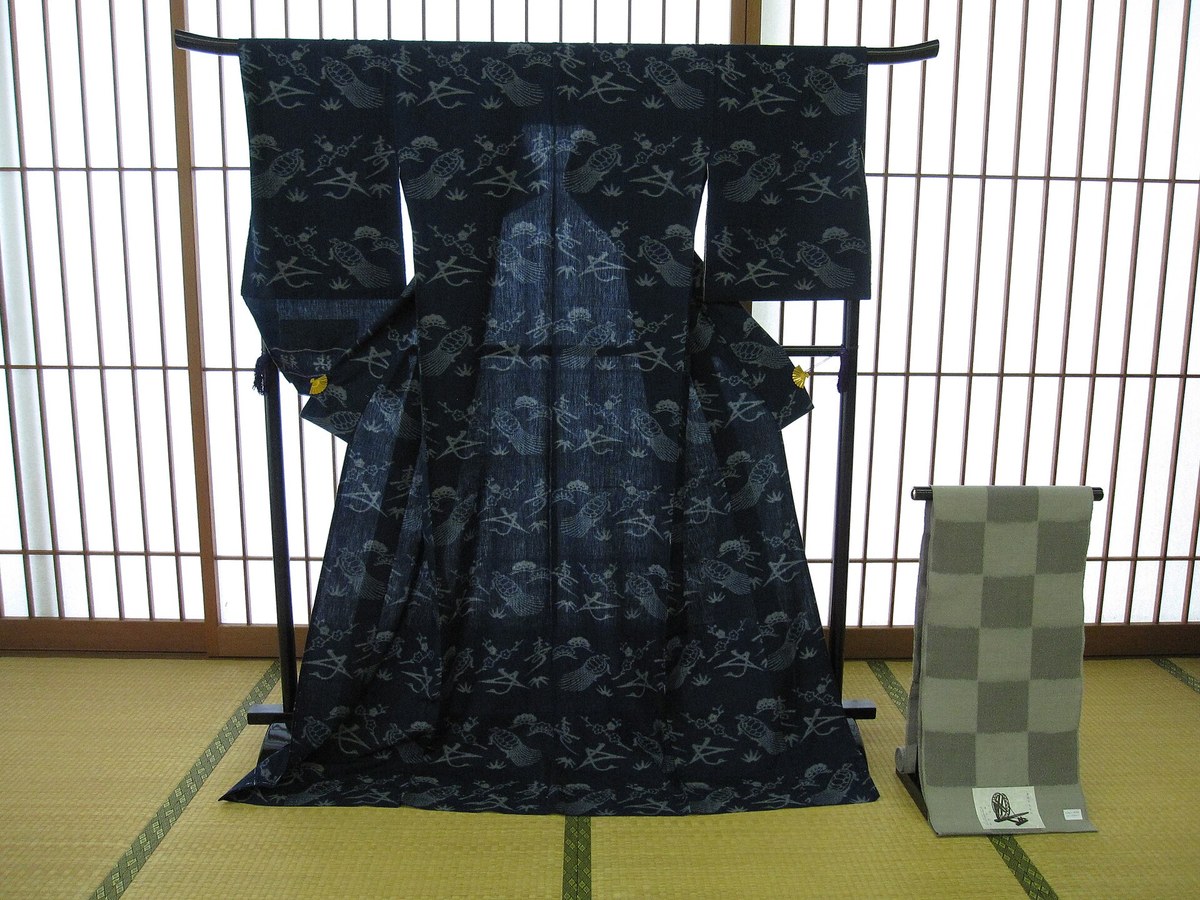
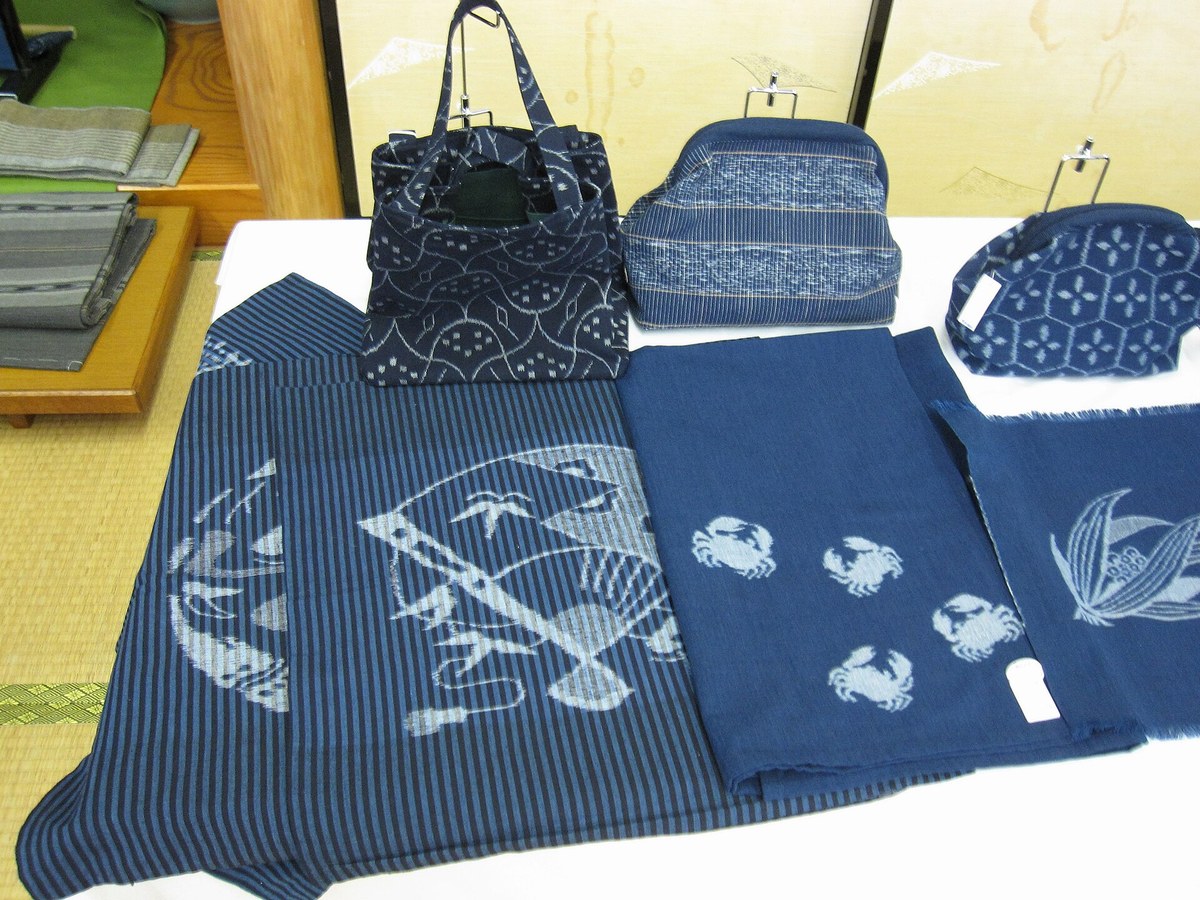
Kasuri is ikat: the pattern is dyed into the threads before weaving, so the picture does not exist until the loom brings it together. Yumihama-gasuri is famous among Japan’s kasuri as e-gasuri — picture kasuri — and the prefecture’s record gives its look in one line: a deep indigo ground against which the white kasuri patterns stand out. Our photographs, taken at the special exhibition in Yonago’s Asia Museum, show the two ends of the cloth’s life: a finished kimono, and the cloth and small goods it becomes.
The craft dictionary record is precise about the method: the pattern is woven from the weft alone, using seed threads marked in ink and hand-bound, then dyed in indigo. The motifs are the everyday world — birds, flowers, fans, people’s names — worked as pictures into a cotton cloth meant to be worn, slept under and used.
Farm cloth of the sandbar peninsula
The Yumigahama peninsula — the sandbar running from Yonago toward Sakaiminato — grew cotton, and its farm households wove. The prefecture’s craft record dates the weaving to roughly 250 years ago in the Edo period: housewives weaving beside the farm work, making work clothes, best clothes and futon cloth for their own families, in patterns that carried wishes — the bricolage exhibition record read for this page describes motifs of household peace, good luck and protection woven in with a family’s love.
From the late Edo years to Taisho the craft peaked, popular across the San’in region; then chemical fibres and collapsing demand for kasuri nearly ended it, and after the war a shortage of successors put its survival in doubt. In 1975 the state designated Yumihama-gasuri a Traditional Craft, and in 1978 Tottori Prefecture designated it an intangible cultural property.
One of the three San’in picture kasuri
The encyclopedia places Yumihama-gasuri in a trio: with Kurayoshi-gasuri and Hirose-gasuri it is one of the San’in region’s three e-gasuri. It also carries the shorter name hama-gasuri — beach kasuri, for the peninsula shore it comes from. The peninsula itself lends the longer name: Yumigahama is also read Yumihama, and the cloth takes the place’s name with it.
Survival is now institutional and small. The Yumihama-gasuri Denshokan training hall, which raised new weavers, closed in 2018; the cooperative and the preservation society continue the work, and the cloth is exhibited at Yonago’s San’in History Museum and Asia Museum and at the Umi to Kurashi museum. Output in the present century is, in the encyclopedia’s word, slight.
Buying a piece of the loom
There is no standard price list to quote, and this page does not invent one: production is too small. The documented buyable form is finished small work — Sakaiminato’s hometown-tax listing, carried by Yonago Takashimaya’s Daisen Brand-kai, offers a Yumihama-gasuri notebook case (about 18 by 14.5 cm) with a matching seal case, the outer cloth 100% cotton kasuri — and exhibition sales are the other route: Yonago Takashimaya’s history exhibition showed and sold some six hundred works by preservation-society members.
Buy it the way the peninsula made it: as a thing to use daily. The kasuri dictionary lists the cloth’s uses from kimono and obi yardage to noren, wall hangings and table centres, and the cooperative’s modern small goods — cases, bags, caps — are the same cloth in today’s sizes.
Sources — checked 14 November 2026
- Yumihama-gasuri — encyclopedia record (the e-gasuri trio, the 1975 and 1978 designations, the survival)
- Yumihama-gasuri — Tottori Prefecture craft records (Torinet), checked November 2026
- Yumigahama-gasuri — kimono culture dictionary record (the weft-only method, the uses)
- Yumihama-gasuri notebook case and seal case set — JRE Mall hometown-tax listing for Sakaiminato, checked November 2026
Checked 14 November 2026 (stored links re-fetched and judged per product): reserved where the page says so, with an editorial review note kept per product. Press, PR and travel use stays outside the grant.
Editorial review 2026-11-14