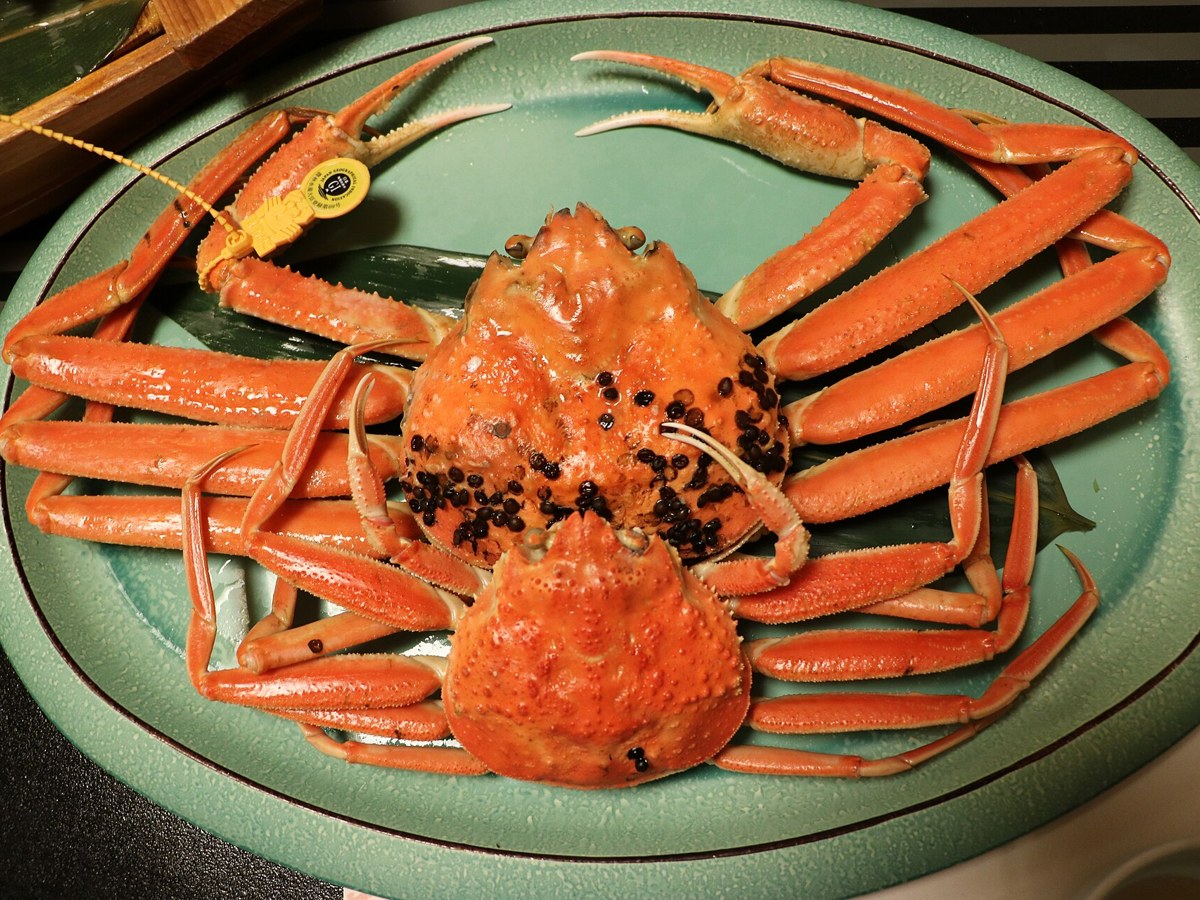
Tottori's pear was summer; its second story is the prefecture's winter. Matsuba-gani — the 'pine-needle crab', the San'in coast's name for a mature male snow crab — comes ashore at Sakaiminato, Tottori Port and Ajiro from November to March, and Tottori grades it like no one else: five criteria, a prefectural star brand, and a first auction where a single crab made ¥1,400,000 this month. Below the ceremony, it is simply the best-eating crab in Japan, and this page prices both ends of it.
A season with dates, a crab with a local name
Snow crab is one animal with a wardrobe of names: land the same male crab in Fukui and it is Echizen-gani, in Ishikawa Kano-gani, and along the San'in coast — Tottori, Shimane, northern Hyogo — Matsuba-gani, the pine-needle crab. The females have their own name and their own much shorter season, oyagani, taken only to the end of December. Tottori's male season is fixed by rule: the 2026 fishery opened on 6 November 2026 and runs to 20 March 2027.
The first landing came the next morning, 7 November, when 23 offshore trawlers brought the season's first crabs into the prefecture's three ports — Ajiro in Iwami, Tottori Port at Karo, and Sakai Port in Sakaiminato, the largest crab port in the country. The prefecture's governor opened the Tottori Port auction in person; winter on this coast starts with crab, and everyone official attends.
Itsukiboshi: five criteria, one crab in two thousand
Since the 2015 season Tottori has graded its very best under a prefectural top brand: Tokusen Tottori Matsuba-gani Itsukiboshi, 'five shining stars'. A crab qualifies only if expert graders confirm all five criteria — a carapace at least 13.5 cm across, a weight of at least 1.2 kg, every leg present, vivid colour, and meat filling the shell. Across the brand's first eleven seasons the appearance rate ran between 0.01 and 0.06 percent of the catch: on the 2026 season's first morning, the three ports certified twelve between them, four a port.
The first-auction prices are ceremony, not shopping, and this page labels them so: the top Itsukiboshi at Tottori Port made ¥1,400,000 on 7 November 2026 (Ajiro's top was ¥130,000, Sakaiminato's ¥120,000), and the standing record — ¥5,000,000 for one crab at the 2019 first auction — is a Guinness World Record for a crab sold at auction. The theatre markets the fishery; the fishery itself is priced in the next section.
Practical details: what a crab for the table costs
For an eating crab, use the Sakaiminato sellers' retail listings, checked on Takashimaya's San'in speciality store (shipping included): a boiled Matsuba, frozen, starts at ¥8,964 for a small single crab from Nakaura Shokuhin, the port's crab specialist; a medium single crab is ¥15,984, two small crabs ¥14,904, and a crab of about 1 kg is ¥33,900 from the Mikuriya fish centre. Deliveries of the boiled-frozen crabs run to early March, inside the season.
Eating it where it lands is the other way: the ports' fish centres at Sakaiminato and Karo sell the morning's crabs, and the coast's inns build winter courses around them — boiled (yude-gani), grilled (yaki-gani), in crab-suki hot pot, and, at the ports in season, as sashimi. Tokyo gets a taste by design this year: the prefecture's Matsuba-gani fair runs at the Hotel New Otani from 10 November to 29 December 2026.
Reading a crab before you pay
The Itsukiboshi criteria are a good buyer's checklist at any grade: look for a wide, hard carapace for the weight; all ten legs present and thick at the base; bright colour; and heft — a well-filled crab feels dense for its size, because the meat, not water, is doing the weighing. Tagged crabs at the San'in ports certify the landing port and boat, which is the provenance system the whole brand structure rests on.
And respect the calendar the prefecture publishes. Matsuba eaten in January and February, mid-season, is the fishery at its best and its most honest price; the November ceremony crabs and the last March stragglers are bookends, not benchmarks.
The crab prefecture
Tottori leans into the title — it campaigns nationwide as Kanitoriken, 'Crab Prefecture', a pun on its own name, and runs a winter lottery that sends the season's crab to six hundred guests who stay in the prefecture. Playful, but the substance underneath is real: Japan's leading crab-landing port, a graded prefectural brand a decade old, and a season the whole coast organises itself around.
For this collection the pairing is the pleasure of it. Tottori's first story was a pear bred in the prefecture and named for a century; its second is a wild crab the prefecture grades to five criteria. Cultivation and capture, summer and winter — the two halves of how Tottori eats.
Sources — checked 10 November 2026
- Tottori Prefecture — 2026 season first landing and Itsukiboshi release (PR TIMES, 7 November 2026)
- Takashimaya Online Store — San'in speciality feature: crab selection
Original prose and official links only; no source text or maker media reproduced. Photos are credited Creative Commons works, not product photographs.
Editorial review 2026-11-10