Hagi's soft clay gave Yamaguchi its first story here. Its second is the prefecture's famous risk, made routine by one city: fugu in Shimonoseki, where the largest share of Japan's pufferfish is handled, where the country's only fugu-only wholesale market auctions the catch, and where the fish is not called fugu at all — it is fuku, good fortune.
The capital is a market
Shimonoseki's claim is infrastructure. Fish from across Japan converge on Haedomari Market, the only market in the country dedicated exclusively to fugu, are processed by the city's licensed specialists, and ship out nationwide — which is why guides put the city's share of the trade at roughly seventy to eighty percent, the largest in Japan by any count. The city describes itself as the country's leading fugu-handling centre, and Shimonoseki Fuku holds GI registration No.19, granted in 2016.
The renaming tells you how deep it runs: in Shimonoseki the fish is fuku, a homophone for good fortune, avoiding the unlucky sound in fugu. A city that renames its dangerous fish for luck, builds it a dedicated market and registers it as a GI is not dabbling in a delicacy — it is running a national utility for one.
Licensed hands only — and the seasons
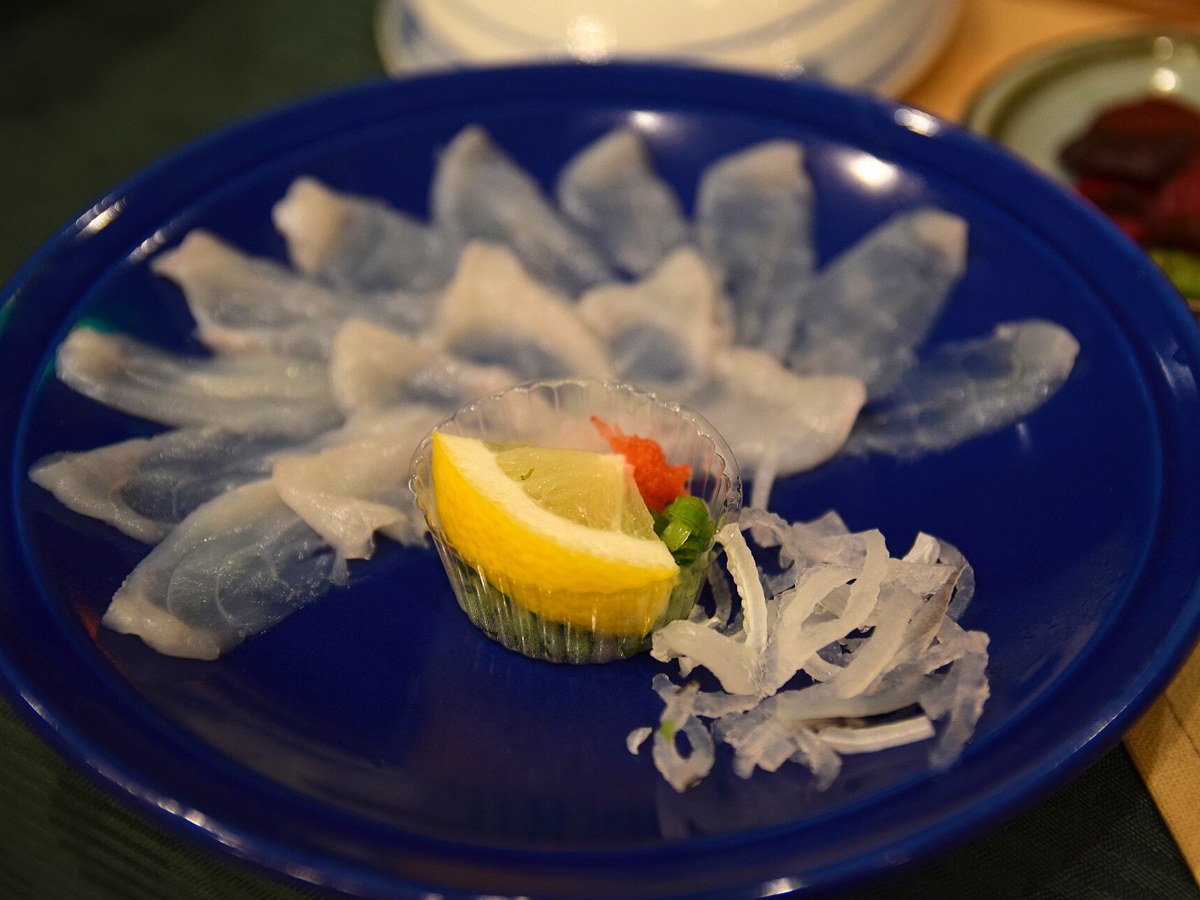
The safety rule comes first and without decoration: fugu is prepared only by licensed chefs, in Shimonoseki as everywhere in Japan, and the city's whole processing system exists to keep that chain licensed end to end. Visitors eat fugu here the way the system intends — at market stalls and restaurants staffed by the licensed trade.
The classic season is winter: torafugu, the premium tiger puffer, is at its fattest from November to February, with the broad season running October to March, and shirako a December-to-February delicacy. Because Shimonoseki processes and ships in every season and farmed fish is available year-round, its restaurants serve fugu all year — but the wild winter course is the one the city is famous for, and some houses pause it from May to September.
Practical details: ¥400 at the market, ¥60,000 at the top
The democratic end is Karato Market, the waterfront wholesale hall whose weekend food event, Iki-iki Bakangai (Friday to Sunday and holidays), sells fugu nigiri at ¥400-800 a plate and fugu karaage at ¥200-400; a fugu-focused market meal runs about ¥2,000-3,500, cash in hand, before the popular stalls sell out around midday. Market lunch sets elsewhere in the city run roughly ¥2,000-4,000.
The formal end is the full course — sashimi (tessa), hot pot (tecchiri), porridge and more — from about ¥6,600-8,800 at set-course houses to over ¥60,000 per person at the top end in the checked guide's October 2026 range. Between the stall and the ceremony sits the same licensed fish; what changes is the room, the courses and the ceremony around them.
Why the trade trusts one city
Every regional food in this collection claims a flavour. Shimonoseki claims something rarer: competence at national scale. The fugu on a plate in Tokyo or Osaka very likely passed through Haedomari's auctions and Shimonoseki's processors first — the city is the supply chain, not just a hometown.
That makes the market stall the honest place to start. Eating fuku where the country's fugu is landed, graded and shipped — for the price of a coffee-and-cake set — is the shortest line between a national system and a single bite.
Scope: what 'limited' means here
The edition is Shimonoseki's handling and its tables: fugu traded through its specialist market and served by its licensed houses, plus the GI Shimonoseki Fuku. Fugu is eaten across Japan and this page says where much of it is handled; the share is stated as the largest, with the guides' 70-80 percent range attributed, not asserted as audited fact.
Sources — checked 9 November 2026
- Food in Japan: Fugu in Shimonoseki — safety, season and prices
- Food in Japan: Fugu in Yamaguchi — history, safety and where to eat
- Japan Activity: Shimonoseki fugu guide — eating pufferfish safely (2026)
Original prose and official links only; no source text or maker media reproduced. Photos are credited Creative Commons works, not product photographs.
Editorial review 2026-11-09