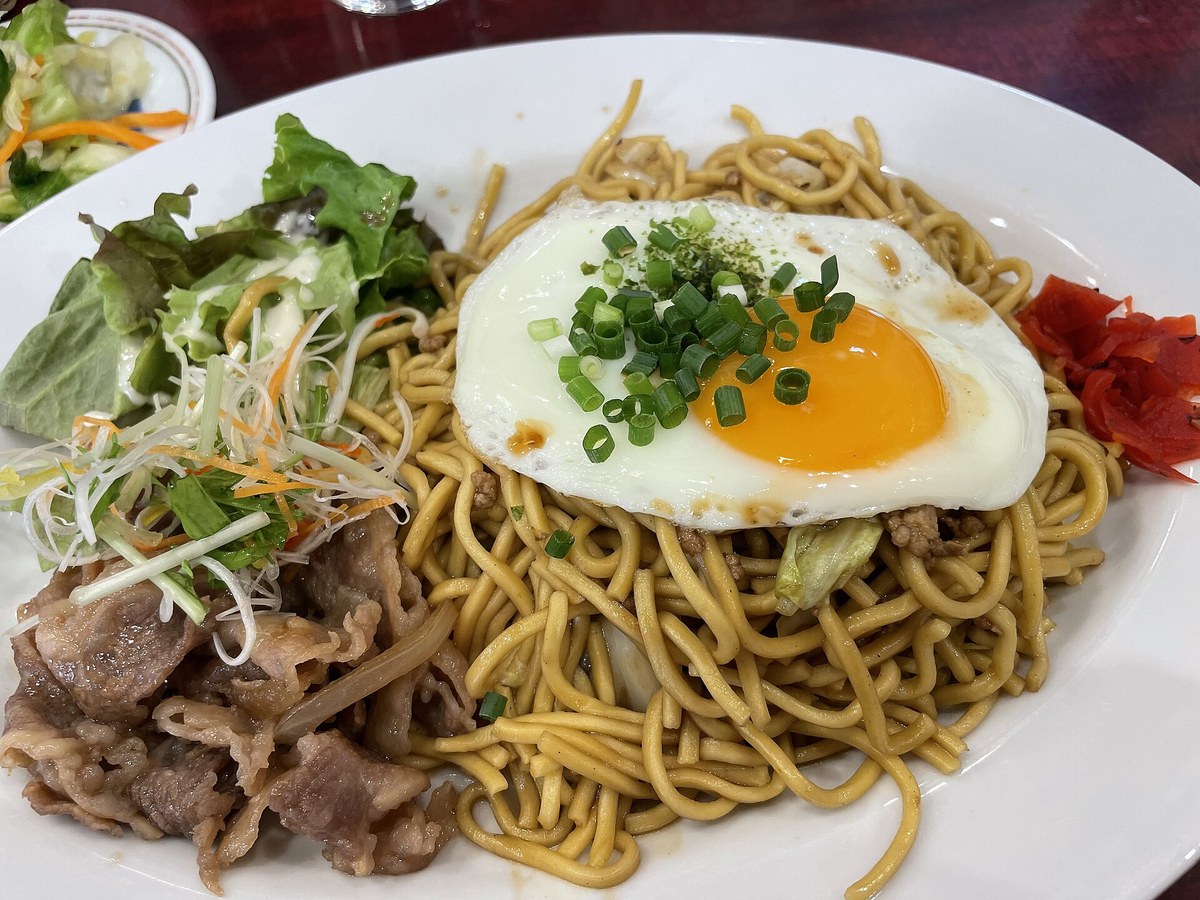
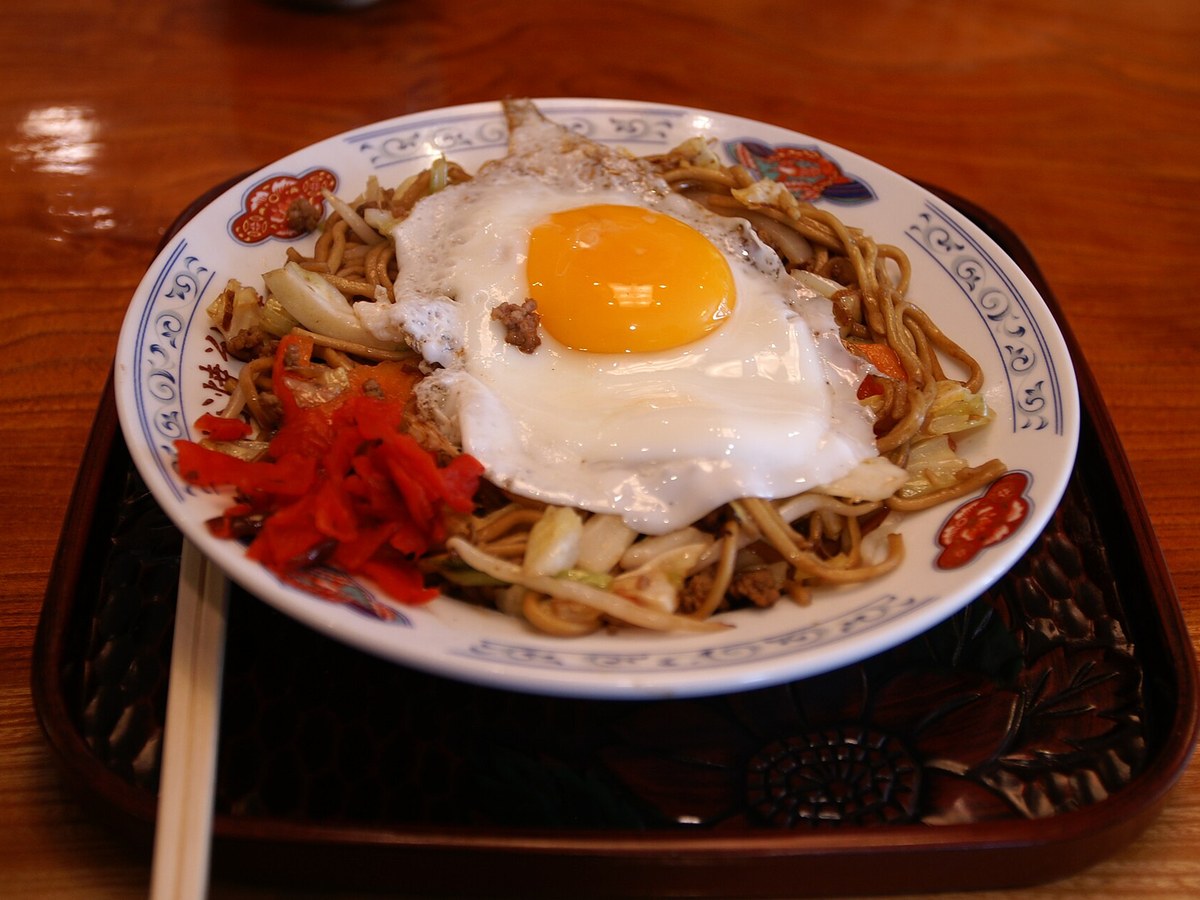
Every other yakisoba in Japan starts with steamed noodles. Yokote's starts with boiled ones — thick, straight and square-cut — and that single decision makes a different food: soft, moist noodles that drink in a mild Worcestershire sauce and the yolk of the sunny-side-up egg laid on top, fried with minced pork and cabbage and finished with crunchy Fukujinzuke pickles where other towns put red ginger. The dish was a cheap diner plate in Yokote City, Akita, in the early 1950s; today its name is a registered regional trademark, its restaurants are certified, and it holds the 2009 B-1 Grand Prix gold — yet the plate still costs a few hundred yen.
Four features, and one is the noodles
The Food in Japan record defines Yokote yakisoba by four features, and three of them are visible from across the room: thick boiled noodles, finely minced pork, a sunny-side-up egg with a soft yolk, and Fukujinzuke pickles. The fourth is the method. Ordinary yakisoba noodles are steamed, so they stay firm and crisp a little on the griddle; Yokote's are boiled, so they arrive soft and moist, drinking in the sauce and the broken yolk. The Rinsendo noodle maker's president explained the logic in a 2015 interview the record quotes: boiled noodles let the sauce and yolk cling better.
The egg is not decoration — the record is explicit that the runny yolk works as a second sauce, softening the Worcestershire tang and coating every strand — and the pickle is chosen, not defaulted: Fukujinzuke's sweet crunch suits the rounded sauce where red pickled ginger, the yakisoba garnish elsewhere, would cut too sharp. There is no chili heat anywhere on the plate. What varies is each shop's own sauce blend, sweeter here, drier there, inside the four fixed points.
From a diner's griddle to a trademark
The dish developed in Yokote in the early 1950s as a cheap griddle plate built on locally developed boiled noodles — local accounts name the founder as the owner of a diner called Kamiya-ya, who refined the noodles through years of trial and error with a local noodle factory; the Chef Dojo record credits Kamiya as the first shop, opened in 1955 and now in its third generation. At its height around 1970, the Food in Japan record says, perhaps 100 shops in the city served it, before stricter sanitation rules ended much of the cooking under shop eaves and the sellers thinned out.
The revival was deliberate and dated. Locals had called the plate nikutama yakisoba — meat-and-egg — until Yokote City Hall's promotion project launched the Yokote Yakisoba name around 2000; the shops formed the Norenkai in 2001, entered the first B-1 Grand Prix in 2006, and won the Gold Grand Prix when the fourth event came home to Yokote in 2009. In 2012 the name was registered as regional collective trademark No. 5546212, held by the Norenkai cooperative — a diner snack with a patent-office file.
Certified: the Dojo and the 28
A trademark needs a gate, and Yokote's is a dojo. The Chef Dojo record, updated 25 March 2026, states that restaurants serving authentic Yokote Yakisoba must first pass the official Yokote Yakisoba Dojo Certification, and that certified shops must use noodles from a certified supplier — there are five. The association certifies 28 official restaurants, every one of them in Yokote City, a city of around 80,000 people: to eat the real plate, you go to Yokote.
The city's own contest keeps the certified shops sharp. Fujiharu Shokudo and Kuidoraku have each won the annual Four Heavenly Kings selection for 12 straight years on the Chef Dojo record — Fujiharu as a lunch-only diner the tourism association describes through its steady flavour, Kuidoraku as a former butcher five minutes from the station, proud of its meat. The Food in Japan record, checking the tourism association's list in October 2026, adds the evening izakaya Debataya and the Norenkai steakhouse Sfida to the working roster.
Eating it in Yokote
Prices stayed where a B-class dish should. On the Chef Dojo record updated 25 March 2026: Fujiharu Shokudo's plates run ¥400 to ¥700 by toppings and size; Kuidoraku's run ¥550 to ¥980, beef-topped variations included; and at Ganso Kamiya, the 1955 original, ¥600 to ¥1,200. Order the classic first — minced pork, cabbage, egg — break the yolk partway through rather than at once, and use the Fukujinzuke when the plate turns rich; the Food in Japan record's eating notes are exactly that sequence.
Mind the hours before the prices: Fujiharu serves lunch only, 11:30–14:00, with irregular holidays, while Kuidoraku covers lunch and dinner near the station. To take the name home, packaged noodle-and-sauce sets appear in souvenir shops and supermarkets around Akita, and Kuidoraku sells its own products online — but the certified plate, on certified noodles, is a Yokote City meal, in February ideally, when the kamakura snow huts are lit and a warm, moist plate of noodles makes complete sense.
Sources — checked 13 November 2026
- Food in Japan — Yokote Yakisoba: Akita's Egg-Topped Boiled-Noodle Yakisoba (references accessed October 2026)
- The Chef Dojo — Yokote Yakisoba: Yakisoba with Sunny-Side-Up Egg (updated 25 March 2026)
Original prose and official links only; no source text or maker media reproduced. Photos are credited Creative Commons works, not product photographs.
Editorial review 2026-11-13