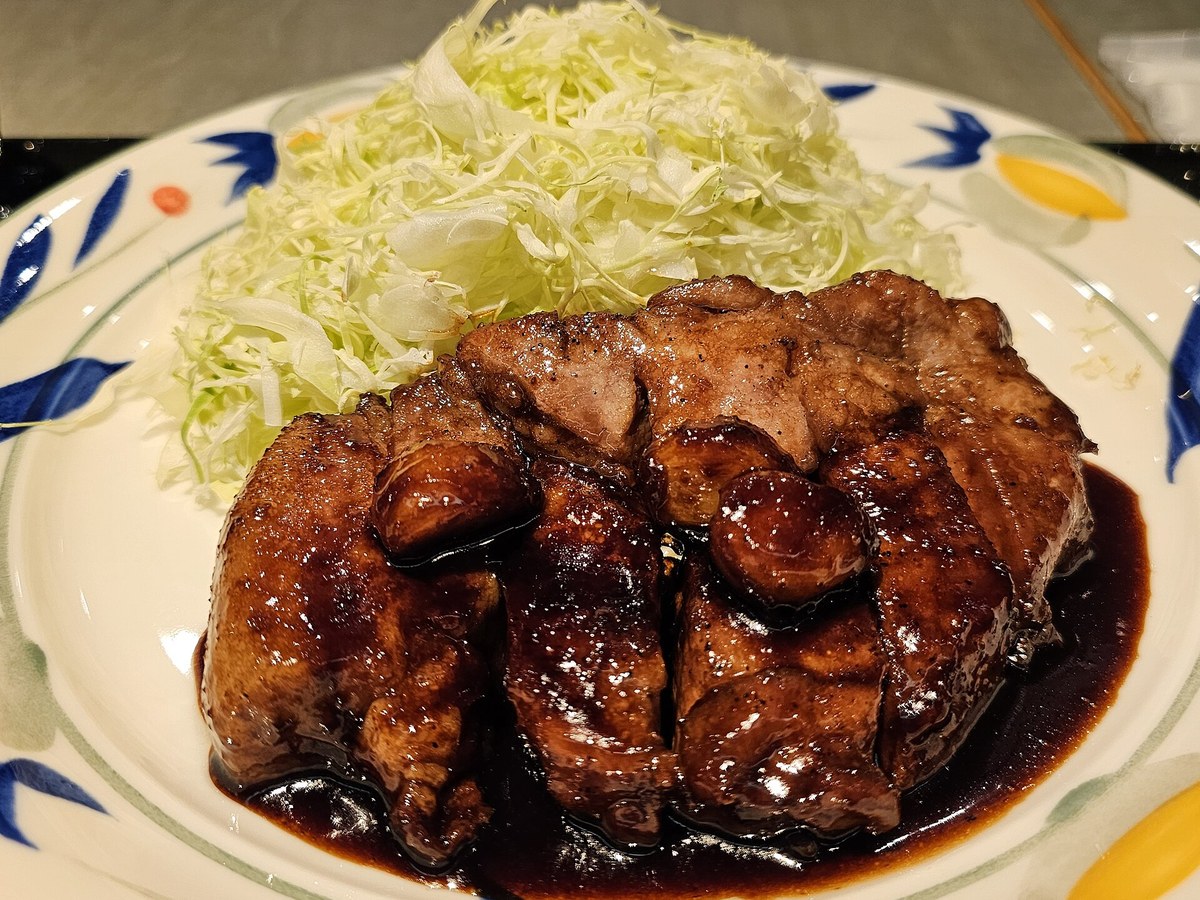
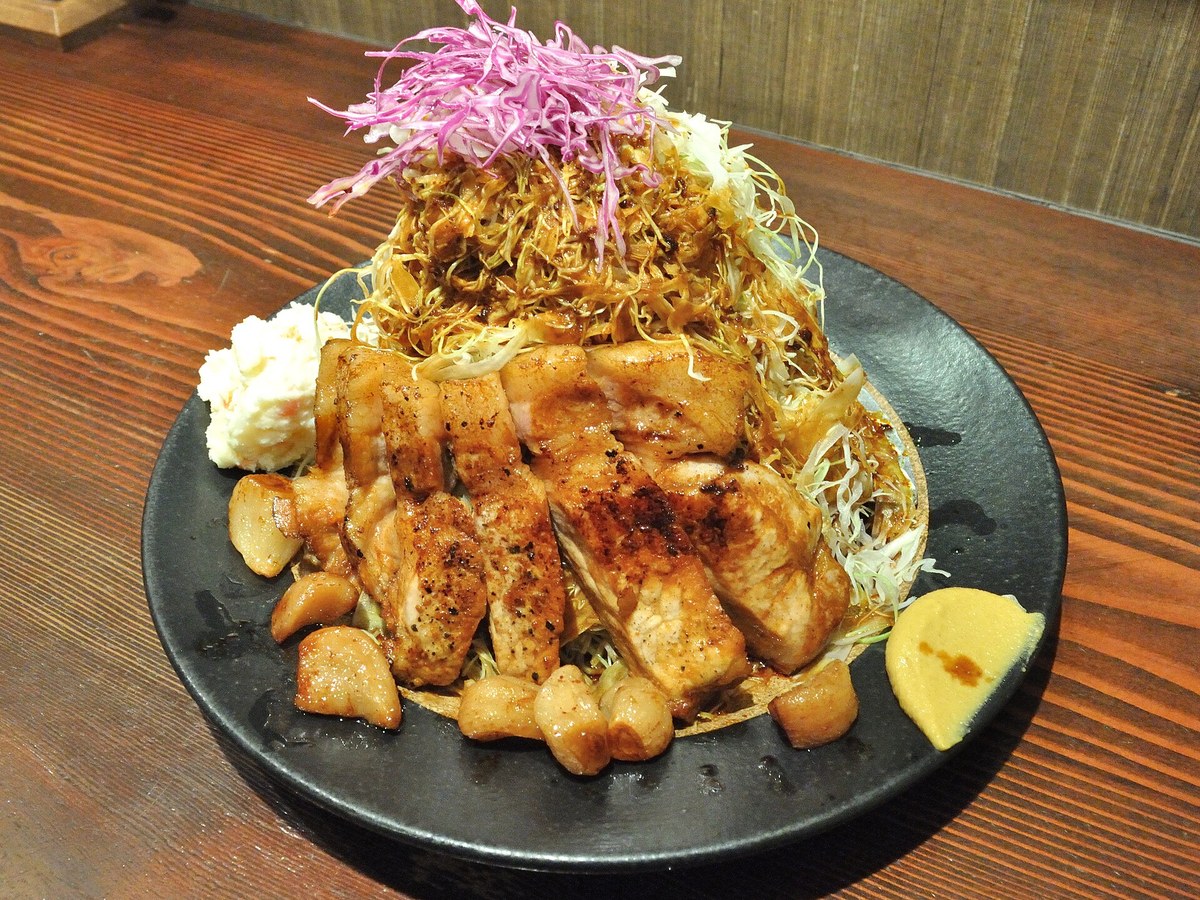
Tonkatsu is breaded and deep-fried. Tonteki is neither. Yokkaichi's pork steak is a thick slab of loin or shoulder — one and a half to two and a half centimetres on the current guide — seared hard on a hot iron plate until the edges char, then drenched in a dark reduction of soy sauce, sugar and Worcestershire-style sauce and finished with a handful of garlic. Beside it, always, a mountain of shredded raw cabbage. The dish emerged in the diners of this industrial port city just after the Second World War, fed the petrochemical workforce for decades, and is now so much the city's own that a local association has written down what counts as the real thing — four conditions, no more, no less.
Four conditions, written down
Most regional dishes are recognised; Yokkaichi tonteki is defined. The Yokkaichi Tourism Association publishes the Yokkaichi Tonteki Association's definition in full: thick slices of sautéed pork; a coating of dark, rich-tasting sauce; garlic served on the side; and shredded cabbage as the main side dish. Meet those four and the plate is Yokkaichi tonteki; miss them and it is a pork steak that happens to be nearby. The association also keeps the roster of participating shops, which the guide describes as the closest thing the city has to an official seal of approval.
The definition has a silhouette. The characteristic Yokkaichi cut leaves one side of a single piece of pork connected while the rest is sliced, so the steak opens on the plate like a baseball glove — the 'Glove', in the tourism record's word. Strip and stick forms, the komagire cuts, also count under the definition, so the rule governs the plate's contents rather than one rigid shape: thick pork, dark sauce, garlic, cabbage.
The steak the factory city could afford
The origin the guide records is economic before it is culinary. Tonteki is said to have emerged in Yokkaichi after the Second World War as an affordable, hearty alternative to Western-style beef steak, served in local shokudo — diner-style eateries — to factory workers from the city's petrochemical complexes. Pork stood in for beef, the griddle stood in for the steakhouse, and garlic and sugar did the work of luxury. It stuck, the guide adds, because it travels well between the lunch rush and the dinner crowd: cheap, filling and fast to cook.
The tourism record dates the taste the same way — a popular dish in Yokkaichi since shortly after the war, now an indispensable flavour for the city's residents. Yokkaichi remains a working port rather than a postcard, which is why the dish was never watered down for tourists: until recently, on the guide's account, there effectively weren't any. What you are served is what the city serves itself.
The last house of the original line
Every dish with a definition also has a genealogy, and Yokkaichi's runs through one closed restaurant. The visit record for Matsumoto no Rairaiken states that Yokkaichi tonteki originated at a restaurant called Rairaiken, now closed, and that Matsumoto's owner is the only survivor who trained there — making his house the only restaurant left in the original tradition, its sauce and lard carried over from the old shop. The queue agrees: some thirty people waiting at noon on the record's visit, most of them locals arriving by car.
The tourism association's own roster gives the same house pride of place: a Chinese restaurant of 48 years whose signature is the 'Yokkaichi Specialty Large Tonteki' — thick Mie pork shoulder loin, a generous slice over 250 grams, cut into the glove shape, with a special-blend sauce passed down from the previous generation and large chunks of garlic. The roster's other names show the definition flexing without breaking: Tonkatsuya-chan builds its sauce on premium Worcestershire with more than ten spices; Ichiraku, at 54 years, insists on a soy-sauce base.
Eating it in Yokkaichi
Order the Large Tonteki at Matsumoto no Rairaiken — ¥1,900 including tax on the visit record published 25 April 2025 — for 250 grams of shoulder loin two to three centimetres thick, with free refills of rice and pork miso soup; the house's other set meals (salt, miso, light-sauce and ginger-soy versions) are ¥1,470, tax included. Citywide, the guide of 2 November 2026 puts a standard tonteki set at ¥900 to ¥1,300 in a no-frills shokudo, ¥1,400 to ¥2,000 at the specialists — Matsumoto's large plate sits exactly in that specialist band.
To take the original line home, Matsumoto no Rairaiken sells its Large Tonteki quick-frozen from its online store at ¥1,520 a serving, shipping excluded, with a six-month frozen life and a limit of forty pieces a day; a vending machine at the back of the restaurant sells it too. And eat the cabbage — the guide is blunt that treating it as garnish makes the dish heavier and more one-note than it is meant to be. Sauce spooned over the cabbage is not a garnish decision; it is the second half of the plate.
Sources — checked 13 November 2026
- Yokkaichi Tourism Association — 'Yokkaichi Tonteki' is Yokkaichi's energizing food! (checked 13 November 2026)
- Japan Trove — Tonteki: Mie's Sweet-and-Garlicky Grilled Pork Steak and Where to Try It (published 2 November 2026)
- Genjitsutouhi — Matsumoto no Rairaiken, the house in the original tonteki line (visit record, published 25 April 2025)
Original prose and official links only; no source text or maker media reproduced. Photos are credited Creative Commons works, not product photographs.
Editorial review 2026-11-13