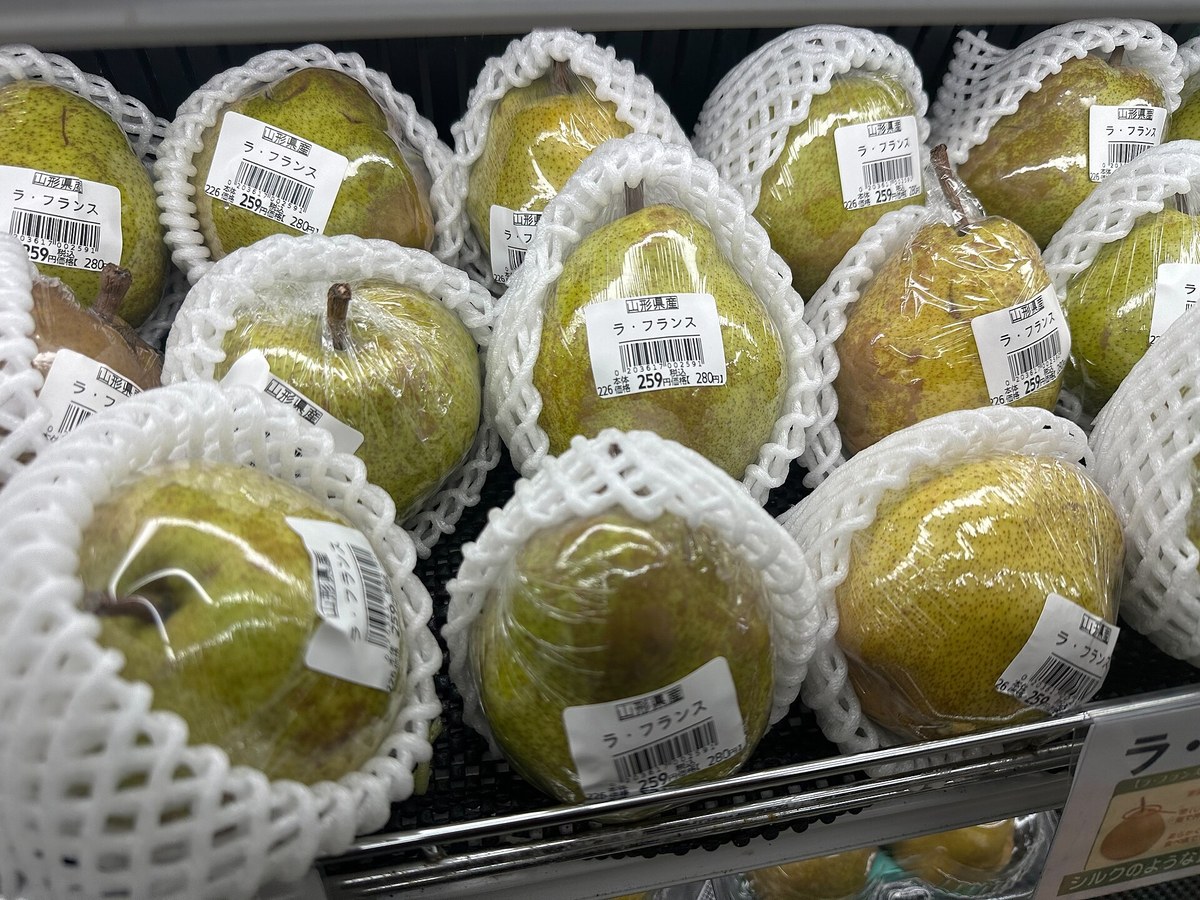
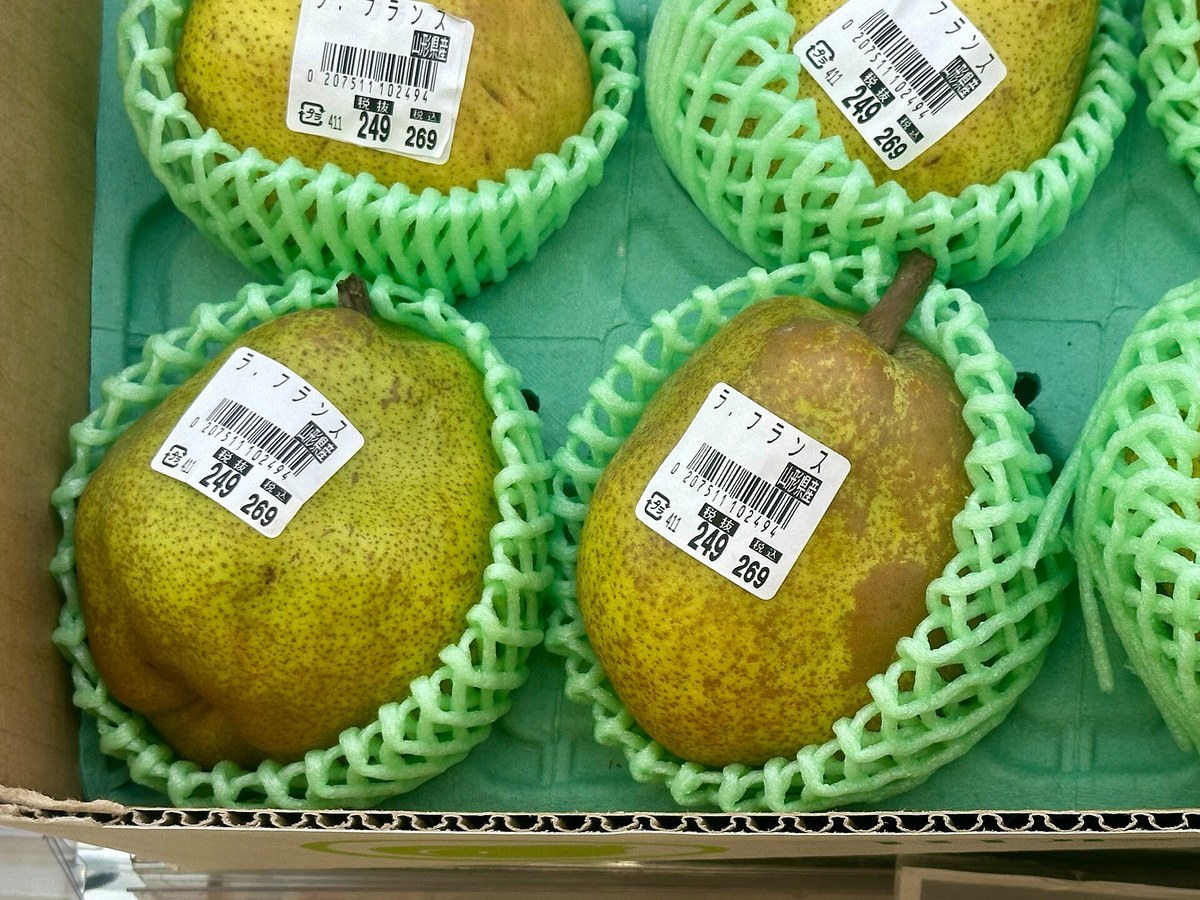
The most French-named fruit in Japan is, by area, overwhelmingly a Yamagata product. La France — the buttery European pear that must be ripened off the tree and eaten in the few days when it turns fragrant and soft — accounts for most of Japan's western-pear orchards, and four-fifths of those orchards stand in Yamagata. In 2020 the name was locked to the place: Yamagata La France entered the Geographical Indication register as No. 99, with the whole prefecture as its production area and its own promotion association as the control body. This is the story of a cultivar that crossed the world in the 19th century and stopped, almost entirely, in one northern prefecture.
A French pear, a Yamagata register entry
The GI specification is plain about the product: a pear, produced in Yamagata Prefecture, using the La France cultivar — pruned so the trees carry fewer crossing main branches and more fruiting branches exposed to sunlight. The ministry's register gives the formal frame: Registration No. 99, dated 19 August 2020, Class 1 agricultural product, applicant and control body the Yamagata Prefecture La France Promotion Association, formed by the prefecture's agricultural cooperatives and governments.
The United States Department of Agriculture's report on the application adds the market arithmetic behind the paperwork: in 2017 La France accounted for 63.8 percent of Japan's total western-pear production area — 882 hectares — and about four-fifths of those La France pears were grown in Yamagata. A cultivar any prefecture may plant became, in practice, one prefecture's crop; the GI simply wrote that fact into law.
From 68 hectares to the top of the country
European pears arrived early in Yamagata: the specification records that cultivation of European pears began in the prefecture in 1875, in the first decade of Japan's modern agricultural imports. La France itself was a minor variety for a century — the specification puts its Yamagata growing area at just 68 hectares in 1978 — before taste, gift culture and cooperative promotion carried it upward.
By 2016 that area had multiplied eleven-fold to 749 hectares, number one in the country with 82 percent of the national La France area, worked by about 2,300 growers (2015 figure). Exports followed the same curve: roughly half a ton in fiscal 2000 became about 13 tons by fiscal 2018, shipped to Hong Kong, Taiwan, Singapore, Malaysia and the Philippines. The prefecture even sets the season's start: since 2013 Yamagata has announced an official sales-start date for La France each year, so the fruit reaches shops ripened to order rather than picked at random.
Ninety-five percent of the Tokyo market
The sharpest measure of the prefecture's grip is the wholesale market. The GI specification records that in the Tokyo Metropolitan Central Wholesale Market, Yamagata La France's share of both sales volume and value during the November-to-January season averaged over 95 percent across 2002–2018 — for three months of every year, the capital's La France trade is, to all intents, a Yamagata trade.
That dominance is a logistics achievement as much as an orchard one. La France is picked hard and green, then ripened — a fruit the eater must judge by fragrance and the softening around the stem, not by colour. A prefecture-scale cooperative system can hold, ripen and release fruit in step with the market; a scattered patchwork of small growers cannot. The GI's pruning and control rules are the visible part of that system.
Buying the box
The standard purchase is the autumn gift box: the prefectural-products retailer Kauché lists Yamagata-grown La France at about five kilograms, ten to twenty pears, at ¥5,980 with shipping included, dispatched in order of orders received through the mid-November to late-December season. Farm-direct shops in the prefecture — Tendo City calls itself Japan's top La France producer — sell smaller three-kilo boxes alongside the five-kilo standard.
What to check on any listing: the words Yamagata La France or Yamagata-grown La France (the GI name is the guarantee), the season (the fruit exists fresh only from late autumn into early winter), and the ripening state — sound listings ship the pears firm and instruct the buyer to ripen them at room temperature until the flesh yields near the stem. A 'La France' pear with no prefecture named is the cultivar without the register entry: a different, lesser claim.
Sources — checked 12 November 2026
- MAFF — Information on Registered GIs No.91–120 (Registration No. 99, Yamagata La France)
- Yamagata La France — GI Summary of Specification (applicant: Yamagata Prefecture La France Promotion Association)
- USDA Foreign Agricultural Service — Japan Invites Public Comment for La France Pear GI Protection (JA2020-0100)
- Kauché (prefectural-products shop) — Yamagata La France, about 5 kg (checked 12 November 2026)
Original prose and official links only; no source text or maker media reproduced. Photos are credited Creative Commons works, not product photographs.
Editorial review 2026-11-12