Every Yamagata kettle begins as a hole in sand, and the hole is destroyed to free it. Yamagata imono — the casting tradition of Yamagata City, some 950 years old — is known across Japan for walls cast thin and surfaces finished fine, and its rule is absolute: the sand mould is used once and broken. This is Yamagata's second story here, the foundry beside its shogi-carving benches, and its prices explain themselves: a handmade kettle lists between ¥55,000 and ¥104,500.
Foundrymen who stopped at a river
The origin story is a materials report. Roughly nine to ten centuries ago, metalworkers travelling with the forces of Minamoto no Yoriyoshi tested the sand and earth along the Mamigasaki River, found them ideal for casting moulds, and settled. In the early Edo period the Mogami lord Yoshiaki concentrated the foundries into the district now remembered as the casters' quarter, and craft and industry have shared the city ever since.
That cohabitation is part of the craft's character: the same region that casts temple bells and tea-ceremony cauldrons also casts machine parts, and the traditional workshops hold their own by doing what machines don't — one-off sand moulds, hand finishing, walls thin enough to keep a kettle light. Chobundo, founded in 1952 and named from its first two masters' names, states the ambition plainly: kettles made to be used for a lifetime.
One mould, one kettle
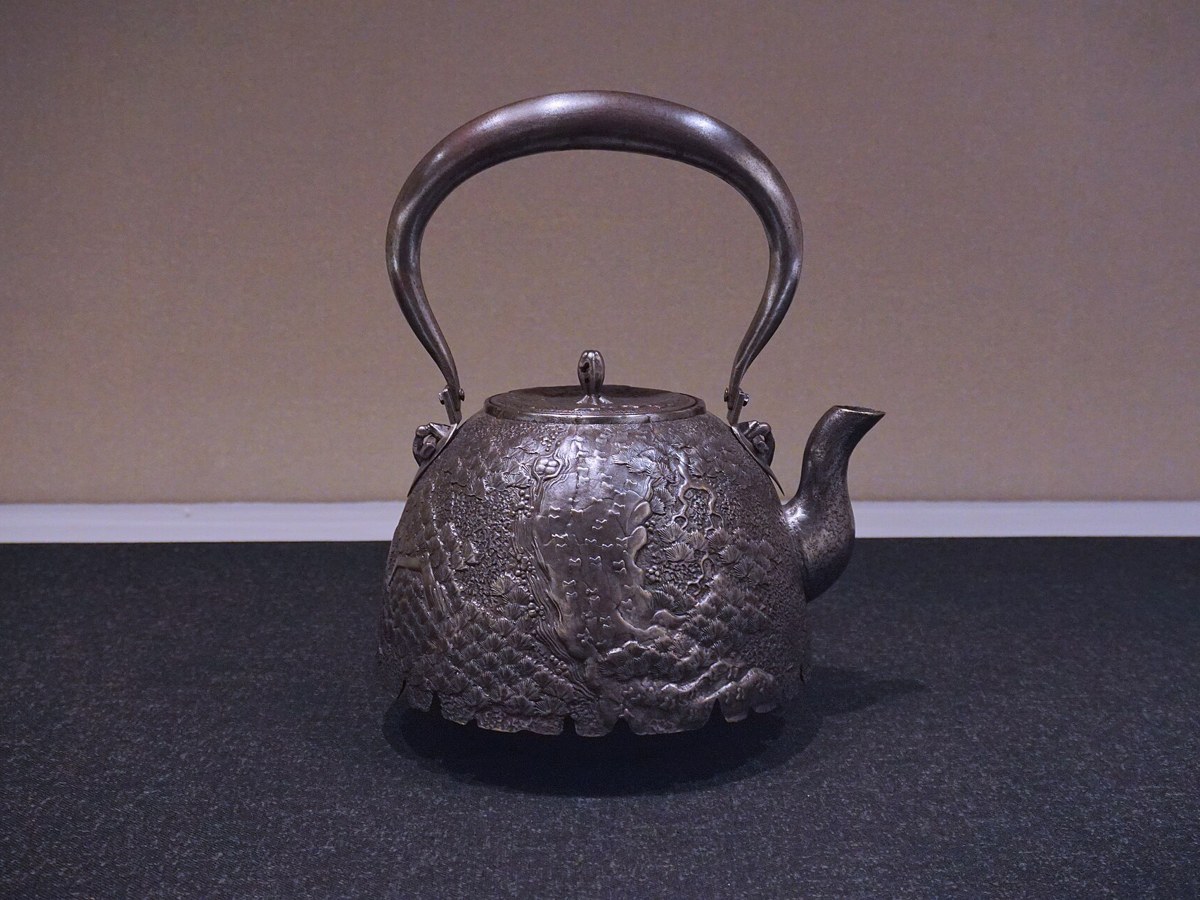
The process explains the price before the price is quoted. Fine sand is compacted and patterned into a mould; molten iron above 1,000°C is poured; and to release the finished kettle, the carefully made mould is broken. There is no second casting from the same negative — each piece is, by construction, the only one its mould will ever make.
What the method buys is the Yamagata surface: thin walls with a clean, refined skin that shows patterns — a flat-round plain body, grapes, Mt Fuji — with unusual delicacy for iron. A 1.5-litre Chobundo kettle weighs around 1.4 to 1.6 kilograms, light for its class, because the walls are thin; iron-sand kettles from the city's studios are said to serve for a hundred years.
Practical details: what the kettles cost
Workshop listings on the iichi craft marketplace price Chobundo's handmade tetsubin from ¥55,000 for the plain Kodai Hiramaru (1.5 litres; the same model also listed at ¥60,500) through ¥71,500 for the Natsume form and ¥99,000 for the Zakuro, to ¥104,500 for the Fuji-zakura; a small 0.4-litre teapot starts at ¥33,000. These are buy-once prices, and the makers sell them as such — one mould, one kettle, decades of mornings.
Buy from the makers' own listings or the city's craft retailers, and read the specification like a foundry sheet: capacity, weight, and heat-source compatibility (the Hiramaru listing confirms IH use) matter more than the pattern. A Yamagata kettle is not a souvenir of Yamagata; it is a tool the city has been perfecting since before its castle was built, priced as a tool for a lifetime.
The other iron city
This collection already holds Morioka's Nanbu tekki, and the comparison is the point of having both. Nanbu ironware is the famous name — heavier in the hand and in the market. Yamagata's casters are the quiet rivals: thinner walls, finer surfaces, a tradition a comparable age, and a district that never became a brand because it was too busy also being an industrial city.
There is a fairness in setting them side by side. Japan's craft map is full of these paired cities — one celebrated, one working — and the working one's kettles, broken out of their single sand moulds in Yamagata this year as nine centuries ago, do not need the celebration to justify the ¥55,000. The mould-breaking does that on its own.
Scope: what 'limited' means here
The scope is the craft ware of Yamagata City's traditional foundries, not the city's industrial casting output, which is large and separate. Kettles travel and are sold nationally, as good tools should be; the limited thing is the production itself — one city, one river's sand, one mould per piece — and the page's prices are named workshops' listings for that production.
Sources — checked 9 November 2026
- Suigenkyo: Yamagata Imono / Yamagata cast metalware — iron kettle, Studio Arai
- iichi: Yamagata imono iron kettle Kodai Hiramaru (Chobundo)
- iichi / note: Chobundo — 1,000 years of Yamagata imono, kettles for a lifetime
Original prose and official links only; no source text or maker media reproduced. Photos are credited Creative Commons works, not product photographs.
Editorial review 2026-11-09