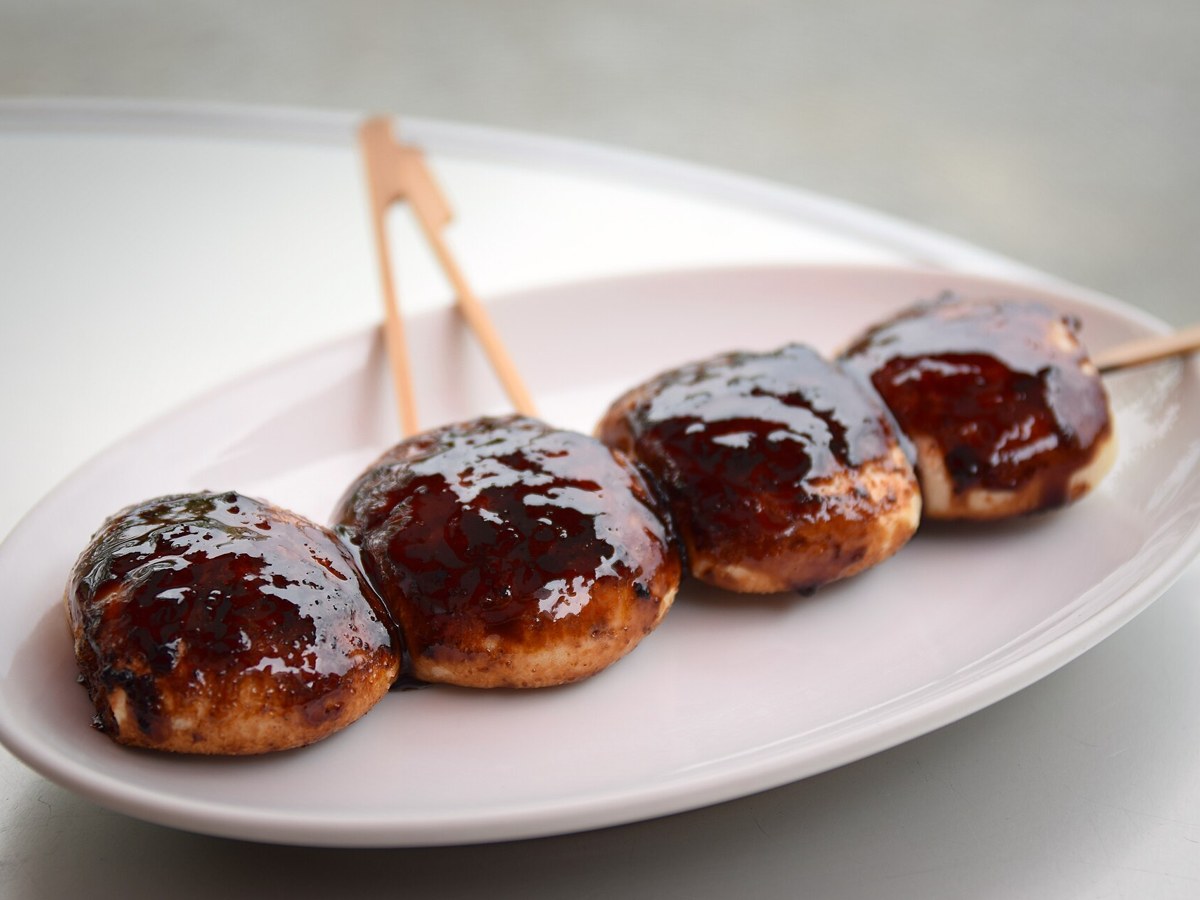
Every prefecture has a soul food. Gunma's is a bun on a stick that the rest of Japan somehow never heard of. Yaki manju looks simple — four pale steamed buns, a dark glossy glaze, a charcoal grill — and tastes like nothing else in the country: soft fermented dough under a sweet, salty, faintly bitter miso caramel, eaten standing up, still warm, for less than the price of a coffee.
The ministry's recipe, from the inventor's house
The form is fixed at the highest level a regional dish can reach: the agriculture ministry's regional-cuisine archive carries the recipe, and its provider is Harashimaya Sohonke — the head house of the shop line that invented the dish. The dough begins as a fermentation starter of glutinous-rice porridge and rice malt, rested one to two nights; wheat flour is kneaded in, the dough divided into roughly 20-gram pieces, naturally fermented, steamed, and skewered in sets of four. The sauce is boiled about thirty minutes — red miso, coarse-grained zarame sugar, mizuame starch syrup, a touch of caramel — then rested about two days before it ever meets a bun.
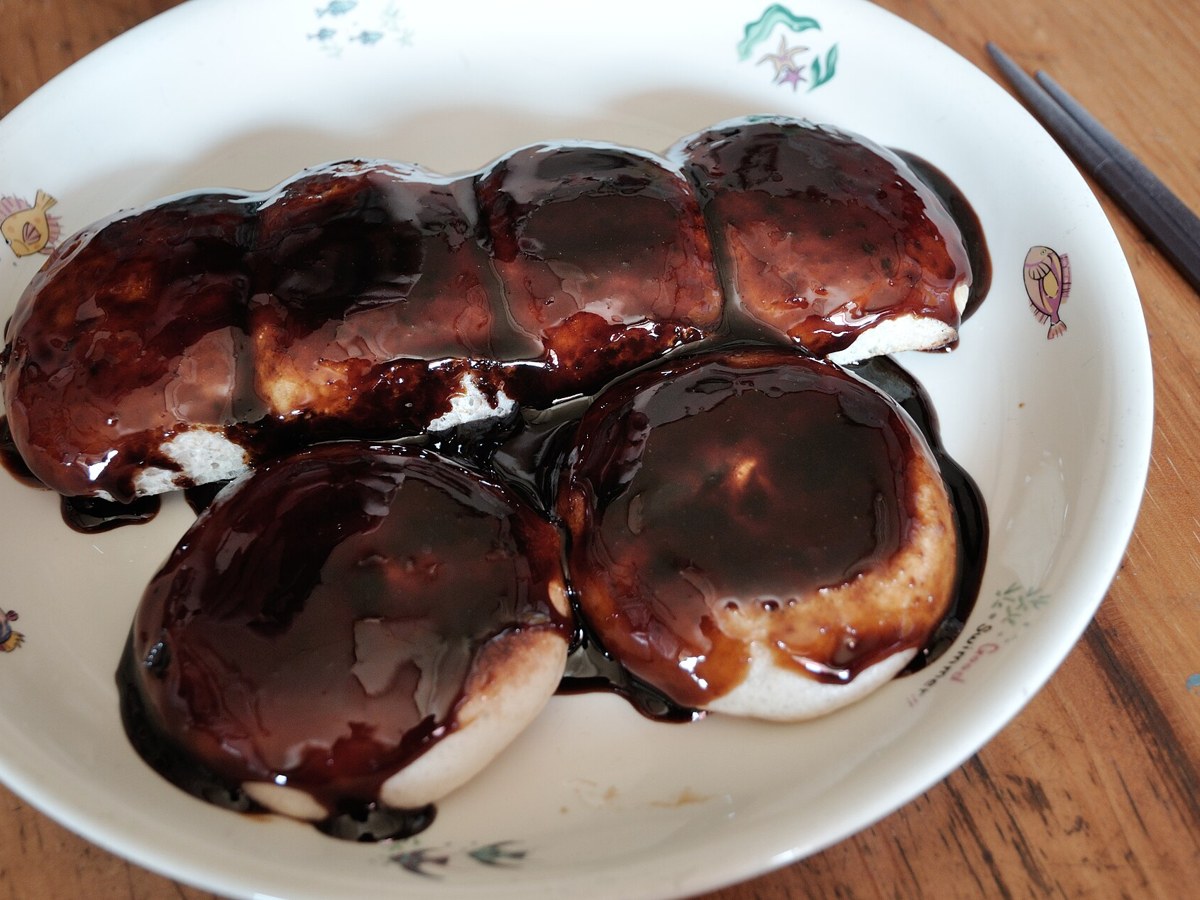
The grilling is a procedure, not a gesture, in the ministry's steps: brush the sauce over the skewered buns, sear the surface, let it dry slightly, brush again — two to three times on both sides — and grill until done. The result is a glaze built in layers, crisping at the edges while the bun inside stays airy. The classic bun is plain, with no filling at all: the whole experience is dough, sauce and fire.
Late Edo, and a century of staying home
The origin is traced to the late Edo period on the checked guide's account, and a Maebashi man, Harashima Kumazo, is widely credited as the inventor: his version used doburoku, unrefined homemade sake, as the dough's fermentation agent, producing a softer bun that took the miso glaze well. The sauce of his day was barely sweet — sugar was dear in provincial Japan — and the sweetness arrived gradually from the Meiji era, as brown sugar syrup and molasses became accessible, until by the early twentieth century the balance was close to today's: sweet and salty in equal measure, with miso's bitter edge underneath.
Then the dish did something rare: it stayed. Through the twentieth century yaki manju remained almost entirely confined to Gunma — eaten at festivals and market days in Maebashi, Isesaki and Numata, sold by shops that stayed open for generations, including Harashimaya, the inventor's descendant house, which still operates in Maebashi today. Gunma people grew up knowing it as a birthright; people one prefecture away had never heard of it. That insularity is the exclusivity, recorded by the guide as social fact rather than slogan.
Two hundred yen of flour culture
The price is part of the identity: a single skewer typically costs ¥200-300 on the checked guide's readings, whether at a historic specialty shop or a festival stall. This is not confectionery pricing; it is the price of a wheat-growing prefecture's everyday snack, and it has kept the dish democratic for a century and a half. Take-home kits — raw buns with the sauce packed separately, to grill at home — are widely sold for visitors, and locals pair the fresh skewer with green tea, whose astringency cuts the glaze.
Eat it where it is grilled, and eat it at once. The bun cools quickly and firms as it does; the fresh one, eaten standing near the charcoal with the miso smoke still on it, is the canonical form. At Isesaki's annual Yakiman Festival the form is scaled up to theatre — an enormous manju several metres long, glazed and grilled before the crowd — but the festival is only the dish's public face. Its real life is the weekday skewer.
Gunma's shelf, given its sweet
Set yaki manju beside Gunma's standing stories and the prefecture's wheat argument completes itself: Mizusawa udon, one of Japan's three great udon; the Takasaki daruma, its craft emblem; the toge no kamameshi, its station lunch. All three are savoury or symbolic. Yaki manju is Gunma's first sweet in this collection — and the one its own people would name first, precisely because it never travelled.
There is a standing local debate about the azuki-filled variant — richer, sweeter, and to purists not the dish at all. Start plain, as Maebashi did. The filled bun can argue its case later; the original's case is dough, miso and fire, and after a century and a half inside one prefecture, it has nothing left to prove.
Sources — checked 11 November 2026
- Ministry of Agriculture, Forestry and Fisheries: Yakimanju — Our Regional Cuisines (official archive; recipe provider Harashimaya Sohonke)
- Food in Japan: Yaki Manju — Gunma's soul food (checked specialist guide)
Original prose and official links only; no source text or maker media reproduced. Photos are credited Creative Commons works, not product photographs.
Editorial review 2026-11-11