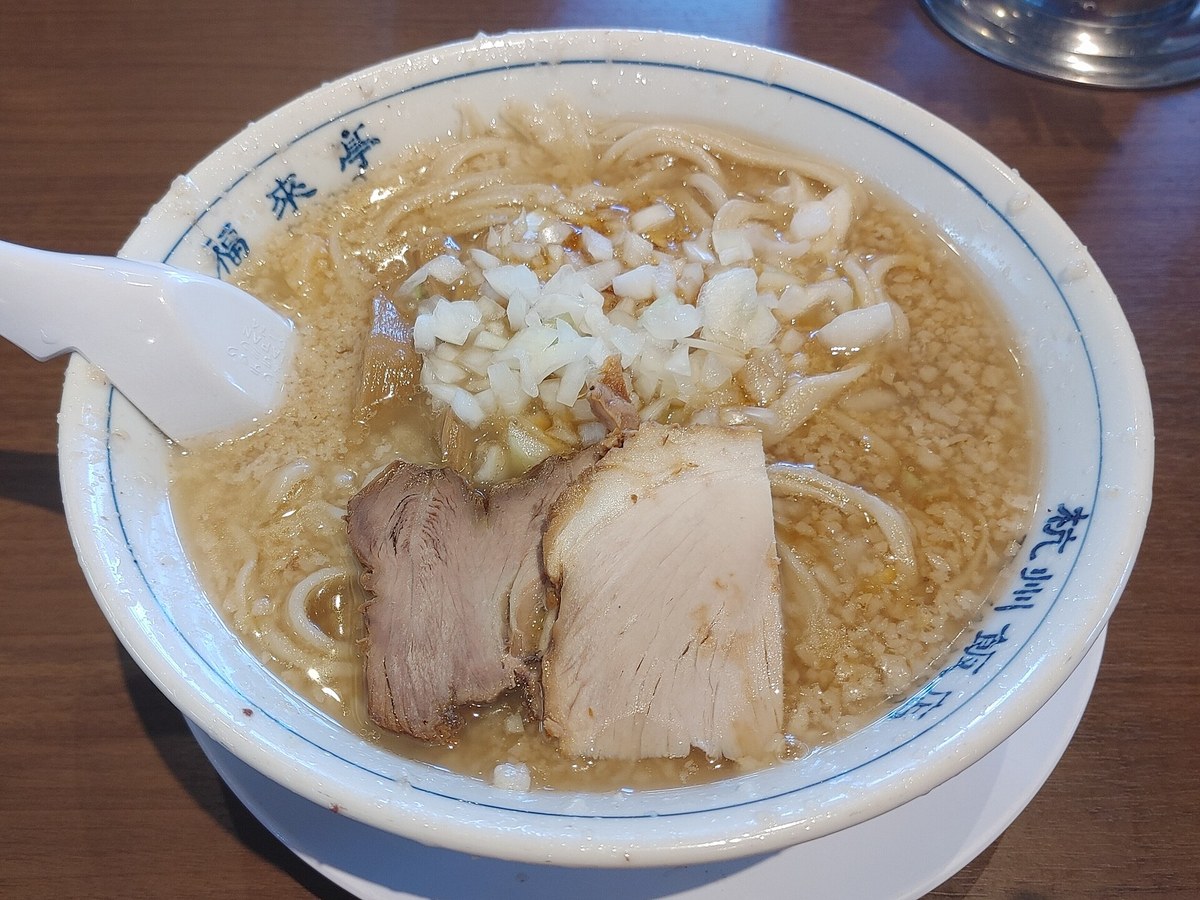
Tsubame’s ramen wears a lid of pork fat: a dark niboshi soy soup under a white blanket of seabura, holding noodles so thick they are compared to udon. It was built for the metalworkers of Japan’s cutlery city — salty for men who sweated, thick-noodled so 800 delivered bowls a day would not go soft on the road — and the critics who arrived at Tsubame-Sanjo Station gave it the double-barrelled name the country knows it by.
A Zhejiang cook, a stall, and a metal town
The record’s founder is Jo Shosei, a cook from China’s Zhejiang province who set up a street stall in Tsubame in 1932 and opened the shop Fukuraitei near Tsubame Station the next year. The stall’s bowl was nothing like today’s: a weak fire meant thin noodles, and the soup was light. The enlarged successor of Fukuraitei — Koshu Hanten, opened in 1977 as its annex and named for the Hangzhou the founder, raised in Wenzhou, had admired from afar — is the house that carries the original line today, in its third generation.
The town explains the bowl. Tsubame was already a city of metal factories — the cutlery and metalware workshops around Asahi-machi and Sachi-machi — and the workers who sweated at the furnaces asked for salt. From about 1937 the soup grew saltier by request, and the kitchen’s long experiments in giving that salt sweetness and roundness, not just force, arrived at the ingredient the butchers were throwing away: pork back fat.
Thick noodles because the road was long
By the 1950s the shop was delivering as many as 800 bowls a day to the factories, and delivery time was the enemy: a bowl that left at four might be eaten at nine. The answer was in the noodle — the flour changed from medium-strength to strong, and the noodle grew steadily thicker, to roughly double its earlier gauge, until it could survive the road without going soft. A soup strong enough to stand up to that noodle had to be saltier still, and the seabura grew heavier to sweeten it.
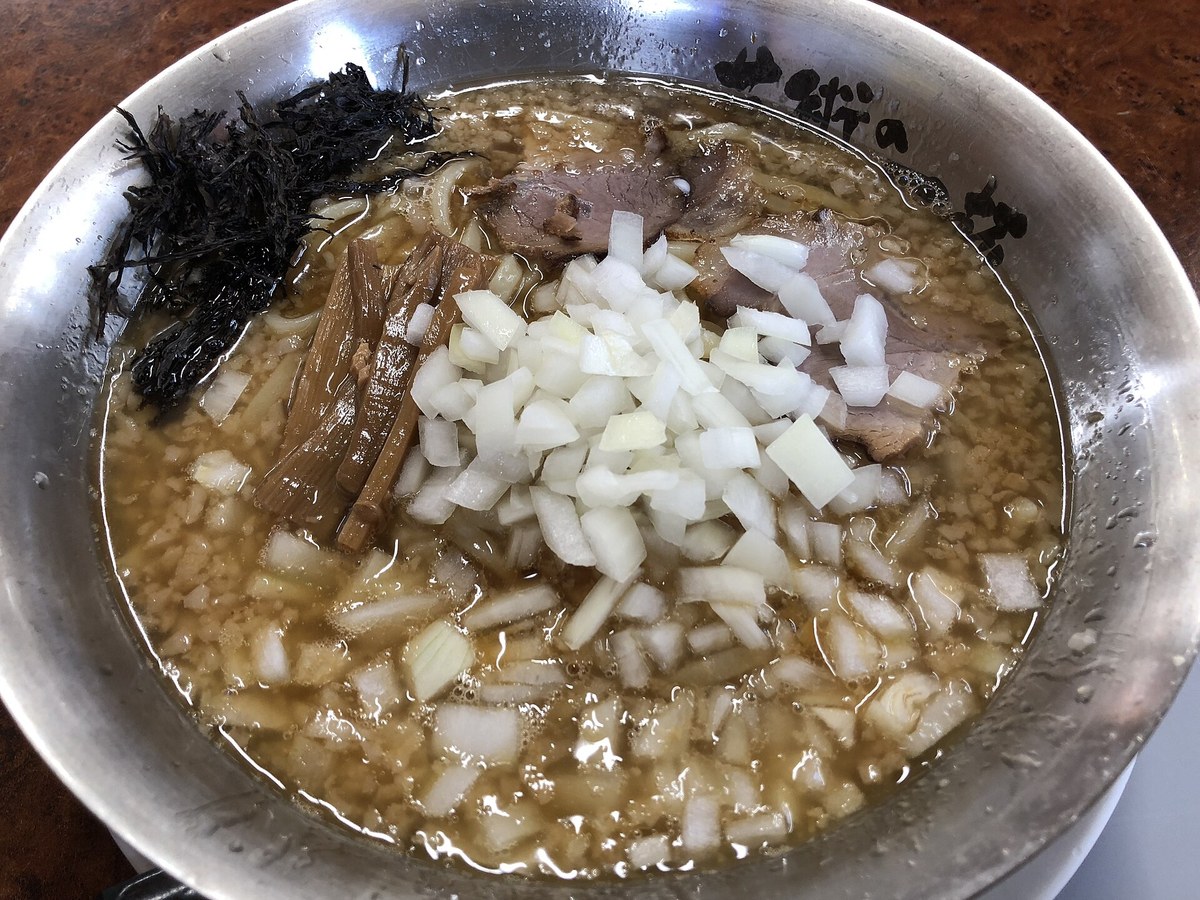
Why the fat, exactly, is a story the family itself corrects. The popular account — a lid of fat to keep delivered soup hot — is the one the second generation, Jo Shokatsu, explicitly denied; the third generation’s account is fuller and plainer: the fat was taken in so working people would feel properly fed, and that it also kept the bowl hot was a benefit noticed afterwards. What is not in dispute is the other garnish: diced raw onion, which replaced long negi at Koshu Hanten in 1983 when negi prices spiked — and stayed, because the bowl was better for it.
Taught away, listed, and certified
Jo Shosei did not keep the technique. On the record, he taught the city’s other shops deliberately — the bowl was to be Tsubame’s, not one house’s — and the disciples carried it across the city; Omura Shokudo, which retrained at Fukuraitei after its own lighter bowl failed to draw Tsubame customers, became a leading house on the borrowed craft. The style is counted one of Niigata’s five great ramens, older, the record argues, than Tokyo’s seabura lines that descend from Hope-ken.
The honours are recent and official. The Michelin Guide Niigata 2020 special edition listed Koshu Hanten (and Ramen Jun’s head shop) as Michelin Plate addresses; in 2022 the Agency for Cultural Affairs chose Tsubame seabura ramen for its 100-Year Food programme, in the future division. Some houses now serve it in stainless “metal donburi” — a bowl only a metal city could make its own signature.
The name, and eating it
Say it carefully in Tsubame: the dish is the city’s own, and the double name is an import. When the local-ramen boom brought critics up the Joetsu Shinkansen, they got off at Tsubame-Sanjo Station and called what they ate “Tsubame-Sanjo style”; the local press and the encyclopedia record both note that the formal name is Tsubame seabura ramen, and that Sanjo — Tsubame’s old rival, whose own bowl is curry ramen — never asked to be attached. This story carries the double name because that is what the rest of Japan searches for; the bowl belongs to Tsubame.
Eat it at the source or at a listed disciple. On the Tsubame City ramen listing read for this story — updated 14 November 2026 — Shumen-tei Jun, one of the record’s representative houses, serves its chuka soba at ¥960 at the JR Niigata Station shop, with the fat graded honestly: mid-fat free, large-fat +¥110, “demon fat” +¥220. Start at standard. The onion is not a garnish to push aside; it is half the design.
Sources — checked 14 November 2026
- Tsubame seabura ramen — encyclopedia record (1932 stall, the thick noodles, the name dispute)
- Tsubame City ramen listings — shop menus compiled (Shumen-tei Jun)
Checked 14 November 2026 (stored links re-fetched and judged per product): reserved where the page says so, with an editorial review note kept per product. Press, PR and travel use stays outside the grant.
Editorial review 2026-11-14