Most noodles are bound with wheat or egg. Uonuma's are bound with the sea — or rather, with the workshop. Hegi soba takes its spring and its sheen from funori, a seaweed the region's weavers boiled to size their ramie threads, and it arrives not in a pile but in neat coiled bundles on a wooden tray, like yarn set out for the loom. It is the only noodle in Japan that a textile town invented by accident, on purpose.
Three marks of the form
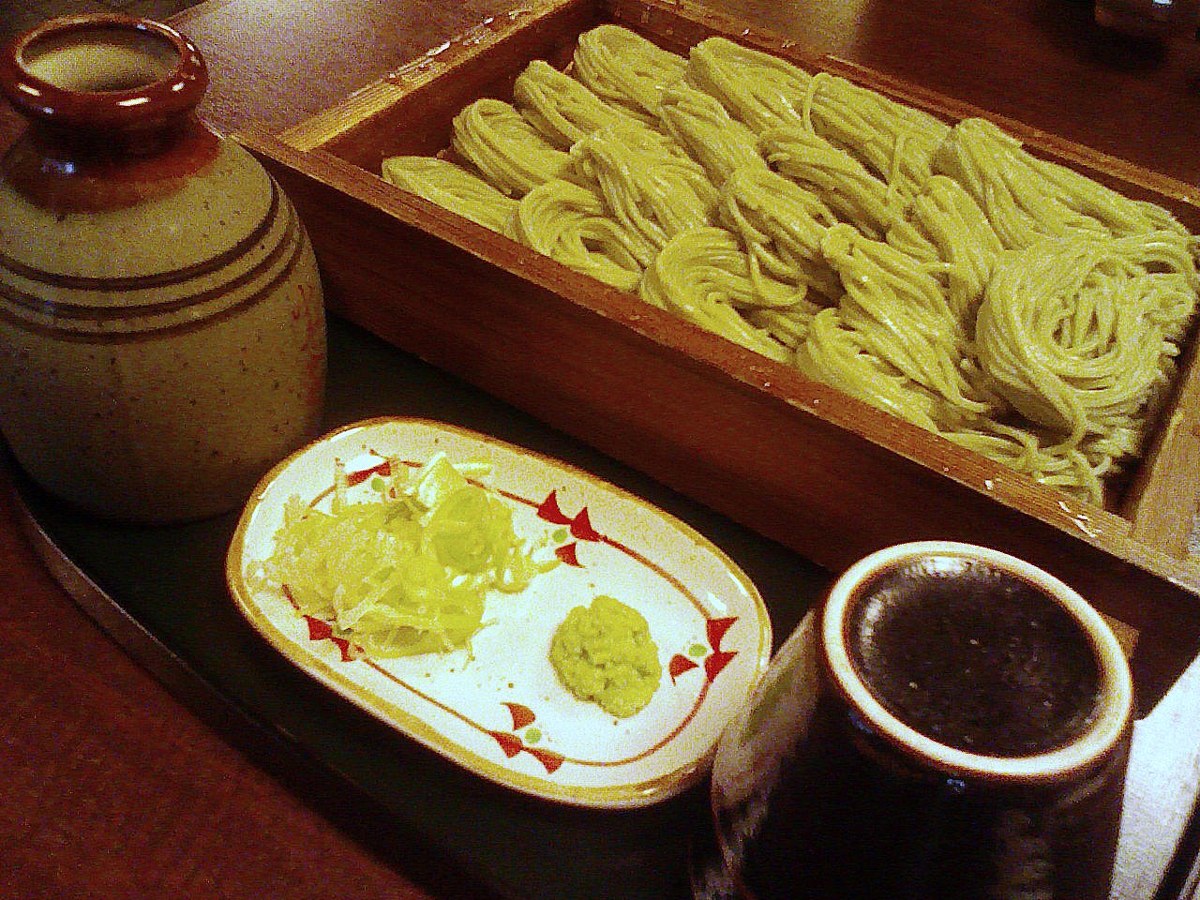
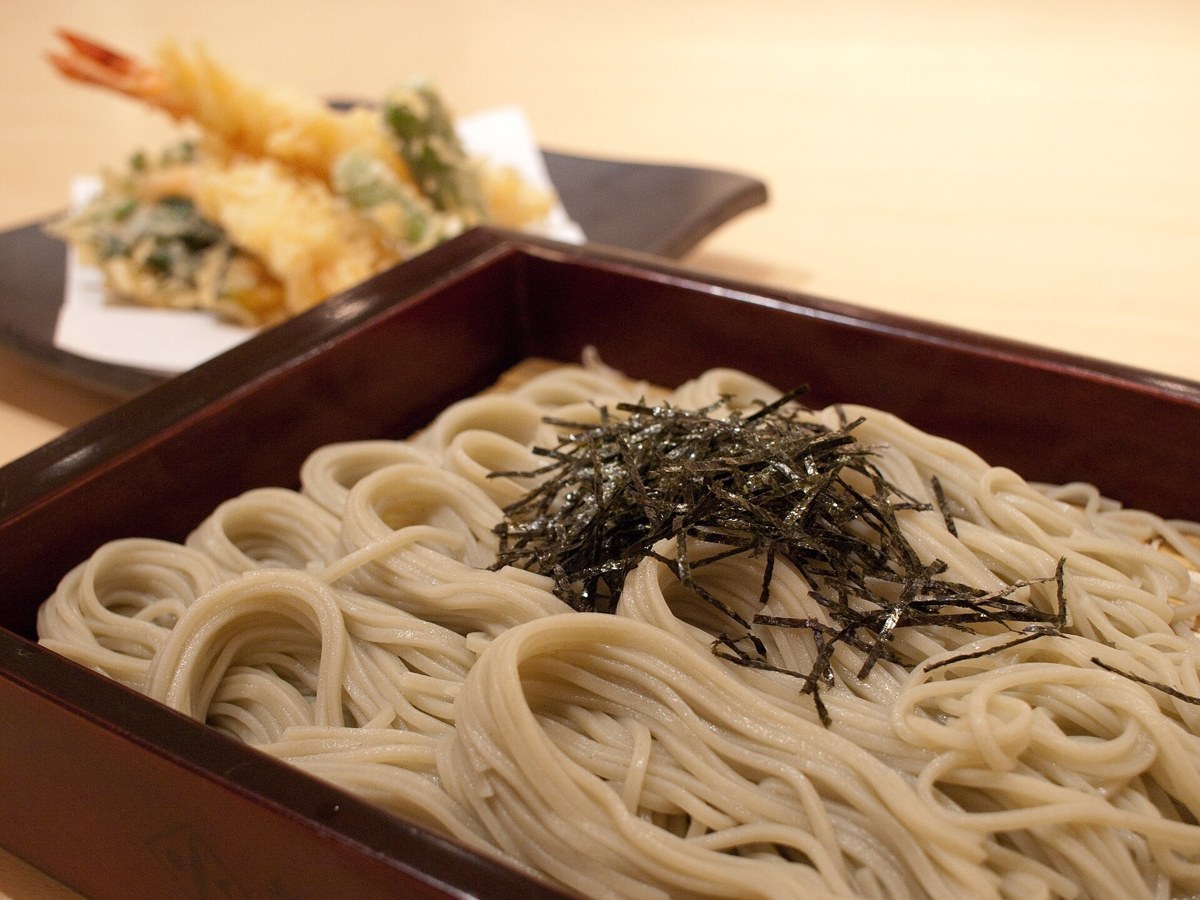
The checked guide defines hegi soba by three things, and all three are visible before the first bite. First, the binder: processed funori seaweed kneaded into the buckwheat dough, giving the noodles their smooth throat feel, their firm elastic bite and a slight green tint. Second, the presentation: the noodles are coiled by hand into bite-sized bundles called teguri, each a single mouthful wound like a small skein. Third, the vessel: a hegi, a rectangular wooden tray whose name comes from the verb hegu, to peel or split wood thin — the tray a woodworking snow country would naturally serve on.
The condiments complete the definition. In Uonuma the traditional partner is karashi mustard — not wasabi — with green onion and sesame; the guide links the custom to how hard wasabi was to grow locally, and notes that some modern shops serve wasabi alongside or instead. The noodles are eaten cold, dipped lightly, one bundle at a time: plain first, then mustard on the noodle itself, then onion in the sauce, then sesame — a sequence the houses recommend for tasting what the funori actually does.
From the loom to the tray
The root is textile, and it is stated by the city itself. Ojiya's official tourism information, as carried in the checked guide, records that the town's weavers coated ramie threads with boiled funori to smooth the fibres for weaving Ojiya-chijimi, the crinkled ramie cloth that made the district famous. The agriculture ministry describes hegi soba as a local dish said to have developed from a fusion of that textile culture with the region's food culture: the same viscous seaweed that kept threads from snagging turned out to keep buckwheat dough — fragile on its own — rollable, cuttable and springy.
The ministry's own regional recipe fixes the proportions: about 400 grams of buckwheat flour to 30 grams of dried funori for four servings, the seaweed simmered gently for about an hour into a thick liquid before kneading. Even the teguri bundles are said to echo the coiled thread bundles of the weaving workshop — a visual link the guide presents as tradition rather than proven rule, and this page keeps that distinction. What is not in doubt is the direction of travel: in Uonuma, the loom fed the kitchen.
Two houses, two firsts
Uonuma argues about its inventor the way only a proud food region can. Wataya of Ojiya describes its main store as the birthplace of hegi soba. Kojimaya Sohonten of Tokamachi describes its founder — Shigetaro, in the company's own words — as the man who completed the original funori binder, its 'ganso funori tsunagi'; the company adds that its noodles have been presented to the Imperial family, and its own site roots the house in the snow country of Echigo-Uonuma, where snowmelt water grows fine buckwheat. The checked guide flags both claims as each house's own account rather than settled fact, and the honest visitor simply eats at both.
The prices are working-noodle prices. A single serving at the checked houses generally runs about ¥900-2,000, with tempura or side-dish sets several hundred yen more; the Kojimaya branch inside Niigata Station reads roughly ¥1,500-2,000 per person, which puts the canonical bowl within a train change. Autumn brings shin-soba, the new-harvest noodles of late October and November, when the flour's aroma is at its height.
Niigata's shelf, given its noodle
Set hegi soba beside Niigata's standing stories and a gap closes: the prefecture had a festival dango, a sake aged in a snow room, and a cutlet bowl drowned in tare sauce — all rice-country foods. Hegi soba is the mountain counterweight, the buckwheat noodle of the weaving valleys, and the prefecture's first noodle in this collection. For the road, the houses sell the noodles fresh, semi-dried and dried at Niigata and Echigo-Yuzawa stations and the regional halls of Tokamachi and Ojiya, and some producers sell online — check the label for the funori, and for wheat flour if that matters to you.
Order the plain tray first, before any tempura set tempts you. The funori's work is subtle — a gloss, a spring, a green hint — and it disappears under heavy sides. One bundle plain, one with mustard: that is the whole argument of Uonuma in two bites, a weaver's material turned into a noodle's soul.
Sources — checked 11 November 2026
- Food in Japan: Hegi Soba — Niigata's funori-bound noodles (checked specialist guide; shops checked against official sources, September 2026)
- Kojimaya Sohonten: the company's own official site (maker's own site, Japanese)
Original prose and official links only; no source text or maker media reproduced. Photos are credited Creative Commons works, not product photographs.
Editorial review 2026-11-11