Takaoka lacquerware is the castle town’s other great craft beside its copperware: lacquer built up and carved like sculpture, inlaid with mother-of-pearl, painted in rust-textured sabi-e. It began with a castle lord’s armour and chests, decorates the city’s festival floats, and has been a designated Traditional Craft since 1975.
Lacquer carved like sculpture
Most Japanese lacquerware is known by its surface; Takaoka’s is known by its depth. Its signature techniques build lacquer up and cut into it: tsuishu and tsuikoku, layer upon layer of coloured lacquer carved in relief; chōkoku-nuri, sculpture coating, which models form in many colours of lacquer with a three-dimensional hand; sabi-e, drawing in rust-textured pigment; and raden, mother-of-pearl inlaid into the black. The products are the castle town’s furniture of daily life — trays, boxes, tea coasters, hibachi — and its showpieces, confectionery vessels and the tai-bon, a tray carved as a sea bream.
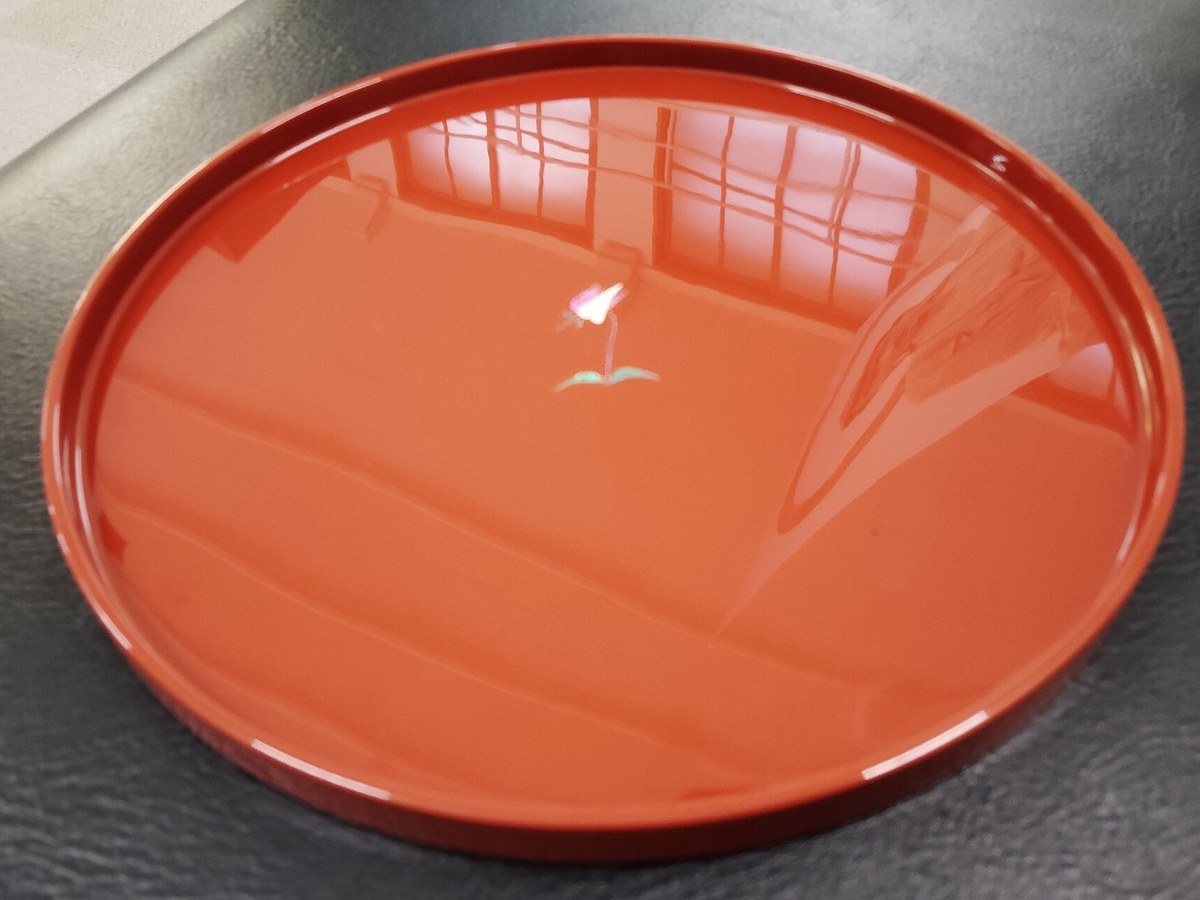
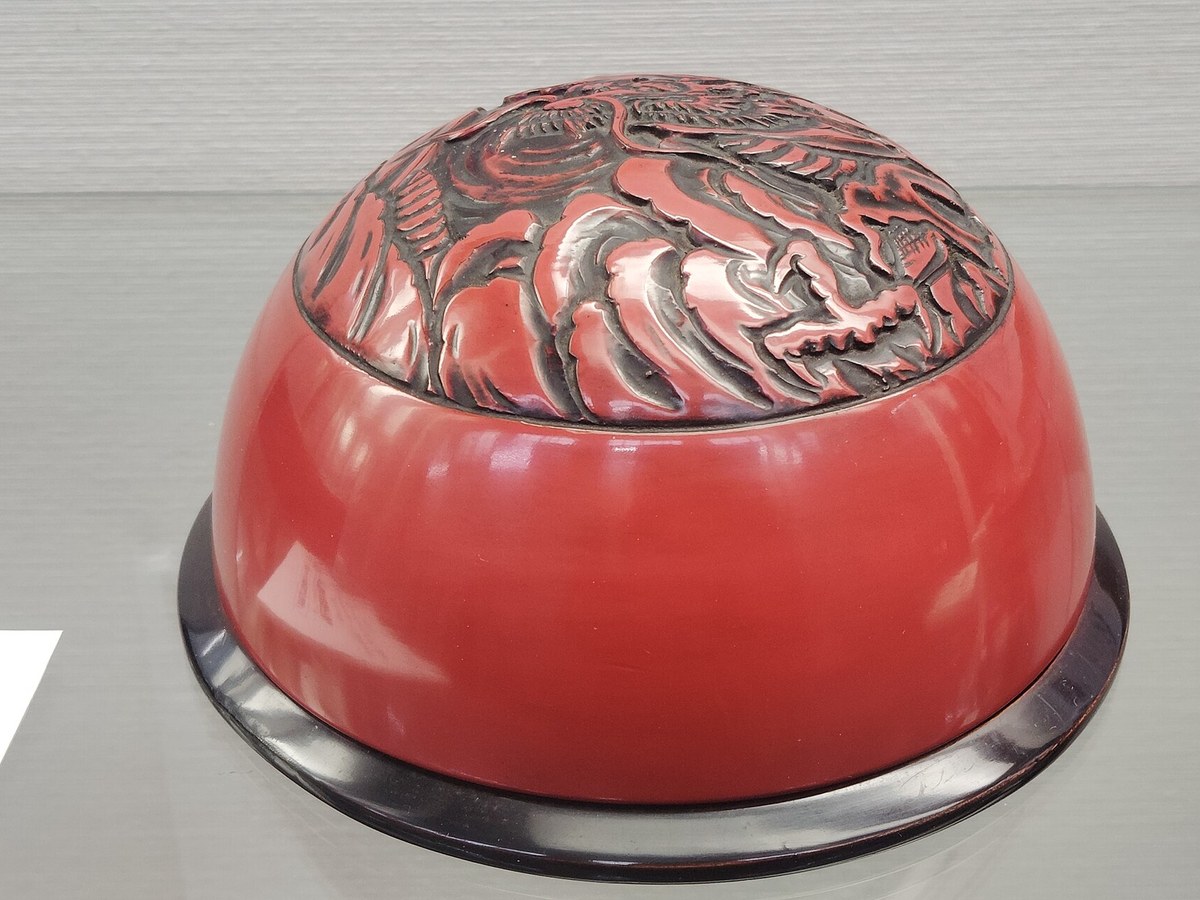
Our two photographs are the craft’s canonical pieces in the Takaoka City Museum — the same works the encyclopedia record itself uses to illustrate the article: a vermilion round tray with a bird inlaid, and a confectionery vessel whose lid carries a dragon in black carved lacquer over red. They are named works, photographed as products, and they show the two poles of the craft: the polished surface and the carved depth.
A castle lord’s commission, a Chinese lesson
The craft’s origin is told from the Keichō years, when Maeda Toshinaga, lord of Kaga, built Takaoka Castle and had the town’s craftsmen make what a castle needs: armour, chests, trays and the goods of daily life. Lacquer in Takaoka begins as castle supply.
Its technique widened in the Meiwa years, when Tsujiya Tanpo imitated Chinese lacquerware in tsuishu and zonsei, and the carved-lacquer methods — tsuishu, tsuikoku — came across from China to join the local hand. From that meeting came the craft’s breadth: carved colour, sculpture coating, sabi-e and raden side by side, absorbed into the town’s everyday goods and gathered, once a year, onto the floats of the Takaoka Mikurumayama festival — themselves designated an Important Tangible Folk Cultural Property — where the lacquer techniques ride through the streets each 1 May.
Exported in Shōwa, designated in 1975
The trade organised in the Shōwa period and sold far beyond Toyama: the record lists exports to the United States, Britain, France, India, China, the Pacific islands and Ethiopia — a castle-town craft on five continents. On 4 September 1975 Takaoka lacquerware was designated a Traditional Craft by the Minister of Economy, Trade and Industry, the national register’s recognition of the techniques and their unbroken local practice.
The craft is still taught where it is made: Takaoka schools invite lacquer craftsmen in and pupils make pieces of their own, and the trade’s cooperative — the Traditional Craft Takaoka Lacquerware Cooperative — carries the name. The Takaoka Regional Jiba Sangyo Center, in Otaya Serio since 1983, presents and sells the city’s crafts together, lacquerware beside the copperware the same castle town is famous for.
Buying Takaoka lacquer
In Takaoka, the Jiba Sangyo Center is the craft’s showroom and shop. Beyond Toyama, the measured piece this run is a university store’s: the University of Tokyo Communication Center sells a Takaoka-nuri raden round tray — black Takaoka lacquer with an abalone-shell inlay worked as a ginkgo design, 21 centimetres across — at ¥5,500. It is a small, modern, usable piece of the raden line, priced like one.
Judge Takaoka work by the carving: in tsuishu and chōkoku-nuri the relief should be cut clean through the layered colour, edges sharp, the sculpture readable by fingertip. A tray is the honest first purchase — the craft began with them, at a castle’s order.
Sources — checked 15 November 2026
- Takaoka lacquerware — encyclopedia record (the castle-town origin, the carved techniques, the 1975 designation)
- Takaoka-nuri raden round tray — University of Tokyo Communication Center store (the ¥5,500 tray)
Checked 15 November 2026 (stored links re-fetched and judged per product): reserved where the page says so, with an editorial review note kept per product. Press, PR and travel use stays outside the grant.
Editorial review 2026-11-15