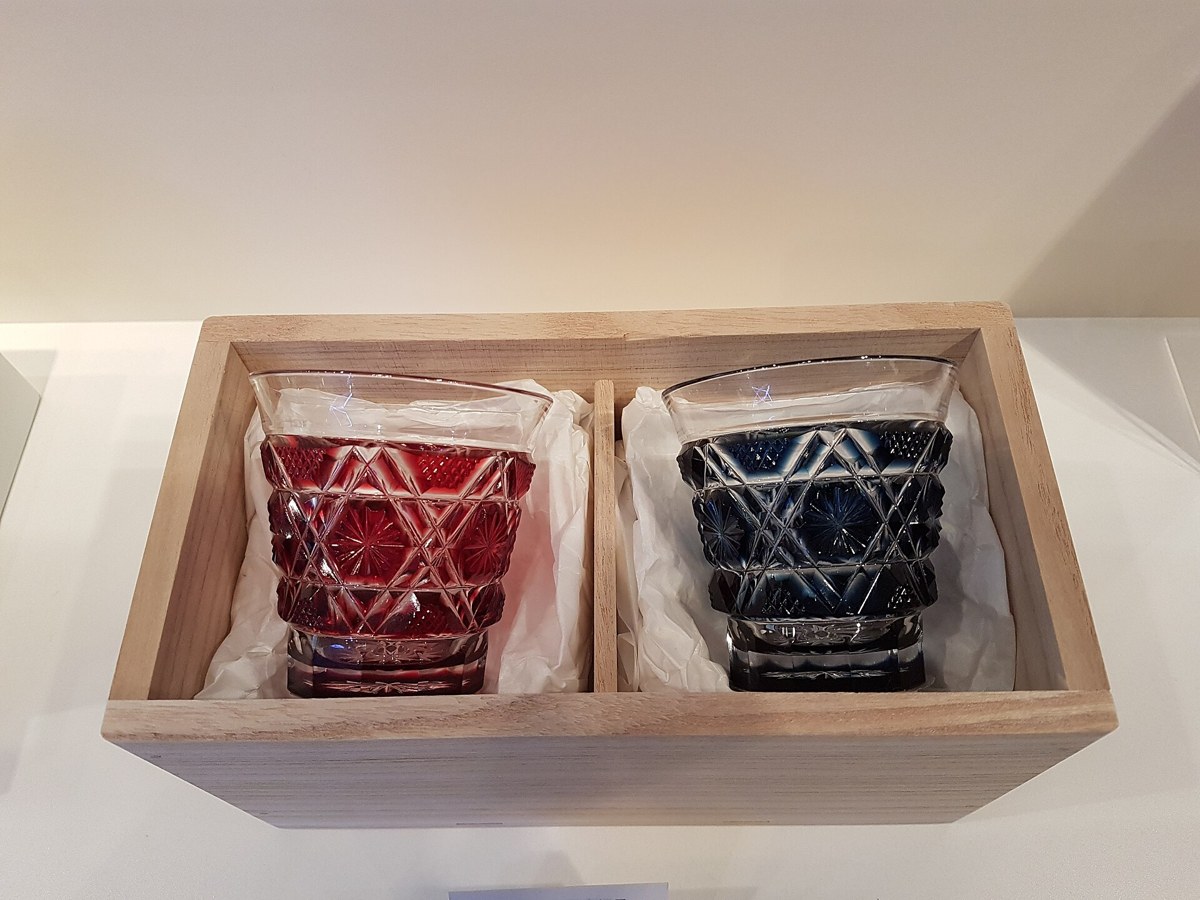
A sake cup the colour of deep water, cut until the colour gives way to clear glass: Satsuma Kiriko is Kagoshima's glory — glass blown in two layers, coloured over clear, then cut back so the pattern lives in the boundary. Shimadzu's two-tone sake cup C-206, all 6.2 centimetres and 105 cc of it, lists at ¥37,400. This page documents why a cup can cost that, and why it could only come from the Satsuma Domain's old capital.
The domain that made glass
Satsuma, the great southern domain ruled by the Shimadzu, ran its own modernisation in the late Edo period — furnaces, factories, and glassworks among them. Its glassmakers developed the technique that still defines Satsuma Kiriko: overlay glass (iro-kise), a skin of intense colour blown over a clear body, cut deeply so the design is carved through the colour into the light. The finest work adds bokashi, a gradation where the cut feathers the colour from deep to transparent — a shading no stencil can imitate, done entirely by the cutter's wheel and hand.
The craft died with its century and was revived in the late twentieth century; Kagoshima Prefecture designates Satsuma Kiriko as a traditional craft of the prefecture, and Shimadzu — the former ruling house, now a company — supervises a certified production in Kagoshima, its pieces stamped as the domain's own line. When you hold the cup, the weight is the first surprise: the walls are thick enough to cut, which makes a 105 cc sake cup feel like a small monument.
What the cutting buys you
Cut glass exists elsewhere in Japan — Tokyo's Edo Kiriko, cut on clear or thinly coloured glass with fine, sharp patterns, is the famous cousin — and the honest comparison sharpens the Satsuma claim. Satsuma cutting is deep and sculptural: fewer, bolder cuts, made into thick coloured overlay, with that graded bokashi edge. It reads less like engraving and more like carving, and it is priced accordingly, because the failure rate at the wheel is part of the cost of every surviving piece.
The two-tone (futairo) work doubles the difficulty: two colours layered over the clear body, then a pattern cut to reveal each at its own depth. The C-206 cup documented on this page is exactly that — a small two-tone sake cup in lapis-toned green, diameter 6.2 cm, height 5.2 cm, capacity 105 cc — sold through Takashimaya's listing with the maker's specifications printed in full.
Practical details: price, where to buy, online sales
Price (checked 9 November 2026): Shimadzu Satsuma Kiriko two-tone sake cup C-206 lists at ¥37,400, tax included, on the department-store listing quoted here — treat it as the entry point to certified Shimadzu work rather than an exception; larger pieces (vases, bowls, decanters) run far higher. At the other end of the prefecture's kiriko world, Kirishima City runs a workshop where visitors make a pendant from recycled kiriko glass, for travellers who want the cutting's story at a smaller scale.
Where to buy: in Kagoshima — the maker's Kagoshima outlets and the Satsuma Kiriko displays and shops around Kagoshima City — and through department stores such as Takashimaya elsewhere in Japan. Official online sales: yes, through the maker's channels and department-store online shops; the edition is the craft's place and designation, not a retail wall. Type of edition: regional edition — a prefecture-designated traditional craft of Kagoshima.
Buying cut glass without fooling yourself
The buying discipline here is provenance, because 'kiriko' is a technique word, not a protected promise. A Shimadzu Satsuma Kiriko piece comes with the maker's mark, its model number (the C-206 above), and dimensions and capacity you can check against the listing — that paperwork is what separates the prefecture's designated craft from a handsome cut-glass souvenir. Buy the cup if you will use it: sake, cold tea, or simply light through coloured glass on a shelf — these pieces were made thick enough to survive being used.
And set the expectation the price sets. At ¥37,400 for 105 cc, you are not buying capacity; you are buying the survival of a domain technology through two centuries, cut by hand into glass that fails often and forgives never. Kagoshima's other souvenir on this site costs ¥216 a piece. The prefecture contains both, and this page is proud of the contrast.
Scope: what 'limited' means here
Satsuma Kiriko is documented as a Kagoshima craft: a Kagoshima Prefecture-designated traditional craft, developed under the Satsuma Domain, with Shimadzu's certified line produced in Kagoshima. It is sold through department stores beyond the prefecture; the limitation is place and designation. Edo Kiriko is a different tradition. Checked 2026-11-09.
Sources — checked 9 November 2026
- Takashimaya product listing: Shimadzu Satsuma Kiriko two-tone sake cup C-206
- Craftpedia (Japanese traditional crafts portal): Satsuma Kiriko
- World Tourism: Satsuma Kiriko pendant workshop from waste glass, Kirishima
Original prose and official links only; no source text or maker media reproduced. Photos are credited Creative Commons works, not product photographs.
Editorial review 2026-11-09