Every other brocade in Japan is woven with thread. Saga Nishiki is woven with paper. Its warp is washi coated with gold, silver or lacquer leaf and cut into hair-fine strips; its weft is dyed silk, worked a few inches a day on a table frame the size of a tea tray. The technique was a pastime of the Nabeshima castle ladies of Kashima in the late Edo period, nearly died with their world, and was carried to London in 1910 — where it took the name it still carries: Saga Nishiki, the brocade of Saga.
Brocade woven from paper
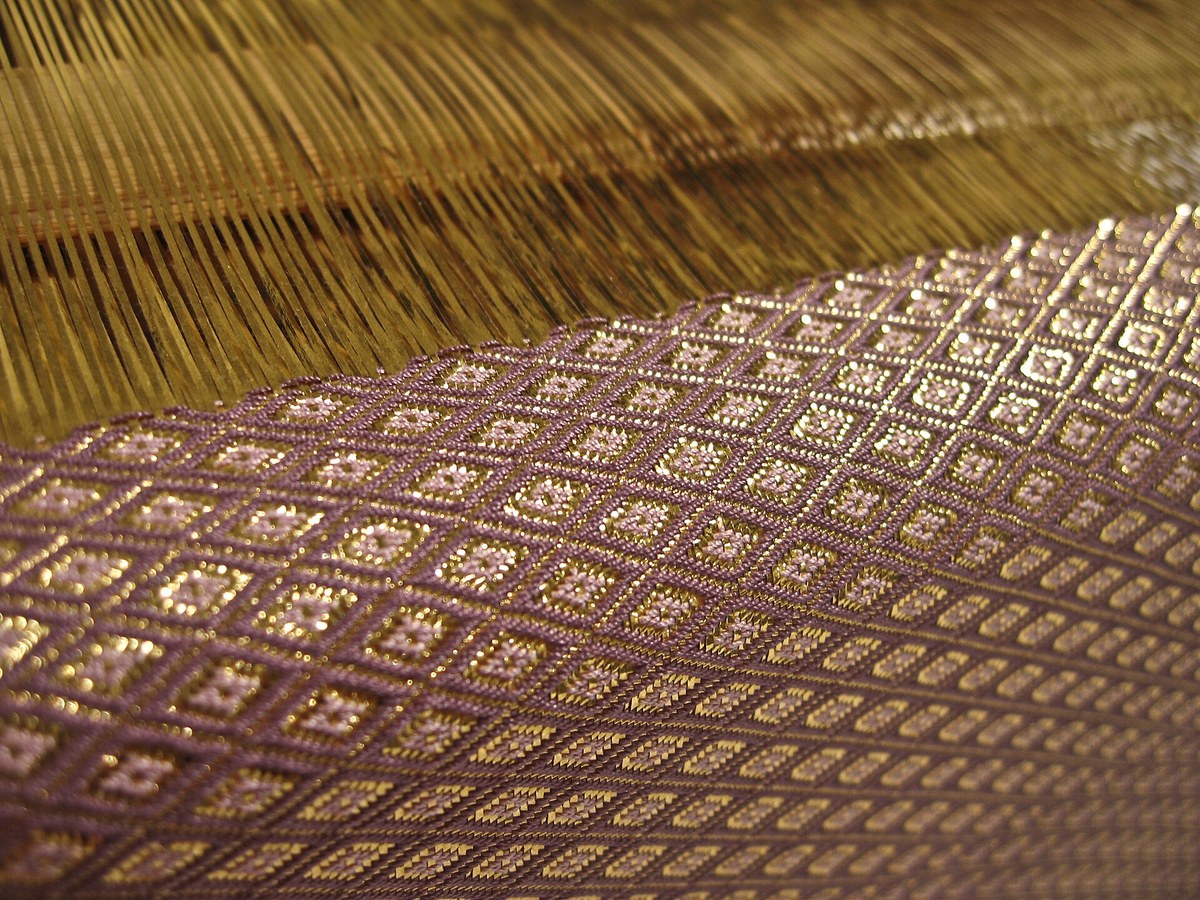
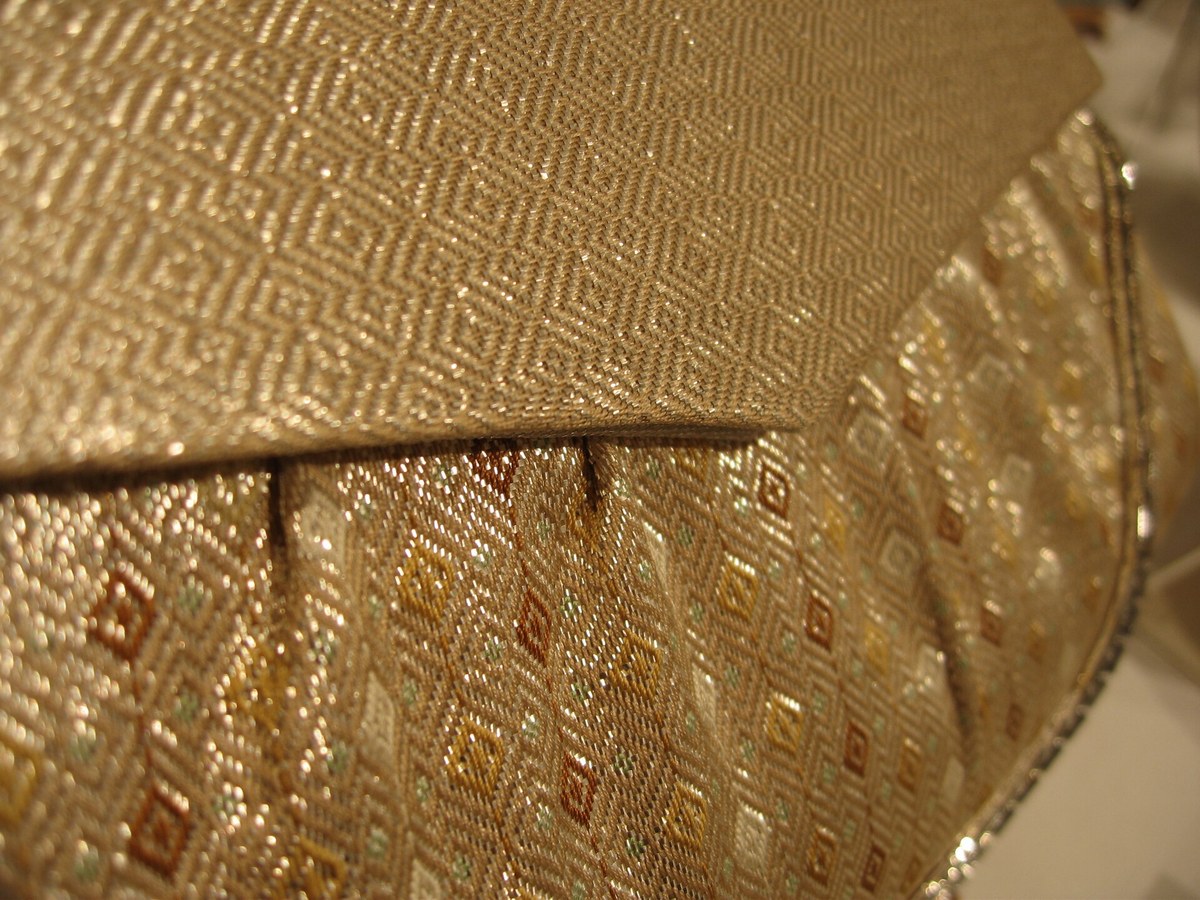
Saga Nishiki's structure has no parallel among Japanese brocades. The warp — the threads held under tension — is not thread at all: it is washi paper coated with gold leaf, silver leaf or lacquer, then cut into very fine strips. The weft woven through it is multicoloured dyed silk thread (Folk Costume Culture Association record). The result is a plain- or twill-weave cloth that catches light like metal and moves like paper — stiff, bright and unmistakably itself.
It is not woven on a loom. The weaver works at a small table frame, an oridai of roughly 46 by 32 centimetres, passing the silk through the paper warp with a needle-like abari and a bamboo spatula. The work is so slow that only several inches of cloth are produced each day, which is why Saga Nishiki has always been a cloth for small, precious things: appliqué, purses, and today bags, wallets and card cases, with some obi cloth.
A sickbed ceiling, castle ladies and a revival
The origin stories are honestly plural, and the records say so. One account credits a bride from Kyoto to the Ogi Nabeshima house, whose paper pastime grew into woven work among the ladies-in-waiting. The better-loved account belongs to Kashima: Kashioka no kata, wife of the ninth Kashima Nabeshima lord, lay sick in bed studying the woven ajiro lattice of the ceiling above her, and longed to copy its beauty into something close at hand — paper twists were woven into the ajiro pattern to comfort her (Folk Costume Culture Association record). Under later Nabeshima ladies the materials were upgraded — paper warp to gold-foil paper, cotton weft to silk — and the cloth, then called Kashima Nishiki, took its present form inside the castle.
The Meiji Restoration abolished the castle world that had kept the technique, and Saga Nishiki lapsed. It was revived through the efforts of the wife of Okuma Shigenobu, the statesman born in Saga, and in 1910 it was shown at the Japan–British Exhibition in London to great acclaim — the occasion on which Kashima Nishiki was renamed Saga Nishiki (Saga Chamber of Commerce record, via Wikipedia). The line has since been carried by named masters: weaver Fumi Koga (1927–2015) was designated a holder of Important Intangible Cultural Property — a Living National Treasure — for Saga Nishiki in 1994.
What it costs, and where to see it woven
A cloth that grows by inches is priced by the hour of the weaver. At the prefecture products select shop SAGA MADO's first Saga Nishiki exhibition-sale (9–17 August 2025, forty-plus pieces), Saga Nishiki bags were listed from 165,000 yen including tax, and a pen case at 7,700 yen including tax (Saga Prefecture products distribution corporation release). Between those poles sit the craft's everyday forms — card cases, purses, pouches and brooches — priced by the area of hand-woven cloth they carry.
The living centre of the craft is the Saga Nishiki Promotion Council (founded 1993), based at the Kyu-Fukuda house in the Saga City History and Folklore Museum, where visitors can watch the weaving demonstrated, try the table frame themselves in experience sessions, and buy pieces at the source. Saga Prefecture designates Kashima Nishiki and Saga Nishiki separately as prefectural traditional local products — the castle name and the exhibition name, both still woven.
Why Saga Nishiki exists only in Saga
Brocade capitals are elsewhere — Kyoto's Nishijin above all — but the paper-warp technique was developed inside one castle household in Hizen, named for its province at a London exhibition, and is still taught and sold from one old merchant house in Saga City by the council founded to keep it alive. No other weaving district works gold-leaf paper as a warp; the material itself is the signature.
It is also a craft whose scale is a statement. A weaver produces inches a day; a handbag represents weeks at the table frame. Saga Nishiki never industrialised, never sped up, and survives precisely as what the castle ladies made: a pastime that turned out to be a treasure.
Sources — checked 13 November 2026
- Folk Costume Culture Association — Saga Nishiki regional entry (Saga City)
- Wikipedia — Saga Nishiki (references: Saga Chamber of Commerce and Industry, Saga Nishiki Process / History, 2 August 2007)
- Mapion News — SAGA MADO Saga Nishiki exhibition and sale (sale held 9–17 August 2025; Saga Prefecture products distribution corporation)
Checked 13 November 2026 (stored links re-fetched and judged per product): reserved where the page says so, with an editorial review note kept per product. Press, PR and travel use stays outside the grant.
Editorial review 2026-11-13