Most famous pottery has a famous potter. Onta ware has a village. In Sarayama, a hamlet in the mountains of Hita, Oita, nine families pound their clay with river-powered mortars, throw on kick wheels and sign nothing — every bowl carries the hamlet's name, not a maker's. It gives Oita its third story, beside Beppu's bamboo and Usuki's yuzu seasoning: the folk kiln the mingei movement called a model for the world.
Nine kilns, one hamlet
The official account of Onta Pottery Village is exact about the scale: in Motoe-machi, Hita City, there are only nine potters. The ware began in the middle of the Edo period, and from the beginning its defining rule was inheritance — the craft has been handed from father to only one son to the present day, and even now the ceramic work is done within families. Oita Prefecture's official guide to the village, which walks all nine kilns, puts the consequence plainly: Onta-yaki is the hamlet's collective brand, and pieces are basically produced without individual names on them.
That anonymity is the point. A Sarayama plate is not one artist's statement; it is the output of a production system that has run for some three hundred years in a single valley — local clay, crushed in the hamlet, thrown by the hamlet's families, fired in the hamlet's climbing kilns and sold from the kilns' own shelves. The nine working kilns today belong to three family lines — Yanase, Kuroki and Sakamoto — and the ware they make is recognisably one ware, which is why collectors speak of 'an Onta' the way they speak of a place, not a person.
The sound of the clay mortars
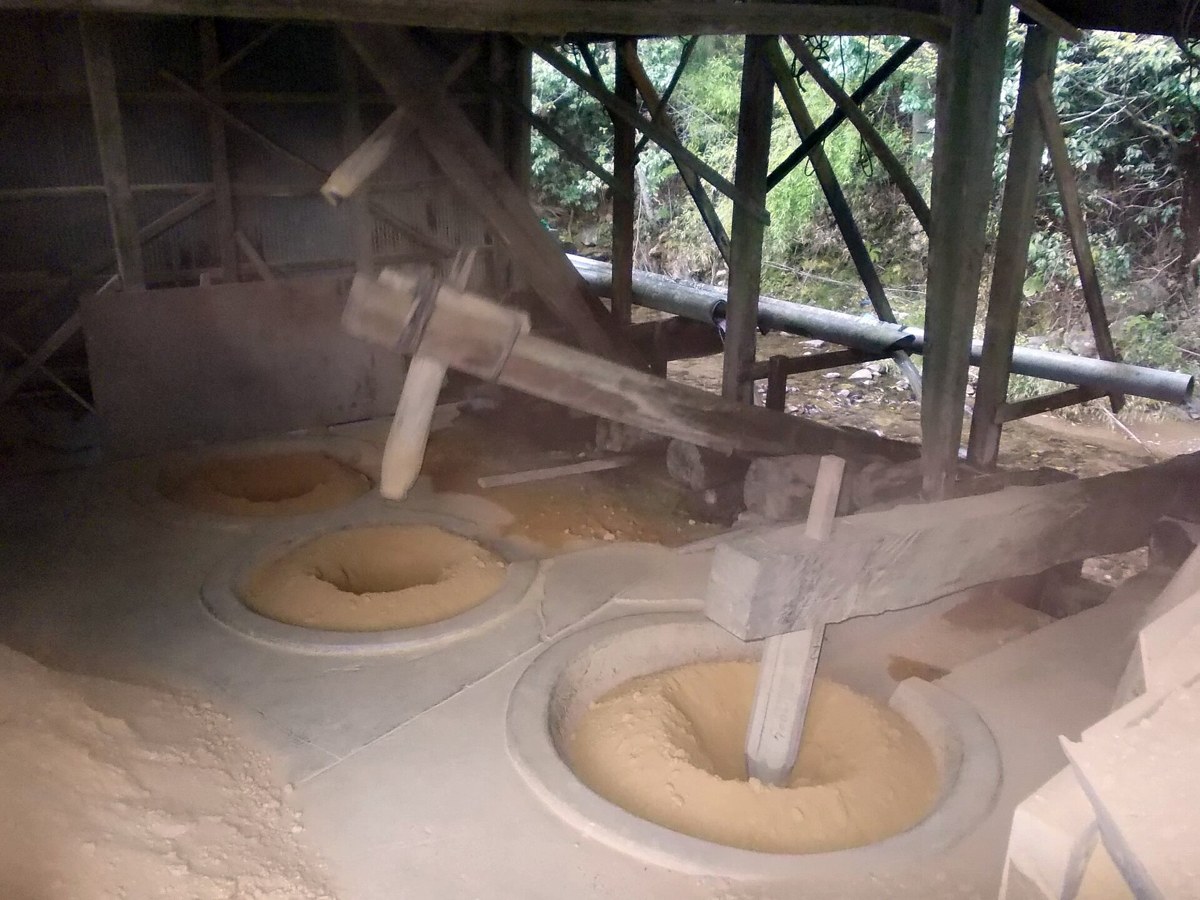
Onta ware is made without machines, and the official account lists the whole toolkit: the mortar that moves via the flow of the river, the kick wheel the potter turns with his feet, and the wood-fired climbing kiln. The mortars — karausu, great wooden pestles rocked by the stream to pound the village clay — number about forty in the hamlet, and their slow, hollow knocking is so much the sound of the place that it has been selected as one of the protected 100 Soundscapes of Japan. Visitors hear the village before they see its pots.
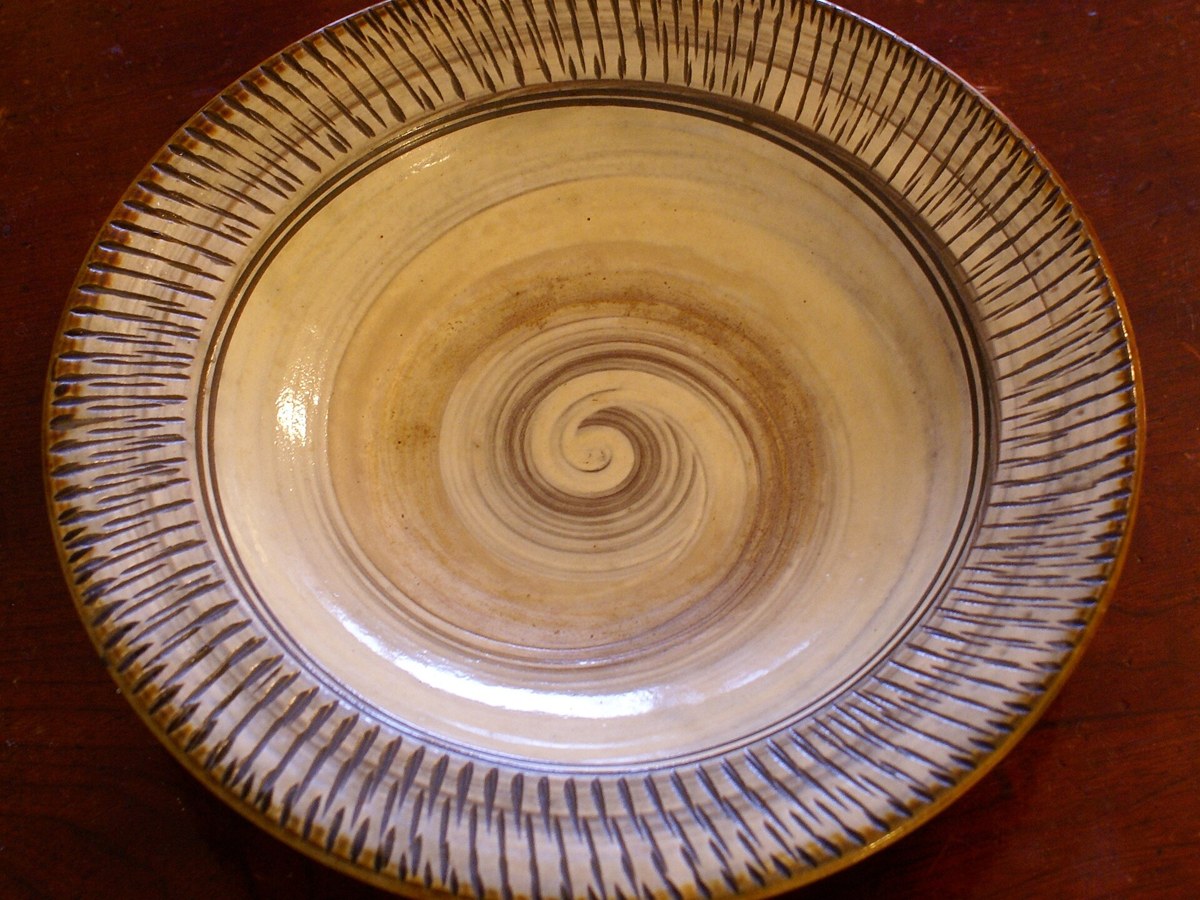
On the wheel, the clay takes the patterns the ware is known by. The signature is tobikanna — a sprung metal blade held against the turning pot so it skips and chatters, cutting a band of rhythmic dashes — alongside hakeme brush marks swept through slip, finger drawings, kushigaki combed lines and poured-glaze patterns. The palette is the folk potter's: dark iron browns, amber and white slip on the valley's own clay. Nothing in the process has been mechanised, which is precisely what the state chose to protect.
Found by mingei, protected by the state
For most of its life Onta was a local ware for local kitchens, little known outside Kyushu. That changed at the beginning of the Showa era, when the founder of the Mingei folk-craft movement, Yanagi Soetsu, together with the potter Hamada Shoji and the English ceramist Bernard Leach, introduced it widely — the kiln account dates the visit to 1931. Yanagi held the anonymous, unmechanised village up as proof of his philosophy: beauty made by unknown craftspeople, for daily use, without self-conscious art. Sarayama became the movement's living exhibit.
The designations followed the philosophy. In 1970 Onta Pottery was selected as an intangible cultural property requiring measures such as the creation of records; in 1995 its techniques were designated an Important National Intangible Cultural Property, with the Onta Pottery technical preservation society — the village acting together — certified as the holder. It is a rare honour structured the same way the ware is: not a person, but a community, holds the title.
What it costs, and where to hear it
Onta is working pottery, and its prices stay in the kitchen range. A trade catalogue's current list prices for the classic tobikanna plates run from ¥2,000 for a small 3-sun plate through ¥2,900 at 5-sun to ¥6,500 for a large 8-sun plate, with brush-marked hakeme plates at the same prices and a hand mug at ¥3,600 — list prices, quoted as such; at the kilns themselves, shelves of seconds and one-offs widen the range in both directions. There is no unified village web shop: the prefecture's guide notes the kilns sell their own work, with mail order and Tokyo dealers beyond that.
The way in is the village itself. The Hita City Onta Pottery Museum, in the hamlet, exhibits the ware's materials and antique pieces and is free to enter, open 9:00 to 17:00 and closed on Wednesdays and over the New Year. Sarayama is about thirty minutes by car from JR Hita Station, or twenty-five minutes from the Hita interchange. Go on a quiet day, when the only soundtrack is the one the state protects: forty wooden mortars, knocking the valley's clay into next season's plates.
Sources — checked 10 November 2026
- ANA Japan Travel Planner: Onta Pottery Village (Oita official tourism account)
- Oita Prefecture official magazine (edit Oita): the complete guide to the Onta ware village and its nine kilns
- Yamashita Kogei trade catalogue price-revision list: Onta ware list prices
Original prose and official links only; no source text or maker media reproduced. Photos are credited Creative Commons works, not product photographs.
Editorial review 2026-11-10