Japan’s hottest ramen is served still boiling, in the pot it cooked in, because a delivery man in postwar Susaki hated bringing people cold noodles. Taniguchi Shokudo’s answer — ramen cooked and carried in an enamel pot, soon an earthen one — became Kochi’s most rule-bound bowl: a soy chicken soup from mature parent birds, firm thin noodles, chikuwa, negi and a raw egg, takuan on the side, all of it written down in 2002 as a seven-point definition by the chamber of commerce project that revived it. In Susaki the pot does not come to the table warm. It comes to the table boiling.
A delivery problem becomes a dish
Just after the war, in a Susaki back street, Taniguchi Hyoma of Taniguchi Shokudo faced the delivery cook’s oldest enemy: ramen that arrived cold. His fix was to cook and carry the bowl in the vessel itself — first an enamel pot, for its heat-keeping — and the nearby Mitsuda Shokudo is remembered as the first to use the earthen pot that became the standard. Taniguchi, Mitsuda and Mizuno are the dish’s three founding houses.
The soup’s secret was standing in front of the shop: a poultry dealer gave Taniguchi his spent laying hens — oyadori, parent birds, too tough for ordinary cooking and too flavourful to waste — free. The broth and the meat have come from those mature birds ever since, which is why Susaki’s soup tastes older and deeper than a young chicken’s can. Taniguchi Shokudo closed in 1980 on its proprietor’s death, and for two decades the dish survived as a local memory with a few faithful kitchens.
The seven points of Project X
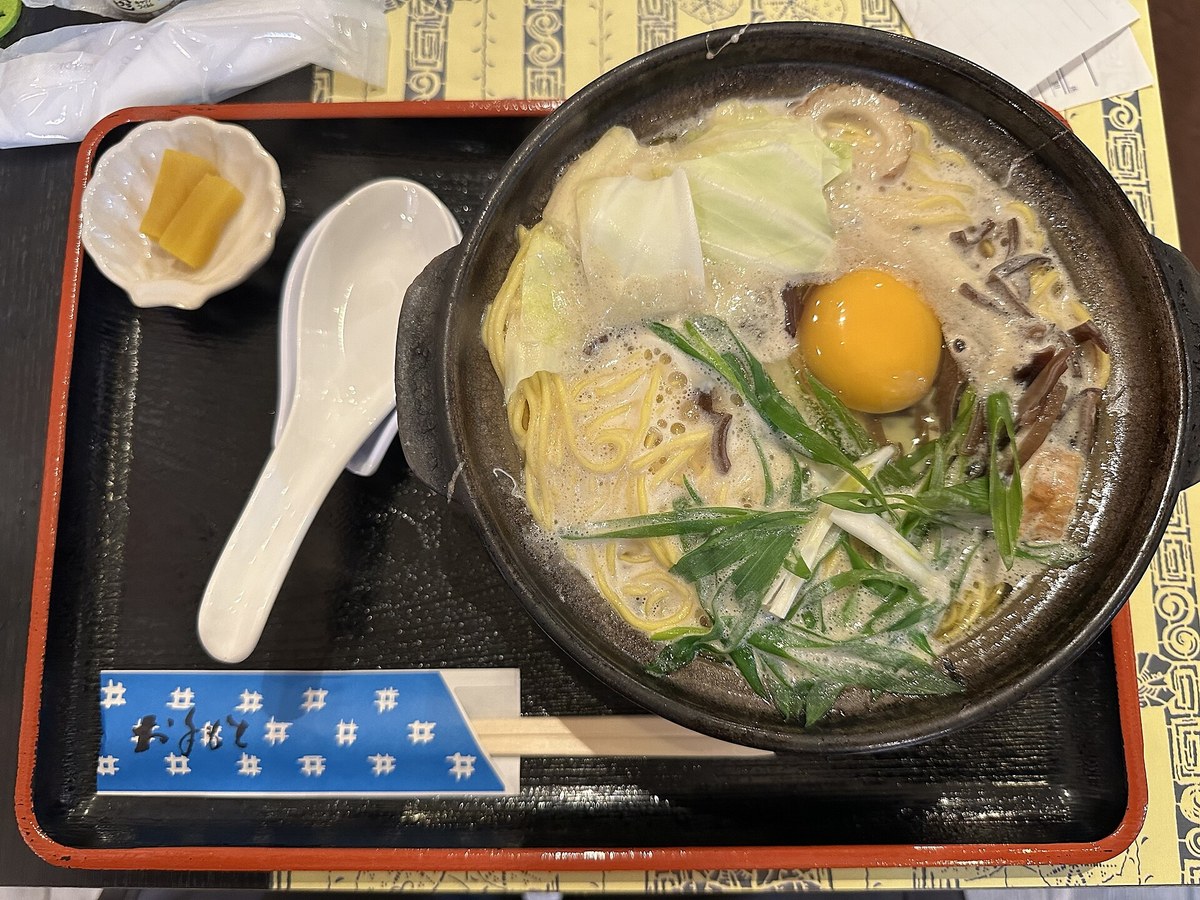
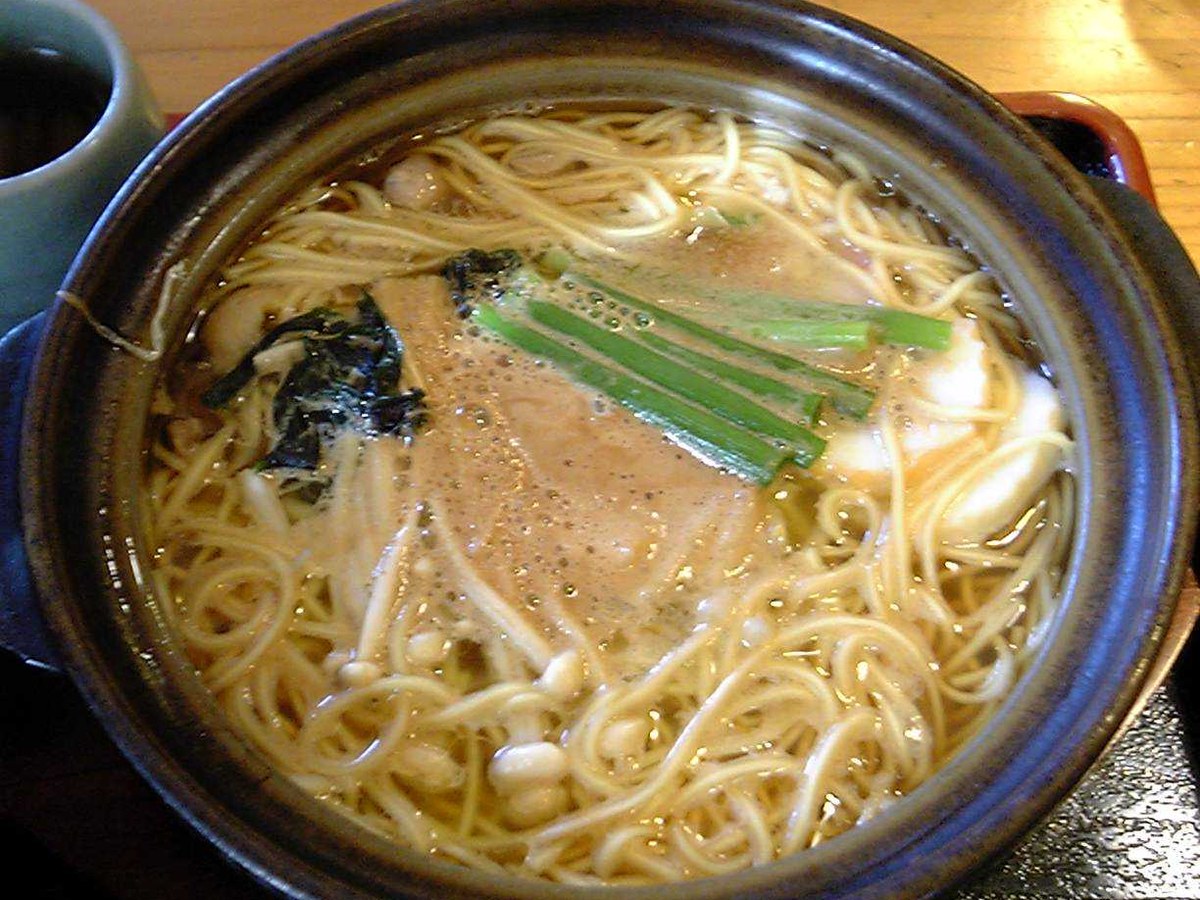
In 2002 the Susaki Chamber of Commerce, the city office and a corps of volunteers formed a revival body with a name borrowed from a television legend — the Susaki Nabeyaki Ramen Project X — and did for the dish what associations do at their best: it wrote the definition down. Seven points: the soup is a chicken stock from oyadori; the base is soy sauce; the noodles are firm, thin and straight; the toppings are oyadori meat, negi, a raw egg and chikuwa (the local sumaki roll); the vessel is an earthen pot, enamel or iron allowed; it is served still boiling; and takuan — the old-style pickle — comes with it.
The definition did the revival’s work: the Project X materials listed thirty-six Susaki shops in January 2011, and the bowl became the city’s calling card. This story’s photographs are the seven points served twice — a modern Susaki pot under cabbage and greens with its yolk intact and its takuan alongside, and the classic earthen-pot bowl that has illustrated the dish since 2006. Nothing in either frame is decoration: even the pickle is law.
The kitchens that carried it
A closed inventor’s shop leaves a dish to its believers. Mayumi no Mise is the famous case: its owner had eaten Taniguchi Shokudo’s bowl as a girl, opened her own shop serving okonomiyaki and yakisoba, and then rebuilt the lost ramen from memory because she wanted it back — the kitchen that carried nabeyaki ramen back into print and television. Hashimoto Shokudo is the present standard, its bowl the one 2026 guides price and queue for first.
The eating protocol is part of the form. The pot arrives boiling — not metaphorically; the soup is at a rolling boil — and the raw egg is left alone at first, to poach in the heat while you take the soup plain. Rice, when it comes, goes into the last of the soup with the loosened egg: the zosui finish the regulars treat as the bowl’s second course. Blow, wait, and respect the pot: this is the one ramen in Japan whose serving temperature is written into its definition.
A boiling bowl, priced
Mayumi no Mise’s own menu prices the revival’s bowl plainly: the regular nabeyaki ramen at 600 yen, 660 yen including tax; the large at 700 yen (770 yen including tax); the extra-large at 800 yen (880 yen); a mini at 350 yen (385 yen). The nabeyaki set — the regular bowl with a chirimen rice bowl — is 1,000 yen, 1,100 yen including tax. Hashimoto Shokudo’s bowl sits in the 700–850 yen band in 2026 guides.
Susaki is a lunch town for this dish: the standing shops open late morning and close when the soup gives out, mid-afternoon at the famous counters. Go at eleven, order the regular, keep the egg whole until the middle, and finish with rice if the shop offers it — the full seven-point performance for the price of a station coffee.
Sources — checked 14 November 2026
- Nabeyaki ramen — the compiled record of Taniguchi Shokudo and the Project X definition
- Mayumi no Mise — the shop’s own menu (nabeyaki ramen, Susaki)
Checked 14 November 2026 (stored links re-fetched and judged per product): reserved where the page says so, with an editorial review note kept per product. Press, PR and travel use stays outside the grant.
Editorial review 2026-11-14