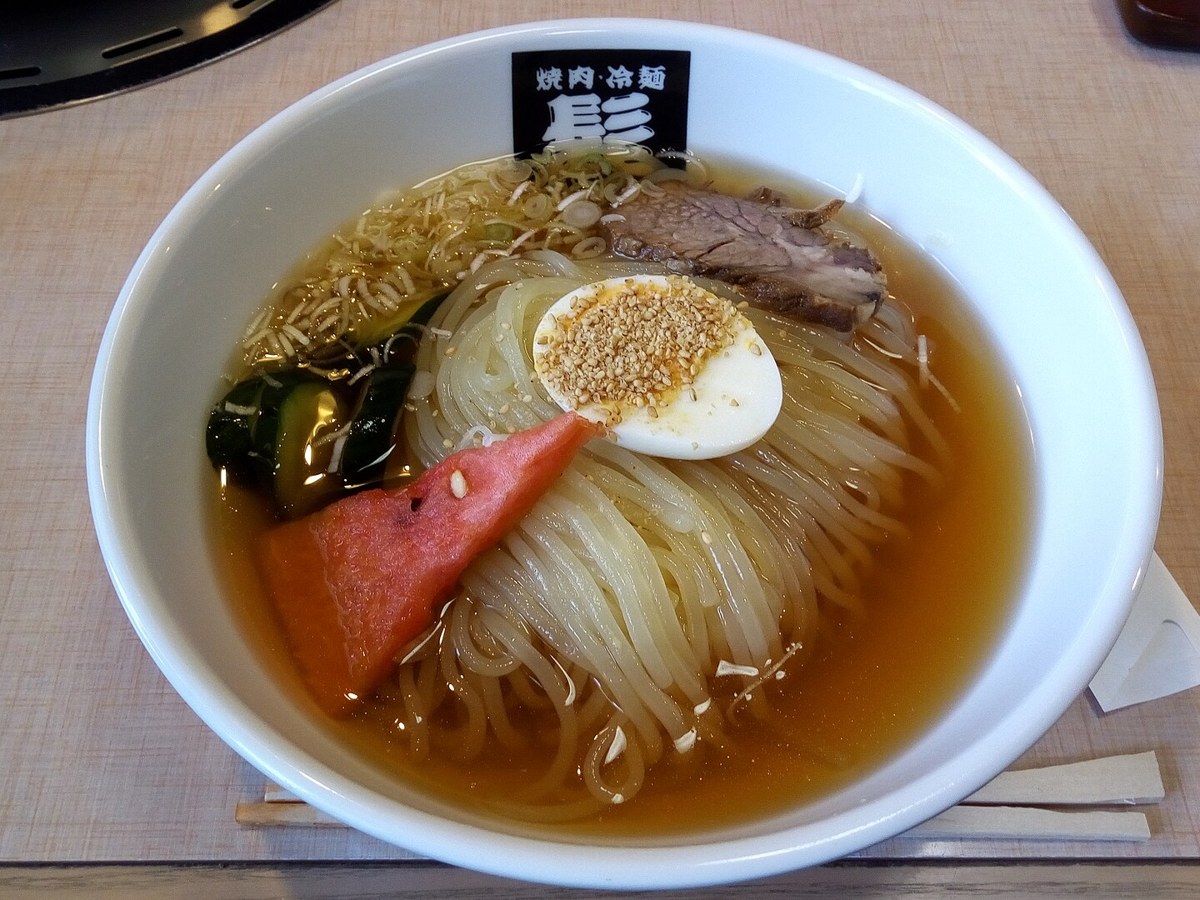
Morioka promotes its noodles as a trio, and this collection already held two of them — the buckwheat refills of wanko soba. The third is the cold one. Morioka reimen is a bowl of thick, translucent, defiantly chewy noodles in an iced beef broth, crowned with kimchi and a slice of watermelon or pear, invented in 1954 by a homesick restaurateur from Hamhung and adopted so completely that locals now treat the yakiniku restaurant as a place you go for the noodles, with grilled meat as the support act.
A Hamhung bowl, rebuilt for Morioka
The story begins with one man and one small restaurant. Shokudoen's founder, Aoki — born in Hamhung, in what is now North Korea, in 1914 — missed the cold noodles of home: the mild, buckwheat-based bowls of Pyongyang and the fiery, chewy ones of Hamhung. In 1954 he opened Shokudoen in Morioka and blended the two, and Iwate's official tourism site records the decisive change he made: the buckwheat came out, and wheat flour went in alongside potato starch. The result is a noodle with no close relative — thick, semi-translucent, and springy enough that early customers, Pyonpyonsha records, complained it was like rubber and impossible to bite through.
Acceptance took a generation. Through the 1960s and 1970s other Morioka restaurants developed their own versions, and in 1986 Pyonpyon-tei, the forerunner of today's Pyonpyonsha, carried a bowl to the Nippon Men Summit in Morioka — after which the name Morioka reimen spread nationwide in the gourmet boom, and in 1990 Pyonpyonsha launched a take-home version. The dish now stands on the farm ministry's list of one hundred rural local dishes, and the prefecture's tourism site counts about thirty restaurants serving it in the city.
Broth, fruit and the spice question
The bowl is an exercise in contrasts. The broth is beef — Shokudoen's runs to roughly eighty per cent beef bone and twenty per cent chicken, on the prefecture tourism account — simmered, skimmed and served genuinely cold, clean and faintly sweet. Against it sit the toppings: cabbage-and-daikon kimchi made for reimen, a halved boiled egg, cucumber, a slice of beef, and the signature surprise, a slice of seasonal fruit — watermelon in summer, pear in the cold months — whose sweetness resets the mouth after the kimchi's heat.
The spice is yours to set, and the question comes before the menu does. The heat lives in the kimchi, so shops grade the bowl by how much goes in — from betsukara, kimchi on a separate plate for the cautious, through regular and hot to extra hot at several times the standard. The safe first order is betsukara: add a spoonful, taste, repeat. A splash of vinegar at the end is the other table custom, brightening a broth you have been drinking straight.
What a bowl costs
Reimen is a working lunch, priced like one. Among the official menus the checked guide could read, a standard bowl lists at ¥1,089 at Daidoen and ¥1,500 at Seirokaku — the two station-area benchmarks — with Daidoen's half bowl at ¥902 for the noodle-tourist attempting all three Morioka noodles in a day, and Seirokaku's large bowl at ¥1,750. Other shops publish their menus only as images or in store, so those two houses carry the price record here; sets that pair a half bowl with a small yakiniku platter cost more again, in the city's favourite format.
The setting is part of the price's meaning. Reimen lives in yakiniku restaurants: the custom, Pyonpyonsha notes, is that locals see the grill house as a place to eat reimen, not just meat — the cold bowl closes the smoky meal, which is why a dish named for cold noodles is eaten in Morioka in January as happily as in August, and why several shops also serve a hot version, onmen, for the unconvinced.
Iwate's shelf, completed
Set reimen beside this collection's two standing Iwate stories and the prefecture's own promotion snaps shut. Morioka's ironware gave Iwate its craft and wanko soba its theatre; reimen gives it the third of the Three Great Noodles the city itself counts — and the only one of the trio that began as an immigrant's homesickness and ended as the hometown's signature. The prefecture's two remaining noodle stories were both buckwheat; this one is wheat and potato, served iced, and it is the bowl Morioka people actually argue about.
Order it betsukara the first time, finish the fruit slice last, and if the noodles defeat your chopsticks, ask — shops cut them without ceremony. It is the most local sentence you can eat in Morioka: Korean roots, Iwate beef, and a slice of pear, in one cold bowl.
Sources — checked 10 November 2026
Original prose and official links only; no source text or maker media reproduced. Photos are credited Creative Commons works, not product photographs.
Editorial review 2026-11-10