No other meal in Japan has an off switch, and it is a small wooden lid. In wanko soba — Iwate's famous noodle ritual, served in Morioka and Hanamaki — a server stands at your shoulder and tips a bite-sized portion of soba into your small bowl every time you empty it, chanting encouragement, until you cap the bowl with its lid and the count stops. About fifteen bowls equal one ordinary serving; a hundred earns a certificate, and a full course costs roughly ¥3,400 to ¥5,400.
Two hometowns, two origin stories
Iwate keeps both of its birth stories and settles neither. Hanamaki tells of Nanbu Toshinao, the 27th head of the Nanbu clan, who stopped in the town on his way to Edo and was served the local soba in a small bowl — a lord's portion, repeated. Morioka tells a plainer tale: at banquets with many guests, no kitchen could hand everyone a large, freshly boiled bowl at once, so hosts served small portions in small bowls, again and again, and called it hospitality.
Either way, the form stuck to the place. Wanko soba is one of Morioka's three great noodles — with reimen and jajamen — and the competitive side was formalised early: the national wanko soba tournament began in Hanamaki in December 1957 and is still held every 11 February. The record books run into the hundreds of bowls; ordinary adults land somewhere between forty and seventy.
How the service runs
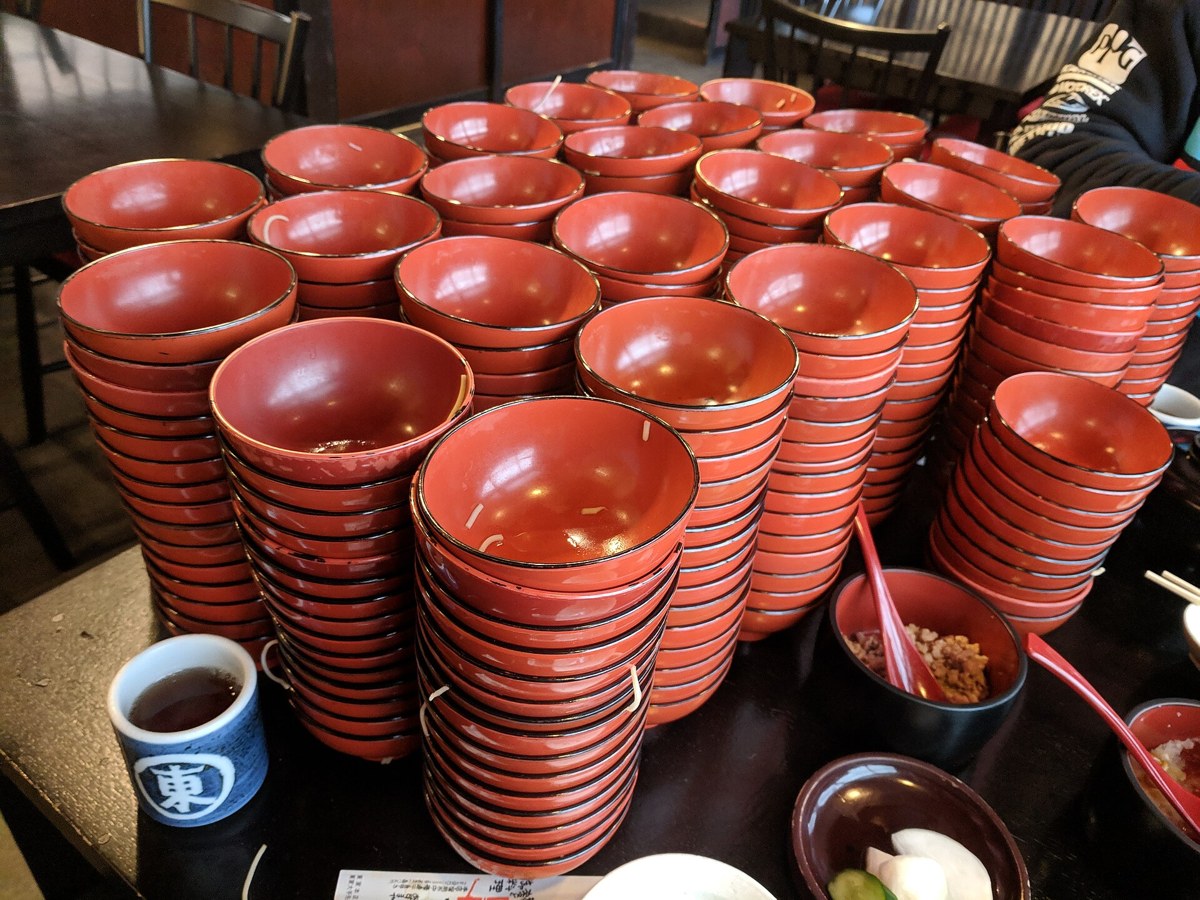
You sit, the server arrives with a tray of small bowls and a pot of warm broth, and the rhythm starts: slurp, empty, refill — 'hai, jan-jan' — slurp again. Toppings rotate at the side of the tray — grated radish, sesame, pickles, sometimes sashimi — so the flavour changes as the count climbs, and the stacked empty bowls beside you become the scoreboard.
The only defence is timing. The lid must land on your bowl before the next portion does; hesitate mid-bite and bowl forty-one is already in. Houses differ in portion size — Morioka City counts about fifteen bowls to a regular serving, while Hanamaki's Yabuya works in portions of about twenty grams and counts ten to a bowl of kake soba — which is why counts are house pride, not a national standard.
Practical details: prices, where to eat, booking
Prices (checked October 2026): in Morioka, Azumaya — serving since 1907 — charges ¥4,500 including tax for the full course; Hatsukoma runs ¥3,400 to ¥5,400 by course. In Hanamaki, Yabuya's course is ¥4,300, and its Morioka Station Fesan branch sells a ten-bowl taster for ¥1,980 — the honest way to try the ritual without the marathon. Courses include the rotating toppings; stacking and certificates are part of the theatre.
Where to eat it: the specialist houses of Morioka (around the station and the castle-ruin park) and Hanamaki, in Iwate. Reservations: several houses require booking for the main courses, and weekends fill; the station taster is the walk-in option. Type of edition: regional edition — a place-defined dining form of two Iwate cities.
Come hungry, leave counted
Wanko soba succeeds because it is a game with excellent noodles inside it. The soba itself is serious Iwate buckwheat, served at the pace that keeps every bite freshly cooked — the original point of the custom — and the count gives the table a shared plot: everyone is watching everyone else's lid hand.
The traveller's strategy is simple: book the full course once, in Morioka or Hanamaki, eat at the server's pace rather than racing it, and put the lid down while you are still enjoying yourself. The certificate at a hundred bowls is real, but so is the afternoon afterwards.
Scope: what 'limited' means here
Wanko soba is documented as the bowl-by-bowl soba service of Morioka and Hanamaki, Iwate, with its houses, prices and tournament as cited. Occasional stagings elsewhere are noted in the limitations; the home ground and its service form are the documented claim. Checked 2026-11-09.
Sources — checked 9 November 2026
- Food in Japan: Wanko soba — how to eat Iwate's bowl-by-bowl soba, prices checked Oct 2026
- Japan Trove: Wanko soba — Iwate's all-you-can-eat noodle challenge
- Japan Activity: 10 things to know about wanko soba in Morioka
Original prose and official links only; no source text or maker media reproduced. Photos are credited Creative Commons works, not product photographs.
Editorial review 2026-11-09