In parts of Japan, you do not ask for a rice paddle; you ask for 'a miyajima'. Hiroshima's fifth story is the wooden scoop of the shrine island — invented there, by tradition, in the late 1700s, protected by the island's own rules about trees, and still produced there in greater numbers than anywhere else in the country.
Carpenters first, paddles by the Edo period's end
Hiroshima Prefecture's craft page traces Miyajima's woodwork to shrine and temple carpenters and cabinetmakers invited to the island in the early Kamakura period. The Chugoku mountains behind the coast supplied the raw material — the Hatsukaichi district across the water served as their lumber collection point — and by the late Edo period the island's workshops were making a wide range of daily goods, beginning with the shakushi.
The paddle's own birth is placed on the island by the Japan Tourism Agency's multilingual record, compiled with Hatsukaichi City: shakushi rice paddles are said to have been invented on Miyajima in the late 1700s, and are now used throughout Japan. Woodworking remained a significant island industry from the 1800s into the early 1900s — on an island whose own groves the visitor still walks through untouched.
The monk, the goddess and the lute
Tradition gives the invention a face. Hatsukaichi City's own newsletter writes that the shakushi is said to have been devised by an Edo-period monk named Seishin; a Hiroshima craft retailer's telling — carried here as the story is told, not as record — has the monk dream of Benzaiten, the goddess enshrined on Miyajima, and take the ladle's curved shape from the lines of her biwa lute, teaching islanders to make it from the island's sacred wood, so that eating rice with it would bring good fortune.
The wood itself obeyed the island's rule. The tourism record notes the paradox at the craft's heart: residents were prohibited from cutting the island's trees, which were the daimyo's property and sacred besides, so most of the timber Miyajima's artisans carved was brought over from the mainland. The craft is Miyajima's; the forests, by design, mostly were not. The fortune framing survives the centuries intact — JNTO still introduces the shakushi as a good-luck charm from Miyajima, and even the island's shakushi-shaped senbei are imprinted with wishes for safety and happiness.
Sixty craftsmen, then the nation's paddle capital
The city's newsletter counts the trade at its height: the 1904 Itsukushima Annaiki, the island's guidebook, recorded sixty to seventy shakushi craftsmen on Miyajima, spoon-makers included. By the middle of the Meiji era the paddle was in demand as a daily article and not only as a souvenir, sales expanded as far as Kansai, and the name became known nationwide — so thoroughly that in some regions, the newsletter records, the shakushi itself is simply called 'miyajima'.
The position never left. The Chugoku Keiren record gives the production area as Miyajima, Hatsukaichi City, Hiroshima Prefecture, and states that Miyajima still comprises the nation's largest production of rice paddles; at the end of Meiji, it adds, nearly 300 craftsmen came from all over Japan to study there, and it lists the Miyajima Traditional Crafts Center — opened in March 1980, on the tourist association's chronology — as the craft's working home. The prefecture's designated woods for the craft include mulberry, zelkova, horse chestnut and cherry, and the process account's bench woods run wider, to cypress, maple and mizume cherry.
Miyajima-zaiku, and the scoop that needs oxen
The paddle sits inside a wider designated craft. Miyajima-zaiku — Miyajima woodwork — was designated a Traditional Craft on 1 November 1982, covering four families: shakushi, rokuro-zaiku lathe-turned work, kurimono hollowed work and Miyajima-bori carving, all finished to emphasise the natural wood grain, and administered by the Miyajima-zaiku Cooperative in Miyajima-cho. The making is slow: the rough shape is cut with a hatchet, dried for one to two years against warping, hollowed and shaped with specialised planes, sanded, and finished with vegetable oil.
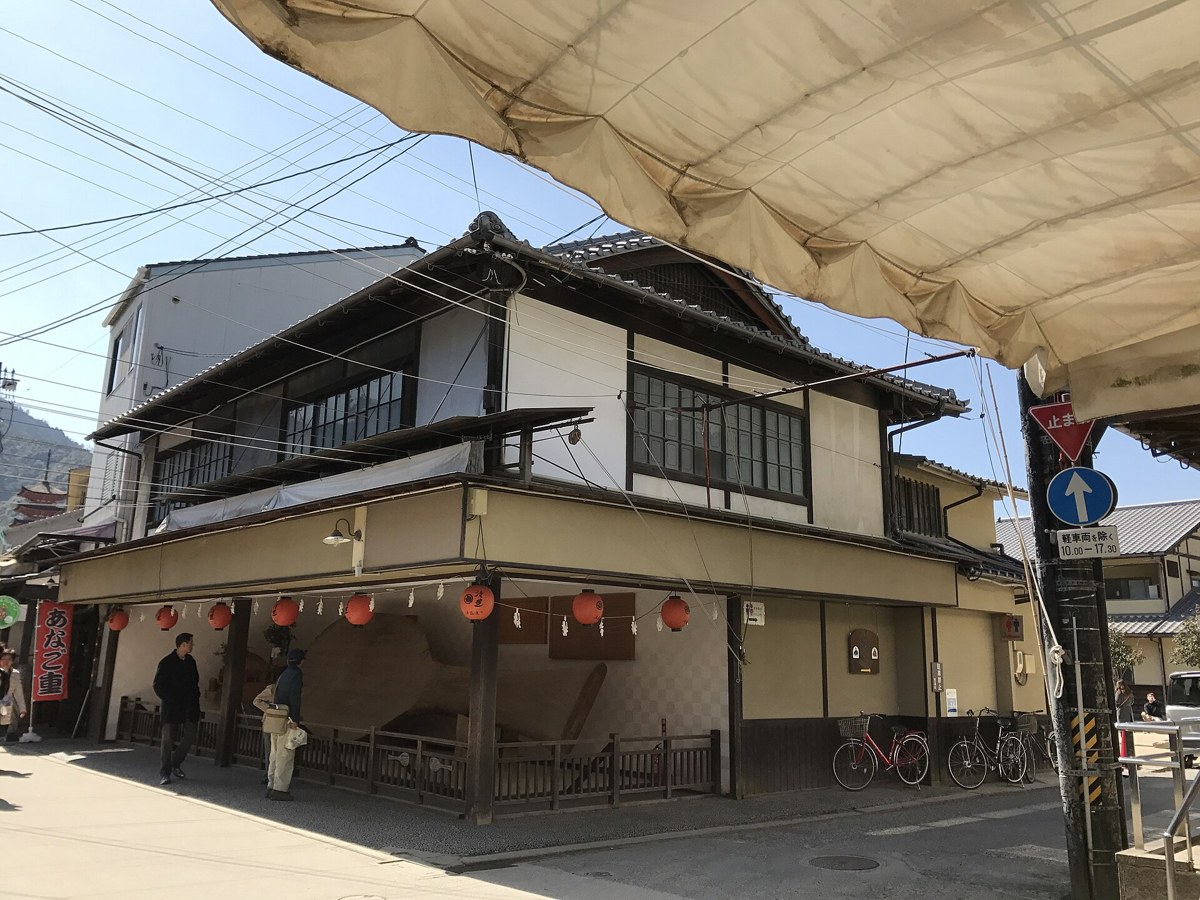
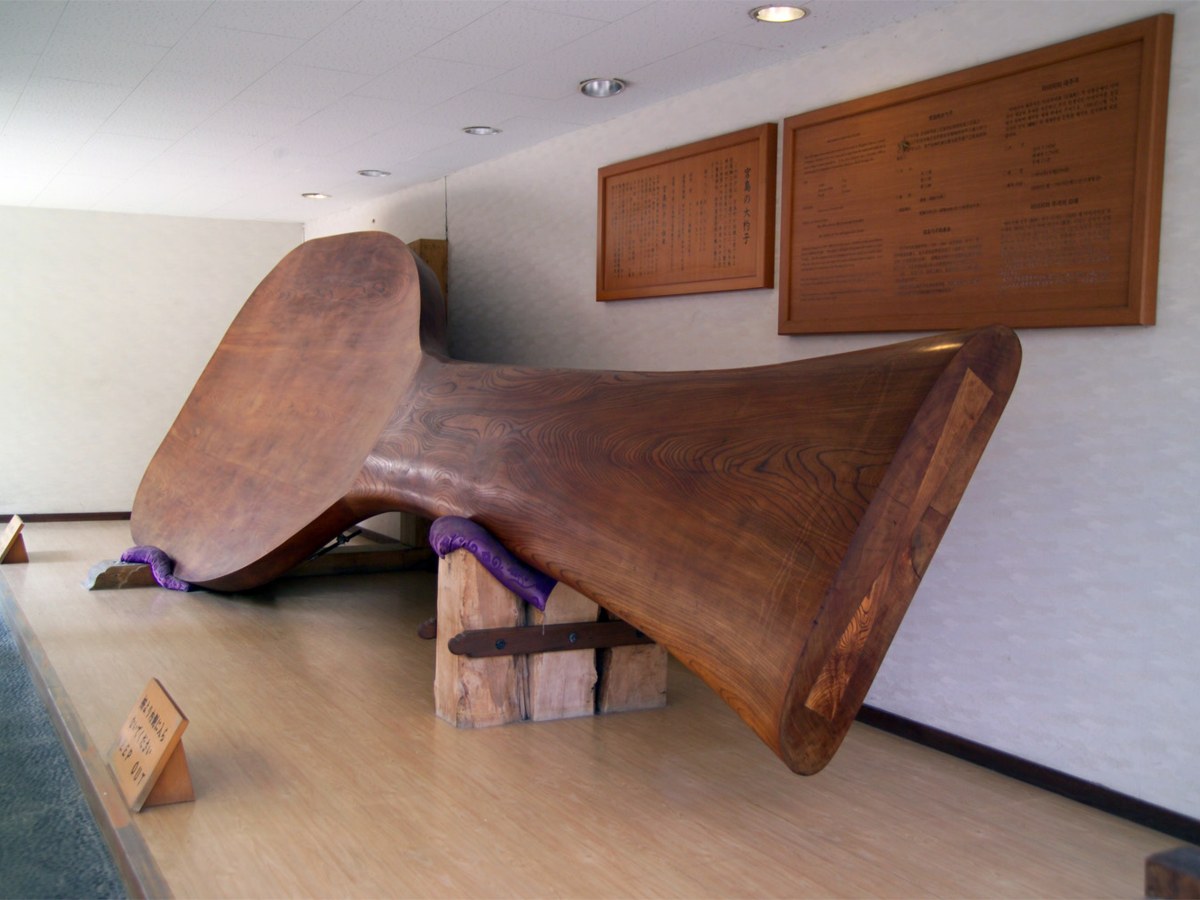
For the island's own monument to scale, three boards of zelkova did it. The city's newsletter records the giant scoop: 7.7 metres long, 2.7 metres at its widest, 2.5 tons — the world's largest ladle — cut from a 1.3-metre-diameter zelkova log the town bought at the Izumo lumber market in 1980, dried naturally for nearly three years, and paraded through the island pulled by oxen. It now stands at the entrance of the etto Miyajima Koryu Center; the tourist association's chronology dates its first display, on the Omotesando arcade, to 25 April 1997.
Sources — checked 11 November 2026
- Hiroshima Prefecture: Miyajima-zaiku designated craft
- Japan Tourism Agency multilingual record: Miyajima shakushi
- Hatsukaichi City newsletter (Machinami Tsushin No. 44): the shakushi record
- Shakushi no Ie (Miyajima): lettered decorative scoop
Original prose and official links only; no source text or maker media reproduced. Photos are credited Creative Commons works, not product photographs.
Editorial review 2026-11-11