In Osaka they mix. In Hiroshima they build. A ladle of batter no thicker than a crepe; on it, a startling mountain of shredded cabbage; pork, bean sprouts, tempura crumbs; the whole tower flipped in one motion and landed on a sizzling disc of fried noodles; an egg spread on the iron to seal it; sauce, seaweed, bonito. Seven hundred grams of architecture for about a thousand yen — and in Hiroshima, a city of some 2,000 okonomiyaki shops, it is not a speciality. It is lunch, identity and reconstruction history served on a griddle.
The layered construction
The checked guide builds the pancake layer by layer, and the order is the definition. The chef ladles a thin crepe of batter — roughly 50 grams — into a 25-centimetre circle on the teppan. Onto it go 200 to 300 grams of finely shredded cabbage, bean sprouts, slices of pork belly, scallions and tenkasu tempura crumbs. The mountain is flipped whole — the moment first-timers gasp at — then set onto a separate tangle of fried yakisoba noodles cooking alongside. A whole egg is cracked and scrambled flat on the iron, the pancake is laid over it, and the stack is glazed with a fruity, slightly sweet okonomi sauce — most commonly Otafuku, a Hiroshima company — and dusted with bonito flakes and aonori.
Against Osaka the contrast is structural, not cosmetic: Osaka mixes everything into the batter before grilling, producing a denser, fluffier pancake of 400 to 500 grams eaten as a snack or shared plate. Hiroshima's weighs 700 to 900 grams, is drier and more savoury than sweet, and is a full single-person meal whose layers stay distinct — cabbage steaming sweet inside its own stratum, noodles crisped as a base, egg as the seal. The second checked guide fixes the local shorthand: the default order is nikutama soba, pork, egg and noodles, and the pancake is eaten with a small metal spatula, the hera, straight from the teppan.
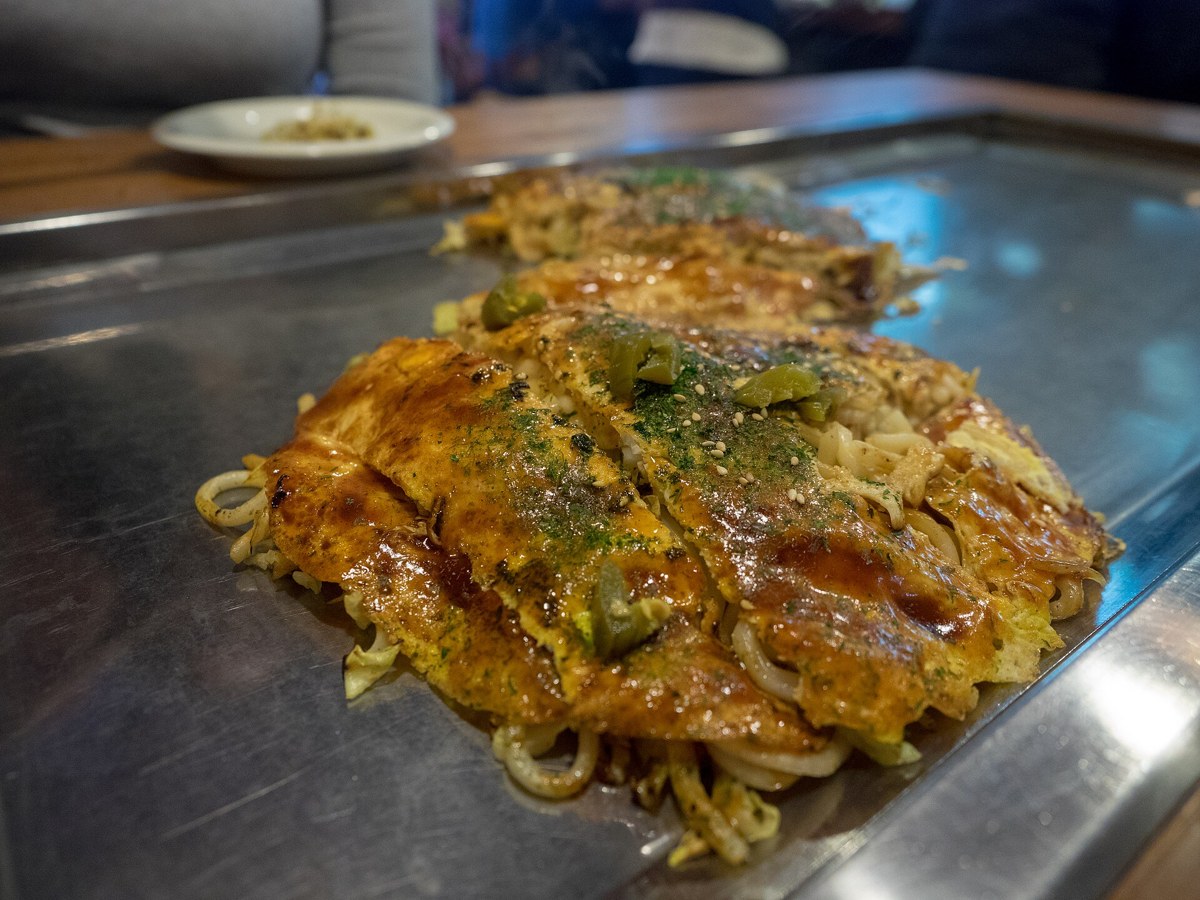
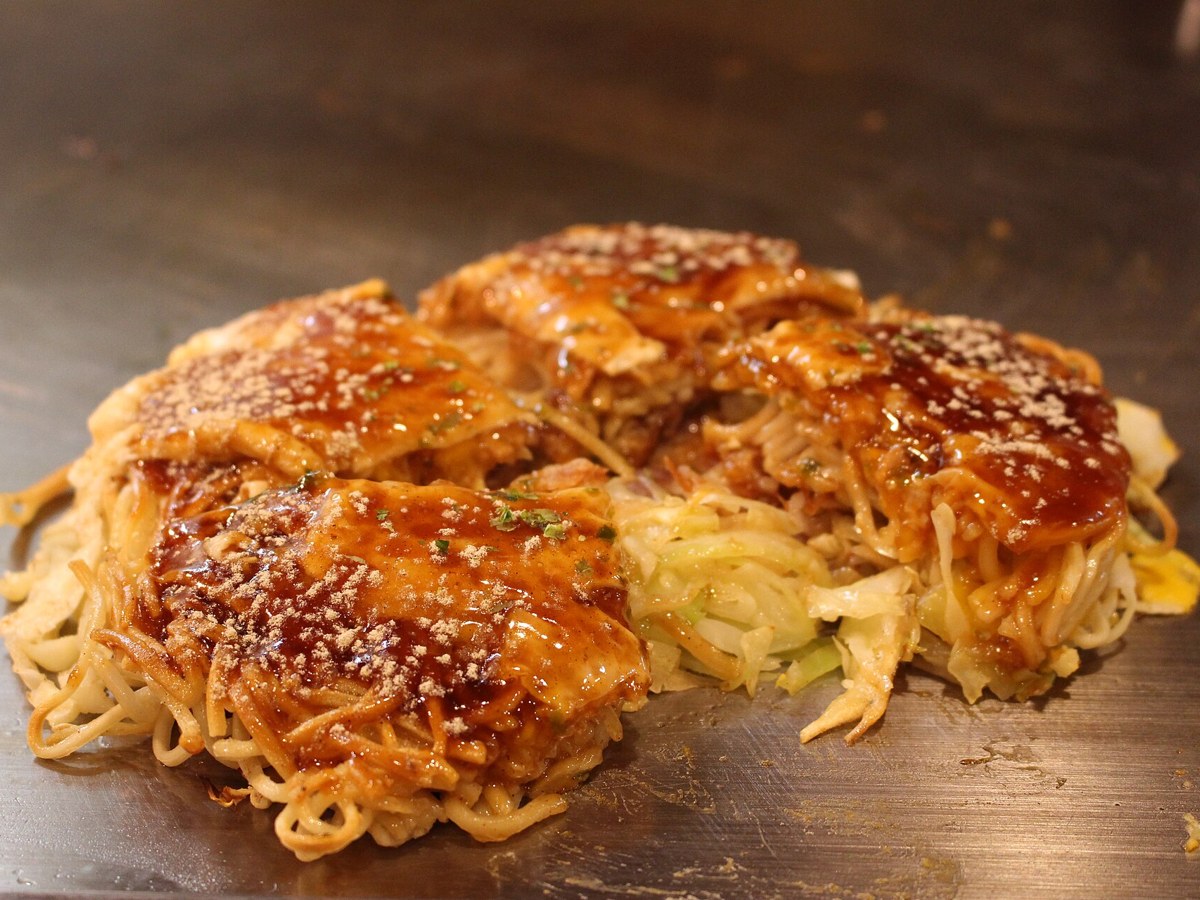
From a penny snack to a city's rebuild
The ancestry is a children's treat: before the war, issen yoshoku — 'one-coin Western food' — was a thin batter pancake with green onion and a smear of sauce, sold cheaply at sweet shops. After 1945, in a destroyed city under severe food shortage, Hiroshima's stall-keepers rebuilt the snack out of what there was: flour from American aid, cabbage because it was cheap and plentiful, bean sprouts, then pork — bulking the crepe layer by layer into a meal. Noodles became standard as the city recovered, and by the early 1950s shops like Mitchan in Hatchobori — which claims to have invented the layered style in 1950 — were stacking pork, cabbage and yakisoba in distinct strata and calling it oko.
The result, on the checked guide's figures, is a density no other regional dish on earth matches: roughly 2,000 okonomiyaki restaurants in Hiroshima, about 1.7 shops per 1,000 residents — the highest concentration of any regional dish in any Japanese city. Its cathedral is Okonomimura, the 'Okonomi Village' near Hondori, where about 24 family-run stalls have stacked under one roof since 1965, each with its own sauce and style, most pancakes running ¥900-1,500. A dish invented to survive scarcity became the city's favourite way to feed itself well.
What the stack costs
The checked guide's price line is a working meal's: the finished stack costs ¥900-1,500 at counter shops, and Okonomimura's stalls run the same band. The second guide reads a basic pork, egg and noodle pancake at roughly ¥900-1,300, with the toppings economy on top of it — cheese, shrimp, squid at a few hundred yen each, winter oysters from Hiroshima Bay as the seasonal premium. For 700 to 900 grams cooked in front of you on the iron, it remains one of Japan's great-value lunches.
Hiroshima's standing stories are a maple-leaf cake from Miyajima's island, the brushes of Kumano and a lemon cake from Setoda. Hiroshima okonomiyaki is the prefecture's fourth — its first griddle dish and its first city-centre one — and it sits in this collection opposite the other great pancake logic: Akashi's soft egg dumplings over in Hyogo, dipped rather than stacked. Between the two, western Japan's whole philosophy of batter is on the table.
Eating it like the counter taught you
Sit at the counter, not a table — the checked guide is firm that the teppan is the point — and order the default first: nikutama soba, pork, egg, noodles, soba over udon unless you prefer the thicker chew. Do not stir or chop the pancake up to share it into mush; cut a portion cleanly with the hera and eat from the spatula or a small plate, layer by layer, so the cabbage, noodle and egg strata arrive in the order the chef stacked them. Mayonnaise is optional and classic; extra cabbage can be asked for politely; and winter is the connoisseur's season, when Hiroshima Bay oysters go into the stack.
Then do what the city does: compare. Okonomimura alone holds two dozen stalls in one building, each guarding its own sauce blend and cabbage hand, and the neighbourhood counters beyond it number in the thousands. Hiroshima okonomiyaki was never one recipe — it is one construction, rebuilt nightly on two thousand griddles, in the city that invented rebuilding.
Sources — checked 11 November 2026
- Hiroshima Okonomiyaki Guide: Best Restaurants, How to Order & Where to Try (checked 2026 guide)
- Hiroshima Okonomiyaki: Where to Eat and How to Order (checked guide)
Original prose and official links only; no source text or maker media reproduced. Photos are credited Creative Commons works, not product photographs.
Editorial review 2026-11-11