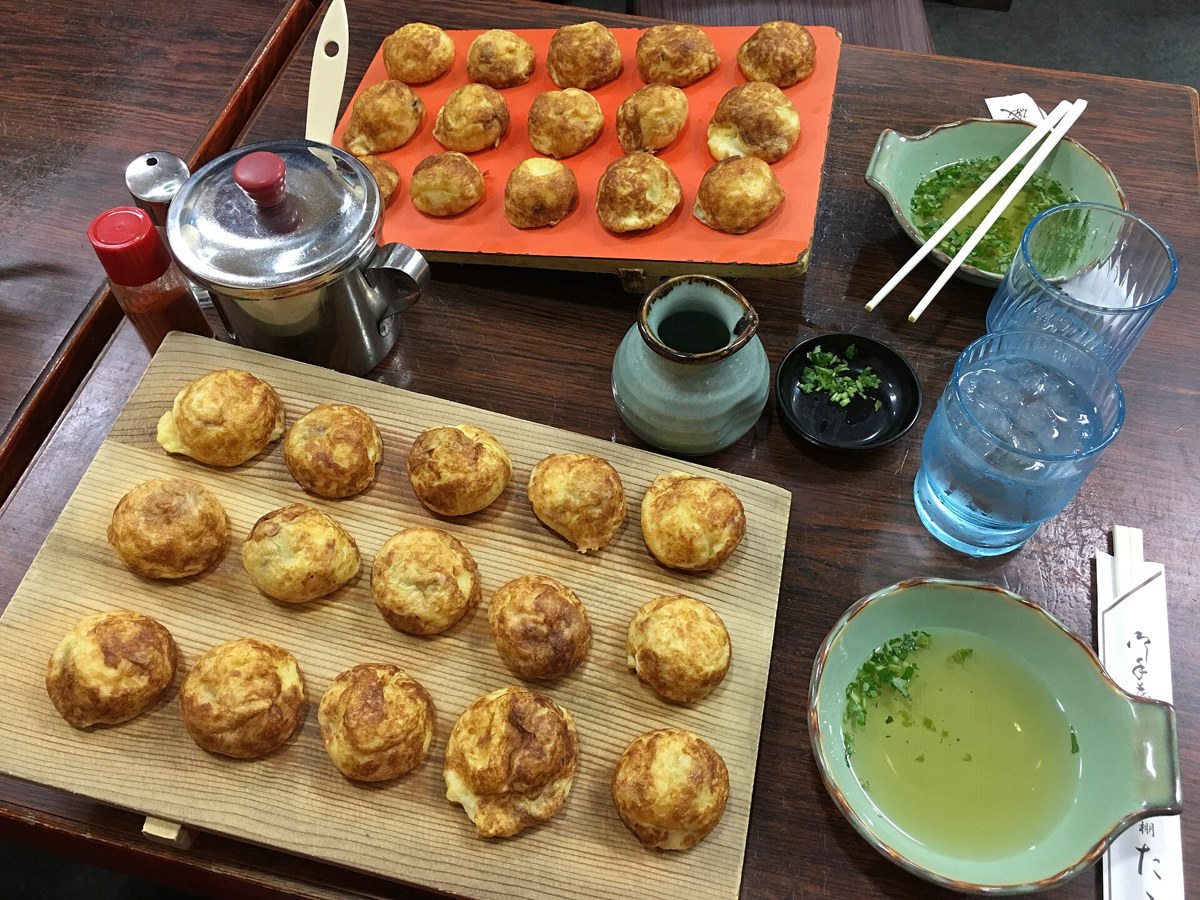
In Akashi, nobody orders akashiyaki. They order tamagoyaki — grilled egg — and what arrives is a wooden board of golden spheres, each one trembling, each holding a single piece of the port's octopus, with a bowl of clear dashi beside them for dipping. It is the dish takoyaki descends from, and it is better mannered than its famous child: no sauce, no mayonnaise, no flakes — just egg, octopus and broth.
An ornament's leftovers, a port's octopus
The standard account — stated by the sources as a theory, and kept as one here — begins with a craft. In the late Edo period Akashi made Akashitama, imitation coral ornaments, and the process used egg whites as adhesive, leaving yolks in surplus. Yolks met flour, dashi and the harbour's octopus, and a soft round dumpling was born. The food-culture atlas dates the birth to about 1889–1890 on a fisheries scholar's 1965 estimate, and stall sales spread the dish through the Taisho period; some of today's shops began as those stalls.
The name came last and came from outside. Inside Akashi the dish was tamagoyaki for a century and still is; 'akashiyaki' spread only later — one recorded theory credits an Osaka food company's 1973 product name, another a city official's coinage around 1988 for promotion. The renaming worked: the country now knows the city by its dumpling, while the city goes on ordering it by its home name.
Egg, starch, copper, dashi
The batter is the whole distinction. Where takoyaki is a wheat-flour ball, akashiyaki is built on eggs, lightened with jin-ko — the starch washed from wheat flour — so the set dumpling is closer to a savoury custard than a cake, cooked gently in copper moulds whose even heat sets the outside without hardening it. Inside goes exactly one thing: a piece of boiled octopus, tender, often Akashi-caught from the Seto Inland Sea outside the door.
Service is a small ceremony. Ten to fifteen dumplings — twenty at the old houses — arrive on a flat wooden board, a bowl of warm dashi alongside, green onion on the table for the broth. You lift a sphere that threatens to fall apart, dip it, and eat it in one mouthful while the two dashi layers — the batter's and the bowl's — merge. Shops guard their ratios fiercely; about seventy of them cook within the city, most within a walk of Akashi Station and the Uonotana fish-market arcade.
What a board costs
This is lunch-priced food and proud of it. The checked guide's current shop readings around Uonotana run from ¥600 at Funamachi and ¥650 at Izumo to ¥700 at Takoiso and ¥850 at Honke Kimuraya; the verified GOOD LUCK TRIP listing for Izumiya, founded in 1951, prices its tamagoyaki at ¥600 for a twenty-piece serving — one panful, eaten by one person, in the local manner. Budget a board, not a banquet: a full serving and a drink rarely pass a thousand yen.
Eat the first piece plain, the second dipped, and decide your ratio from there — regulars season the broth with the table's powdered bonito and green laver as they go. Hyogo's standing stories in this collection are Kobe beef, Nada sake and a stationer's ink atlas, all celebrations; akashiyaki is the prefecture's weekday — the board the port city eats standing between the station and the sea.
The elder, unbothered
The family history deserves its sentence. In the 1930s a customer at an Osaka rajioyaki stall told the vendor that Akashi put octopus in its round dumplings; the vendor swapped his filling, and takoyaki — the world-famous child — was born. Akashi kept the parent: softer, plainer, dipped not dressed, and largely content to be sought out rather than franchised.
So go and seek it. Stand in the Uonotana arcade with the octopus boats unloading a street away, order tamagoyaki by its home name, and eat a board that costs less than the train fare that brought you. Some regional dishes are monuments. This one is a habit — seventy shops deep, a century old, and still too soft to travel. That softness is the certificate.
Sources — checked 10 November 2026
- Akashiyaki guide: Akashi's fluffy octopus dumplings served with dashi (checked specialist guide)
- Food-culture atlas: Akashiyaki
- GOOD LUCK TRIP: Akashi-yaki at Izumiya, Akashi City (verified listing)
Original prose and official links only; no source text or maker media reproduced. Photos are credited Creative Commons works, not product photographs.
Editorial review 2026-11-10