Mito stamina ramen is Ibaraki’s soul-food noodle: a soy ramen — or, in its colder and more famous form, a bed of chilled thick noodles — drowned under a glossy, sweet-hot ankake of cabbage, carrot, pumpkin and seasoned liver. It was devised around 1970 in Katsuta, today’s Hitachinaka, so that students could eat something cheap and nourishing, and it is now served by more than forty shops across the prefecture, each guarding its own version of the sauce.
A sauce, not a soup
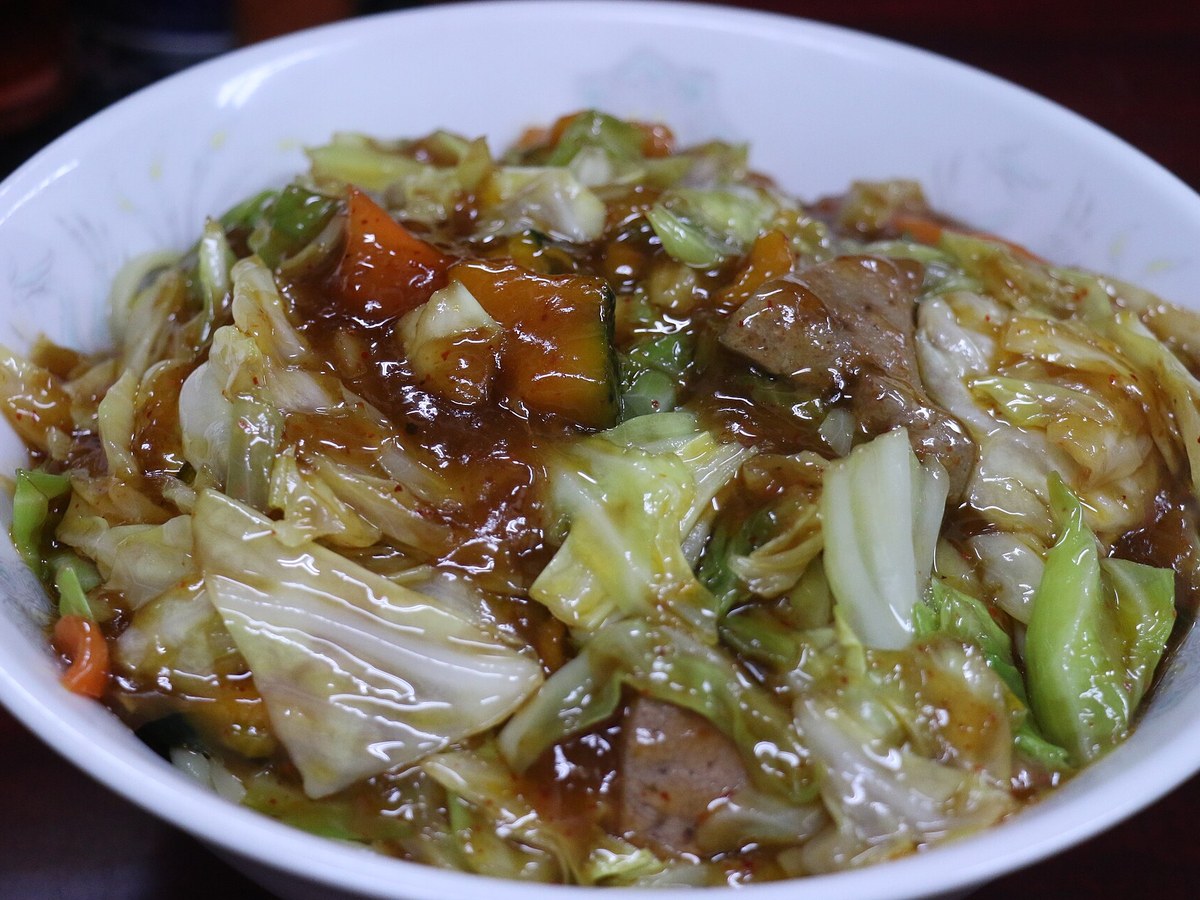
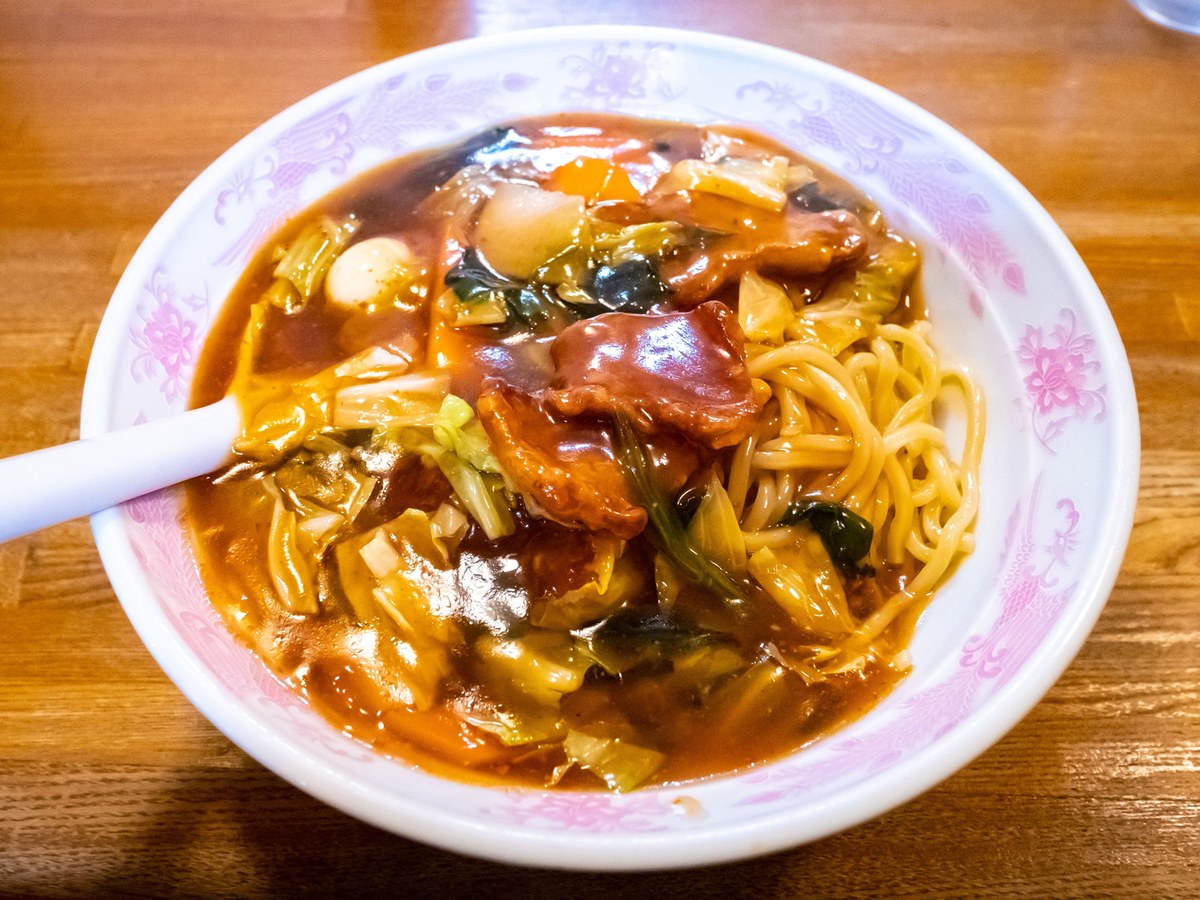
The defining act of a stamina ramen is a pour, not a ladle. The cook builds an ankake — cabbage, carrot and pumpkin with seasoned liver, though some shops use horumon offal, hakusai cabbage or nira chives — sweet and hot at once, and lays it over the noodles whole. In the hot form it lands on a bowl of soy ramen, exactly as the first photograph shows it at Shokiyoshi in Mito: the vegetables still bright under their glaze, the bowl filled to the brim. In the hiyashi form the same sauce goes over noodles that have been rinsed cold, with no soup at all — the second photograph, the niku stamina hiyashi at Ramen Gendai in Katsuta, shows the red-brown ankake sitting directly on the pale noodles.
The style is generous by rule as much as by recipe. Shops will enlarge the bowl as far as you ask, for a surcharge, and many keep a wall of names for customers who finish four full portions or more — at some houses the giant bowl is treated outright as a challenge menu.
Devised for students in Katsuta
The record dates the dish to about 1970, at the ramen shop Daishin in front of Katsuta Station. The owner proposed an ankake ramen; his manager, Nagai Jun’ichi, built it. Liver was then a part of the offal that was often thrown away, and Ibaraki’s vegetables were cheap and close — the founding idea, on the record, was to feed students something inexpensive and full of nourishment. The bowl that resulted was filling, vegetable-heavy and priced for a schoolboy’s pocket.
When the same owner opened Torasan Ramen, also in front of Katsuta Station, Nagai ran it and the dish became a hit. He later moved to Mito and opened Stamina Ramen Matsugoro, which styles itself the souhonke — the head house — of the style; much of the prefecture’s provision descends from its noren-wake lineage, though the record is careful to note that not a few cooks arrived at the dish independently.
Three currents and a yellow offshoot
The prefecture’s own record speaks of three great currents within the style and of evolved forms beyond them: the ankake mixture, the noodle and the soup all vary by house, and the forty-plus shops serving stamina ramen around Hitachinaka and Mito are not copies of one another. Ramen Gendai in Katsuta — founded in 1978, three minutes from Katsuta Station — works the spicy end of the family: its ankake carries doubanjiang heat cut with ginger, poured over thick noodles, and the shop is profiled in the national press as a keeper of the soul food, now in the hands of the next generation.
In 2016 the Hitachinaka chamber of commerce added a deliberate offshoot: Kofuku no Kiiroi Stamina, a curry-flavoured stamina ramen pitched as a new local noodle. The original, meanwhile, had already been certified by the prefecture itself: in November 2017 Calbee sold a regional-limited potato chip in a “stamina ramen” flavour — the surest sign that Ibaraki reads the bowl as its own.
Hot or hiyashi — how to order
Choose the form first. The hot bowl is a soy ramen under the ankake; the hiyashi is the sauce over cold, firm noodles — chewier, more direct, and the form Katsuta’s regulars argue for. At Ramen Gendai the stamina hiyashi-men is ¥900 on the shop’s own posted menu, quoted in a station-area listing updated 13 November 2026; the meat version in the second photograph is the same bowl with pork in place of, or alongside, the standard topping. Portions climb steeply for a surcharge if you ask — the four-portion wall of names is waiting.
The prefecture’s tourism office presents stamina ramen as Ibaraki’s representative local ramen, and Hitachinaka City calls it, on its own site, the citizens’ soul food, with a consented list of serving shops. Start in front of Katsuta Station, where Daishin, Torasan and Gendai all stand within the dish’s first few streets.
Sources — checked 14 November 2026
- Stamina ramen (Ibaraki) — encyclopedia record (the ankake, the two forms, the Katsuta origin)
- Katsuta station-area ramen listing (updated 13 November 2026) — Ramen Gendai and its posted menu
Checked 14 November 2026 (stored links re-fetched and judged per product): reserved where the page says so, with an editorial review note kept per product. Press, PR and travel use stays outside the grant.
Editorial review 2026-11-14