The anglerfish is the fish with nothing to throw away. Ibaraki's winter pot, anko nabe, uses its seven edible parts — the pale meat, the collagen-rich skin, the gills, and above all the liver, ankimo, which melts into the miso and becomes the soup's body. Along the prefecture's Pacific towns — Mito, Oarai, Kitaibaraki — the pot runs from November to March, and in its oldest fishermen's form, dobujiru, it is cooked with no added water at all: the liver is stir-fried in the pot and the miso dissolves in the liquid the fish and vegetables give up. It is winter's richest bowl, priced per person and booked ahead.
Seven parts, one pot
The Food in Japan record, updated 9 November 2026, gives the fish its Japanese nickname — the seven-parts fish — because the anglerfish goes into the pot entire: meat, skin, internal organs, gills and bones, its flavour condensed rather than trimmed away. The saying the record quotes prices the fish: 'fugu in the west, anko in the east' — the east's answer to the blowfish, a high-class fish whose liver is compared, in the same record, to foie gras.
Even the butchery is the coast's own. The fish's surface is slimy and its body too soft to hold on a board, so since the Edo period it has been cut by the hanging method — hooked by the lower jaw, steadied with water or ice and taken apart in the air, rotating as the knife works. The record adds that the method is still performed in front of the Oarai Hotel and some restaurants today, and the GOOD LUCK TRIP record for Kitaibaraki's Shokusai Daishin lists a paid filleting show, booked ahead, among the house's offerings.
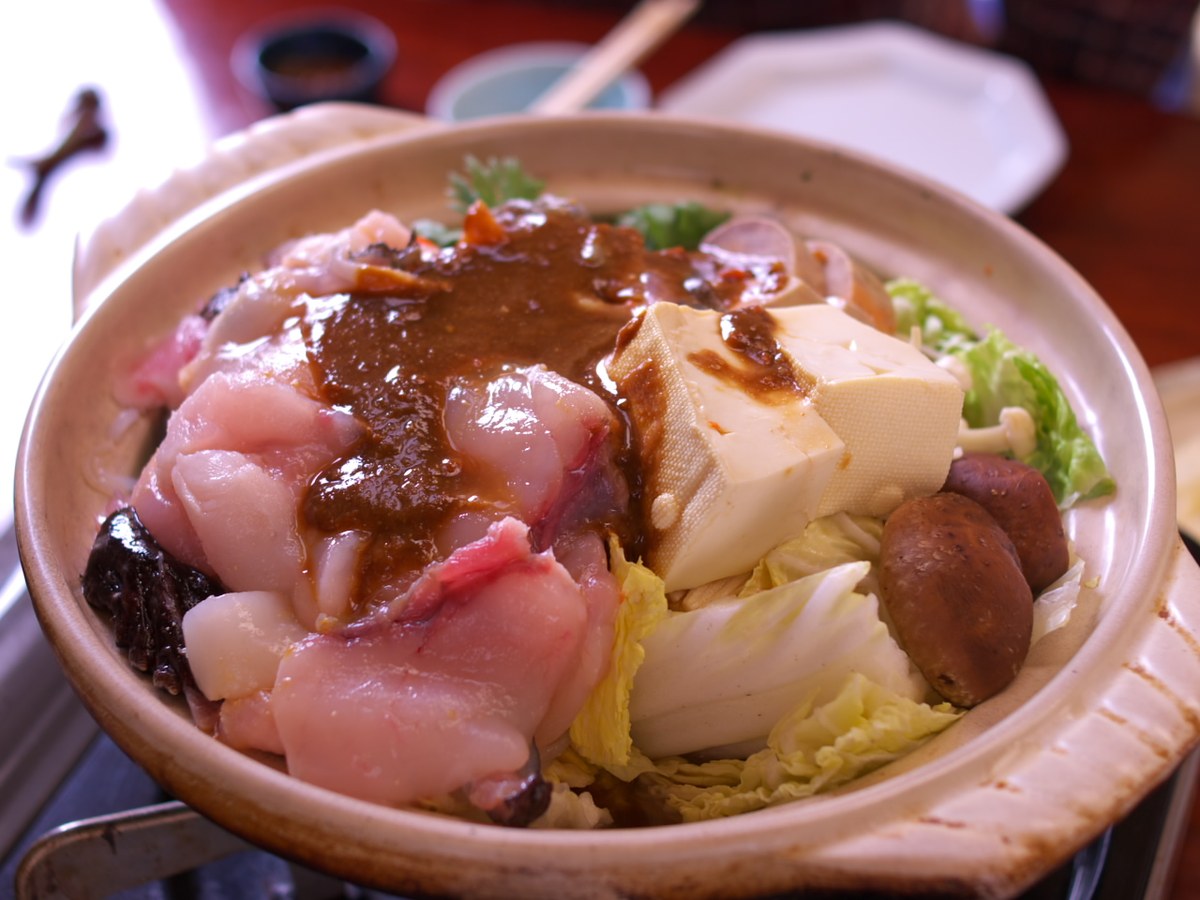
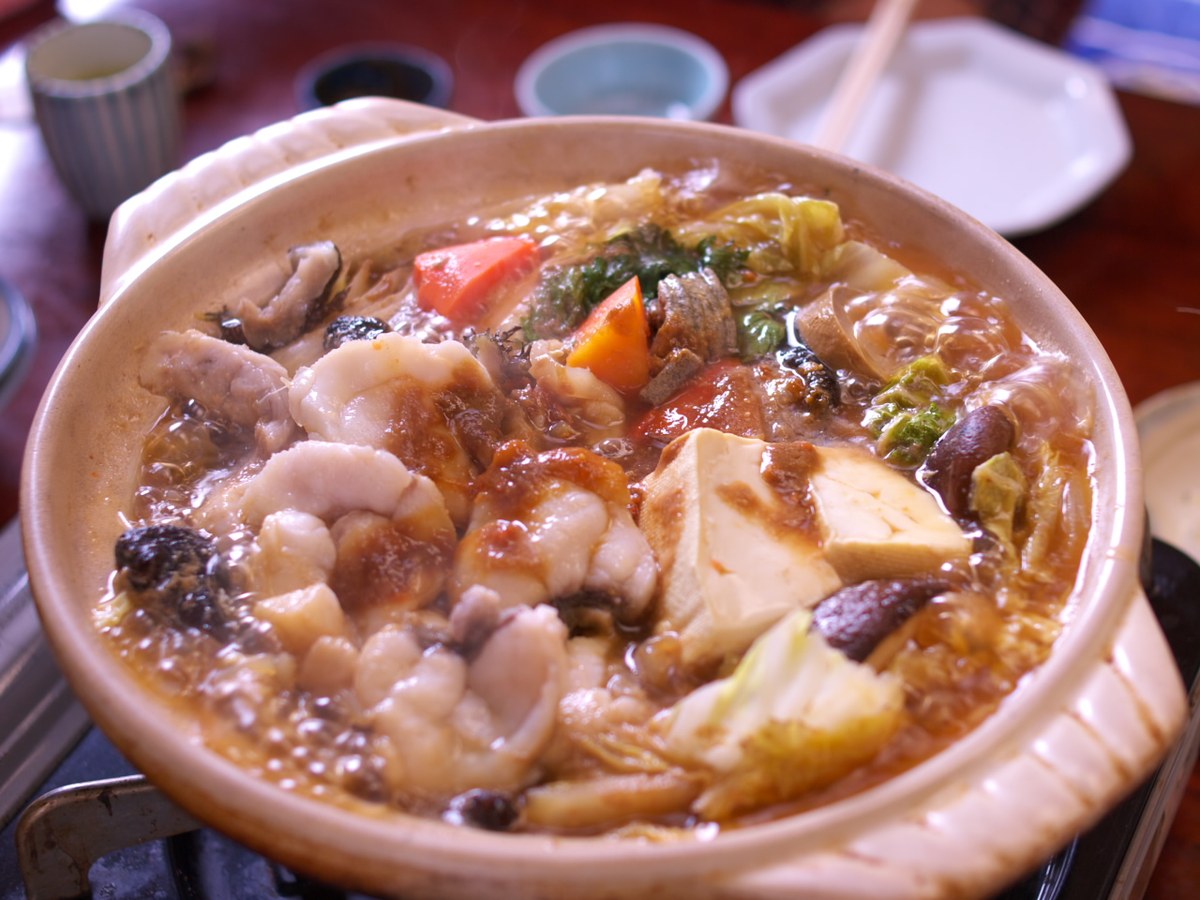
Four seasonings, and the one with no water
The record sorts the coast's pots into four seasonings: miso, the guest-house standard; soy sauce, the elegant style the luxury houses prefer, with a dumpling of liver and miso added as you like; dobu soup, named for the melted liver clouding the broth, served at Oarai, Hitachi and Kitaibaraki; and the fishermen's soup, the hardest form — a pot made with only the water of the anglerfish and vegetables, no added water at all, which the record warns takes time, skill and familiarity, so few restaurants offer it.
The KONOMACHI record states the dobujiru method from the menus' side: the monkfish liver is stir-fried in the pot without water, and miso is added to the liquid released by the vegetables and fish — with the practical note that Sansui in Mito adds stock to make its version easier to eat. At Daishin, the GOOD LUCK TRIP record adds, you watch it happen: the owner adds the liver to the pot and stir-fries it in front of the guests, sourcing his fish from Otsu Port and Nakoso Port himself.
Oarai unified the taste; Mito keeps the old houses
The dish's quality control is a story the Food in Japan record tells about Oarai: when the town's Anglerfish Festival began, the anko juice offered at the inns varied from kitchen to kitchen, so the festival's committee gathered the cooks of Oarai's inns and held a cooking study session to unify the taste — roasted liver in the pot, miso to season — and that shared base, the record says, is the origin of the deliciousness at Oarai's inns and restaurants today.
Mito, the prefectural capital, keeps the senior houses. Kappo Uomasa was founded in 1903 and serves a liver-miso pot from November to March; Yamaguchiro's soy-sauce style is described on the KONOMACHI record as the oldest in Mito, with a liver-based fishermen's style beside it; and Sudaan in Oarai has served since 1926. The season is the discipline: the liver grows fat from December to the end of February, on the Food in Japan record, and outside the winter months most houses simply close the pot down.
Eating it in Ibaraki
The KONOMACHI record, checked 1 November 2026 against the official menus, tax included, gives the working range: a single anko-nabe runs ¥1,990 to ¥4,300 per person — Mondokoro in Mito at ¥1,990, Osakana Tengoku in Oarai at ¥3,520 (mini pot ¥2,640), Shokusai Daishin's Kitaibaraki pot at ¥3,980, Sudaan at ¥4,200, Kappo Uomasa's liver-miso pot at ¥4,180 — with courses and sets from ¥4,000 and ryotei lunch sets at ¥12,650. Dobujiru, for those who want the fishermen's form, is ¥6,050 a person at Uomasa, ¥6,600 at Sansui from two people, and ¥6,980 at Daishin.
Book it and time it. Several houses take the pot only by reservation (Sudaan in advance, Sakanaya Honten entirely), most pots are ordered from two people, and the calendar rules everything: roughly November to March, mid-October to late April at Oarai Yamaguchiro, October to March at Osakana Tengoku. Go in January or February, order the dobujiru if the house offers it, and finish — as Sansui's menu suggests — with the zosui or udon set in the liver-rich broth.
Sources — checked 13 November 2026
- KONOMACHI-note — Anko-nabe (Monkfish Hot Pot) in Ibaraki 2026: 10 Places in Mito, Oarai and Kitaibaraki (checked with official pages 1 November 2026)
- Food in Japan — Ankou Nabe (updated 9 November 2026)
- GOOD LUCK TRIP — Shokusai Daishin, Kitaibaraki (directory record, checked 13 November 2026)
Original prose and official links only; no source text or maker media reproduced. Photos are credited Creative Commons works, not product photographs.
Editorial review 2026-11-13