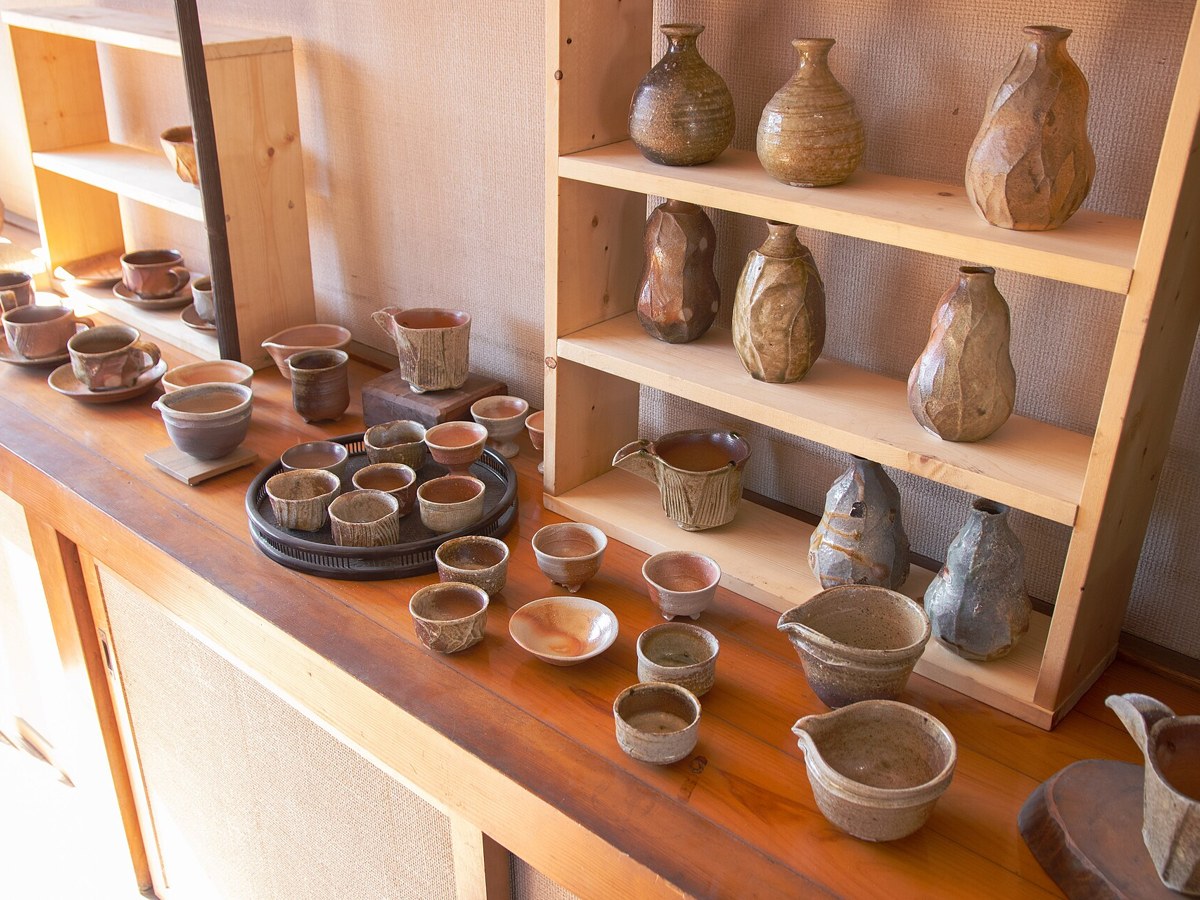
Ask what Kasama ware looks like and the honest answer is: whatever the potter decided that morning. This is the stoneware of Kasama, a small inland city in Ibaraki, where the clay is iron-rich and fires brown, the glazes are poured rather than painted, and the production area's proudest boast — in the national craft account's own words — is that it encourages individuality unconstrained by tradition. It has been doing so since 1772.
Brown clay, poured glaze
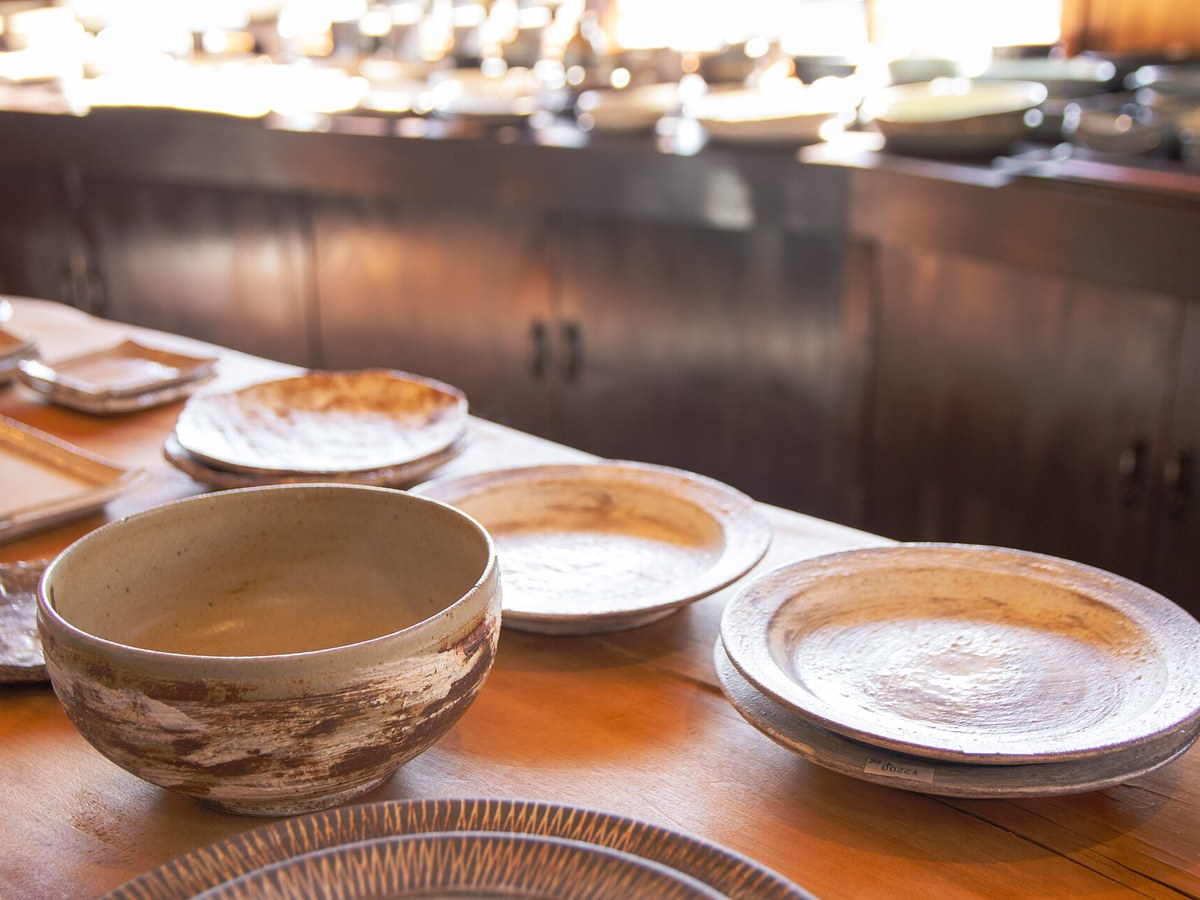
The KOGEI JAPAN craft account fixes the material first. Kasama ware's strong finish is produced with a fine-grained clay called gairome; its high iron content turns the body brown after firing, which is why the characteristic decorations are techniques that work over a dark body — dripping and overlaying glazes, in black and white mattes and beyond. The strength and stain resistance made it kitchenware from the start: water jugs, tea canisters and the daily vessels of a farming region, fired in a process the account walks through step by step — a bisque at about 800 degrees for ten to fifteen hours, then a glost firing at 1,250 to 1,300 degrees for about twenty.
Today the same clay leaves the same kilns as flower vases, household ornaments and art pieces, and the account is explicit about why the range keeps widening: in addition to its diversity of decoration techniques, the production area is very open-minded, encouraging artisans to develop their individuality on Kasama ware without being constrained by tradition and formalities. The checked buying guide sharpens it into the ware's paradox: Kasama-yaki's defining feature is the absence of a single defining feature — no fixed clay body, no signature shape, no obligatory glaze — so a handmade Kasama mug is less a type than a one-off, an individual potter's interpretation in amber ame-yu glaze or white kohiki slip.
1772: a Shigaraki potter walks to Hakoda
The cooperative's official history dates the founding precisely: in 1772, Kuno Hanuemon Michinobu, headman of Hakoda village, began pottery making under the guidance of Choemon, a potter from Shigaraki — the birth of what was then Hakoda-yaki, under the protection of the Kasama domain, whose lord from 1789 promoted pottery as domain policy. In 1861 the domain designated six kilns as its Shiho Kiln, the heritage kilns charged with passing the craft on; the founding Kuno kiln is among them and still works today.
The name itself is Meiji-era commerce. Around 1867 the wholesaler-potter Tomosaburo Tanaka took over one of the heritage kilns and sold the wares of Hakoda and Shishido together as 'Kasamayaki' in Yokohama, spreading the name nationwide; his teapot took first prize at the Domestic Industrial Exposition of 1877. The modern dates complete the arc on the cooperative's record: designation as a government traditional craft in 1992, the joint Kasama-Mashiko 'Kasamashiko' story designated Japan Heritage in 2020, and the ware's 250th anniversary in 2022.
What the freedom costs
The practical anchor is a mug, because the mug is what Kasama's freedom is for. The checked buying guide reproduces a single-kiln handmade Kasama-yaki coffee mug — a Wired Beans 240 ml piece in a black matte finish — listed at ¥5,940, and frames the whole buying question around it: one potter, one small kiln, visible maker's marks, no two pieces alike, and no guaranteed restock when a kiln's run sells out. The craft account's range runs the same way, from affordable daily necessities to new works of art.
Ibaraki's standing stories are a dried sweet potato, Mito's natto and the silk of Yuki. Kasama ware is the prefecture's first pottery — and its first story about making rather than eating. Set it beside its neighbours in this collection and the Kanto kiln map completes: Mashiko ware just over the Tochigi border, taught — the cooperative's history notes — by a potter who learned at Kasama's own Kuno kiln before founding Mashiko in 1853; Shigaraki, the parent tradition, far to the west. Kasama is the source the other two flowed from.
Buying a one-off honestly
Buy Kasama the way the buying guide advises: by the individual piece, not the type name. Expect handmade variation in size, weight and tone as the ware's nature rather than a defect; if you want a matching pair, buy them together, because a single kiln may never reproduce the exact piece; and confirm the live price on the listing, since single-kiln work is priced piece by piece. What you are paying for is precisely the thing mass production cannot offer — a named town's clay, fired in one small kiln, in a form one potter chose.
In Kasama itself, the craft account's facility points the way: Kasama Kogei no Oka, the craft hill above the town, and the Ibaraki Ceramic Art Museum — on the cooperative's record, the first ceramics-specialised art museum in eastern Japan, opened in 2000. Two hundred and fifty years after a Shigaraki potter walked into Hakoda village, the town is still doing what it has always done: handing potters good clay and getting out of their way.
Sources — checked 11 November 2026
- KOGEI JAPAN: Kasama Ware (Kasama Yaki) — description, history and production process (checked craft account)
- Kasamayaki Cooperative: History of Kasamayaki (checked official cooperative history)
- Japan Mono: Kasama-yaki Mug — Handmade Ibaraki Pottery Coffee Cup Guide (checked buying guide)
Original prose and official links only; no source text or maker media reproduced. Photos are credited Creative Commons works, not product photographs.
Editorial review 2026-11-11