In Nagoya the udon arrives still boiling, in the clay pot it was cooked in, and the noodles are — there is no kinder word — hard. That hardness is the signature, not a mistake: miso nikomi udon is made from noodles kneaded with flour and water only, no salt, so they can be simmered raw in a Hatcho-miso broth without dissolving, and they reach the bowl with a core that softer noodles never keep. You eat it with the pot lid as your plate, blowing on every mouthful, in the city that made a stew of its own miso.
The pot, the miso, the five-minute simmer
The agriculture ministry’s Aichi record sets the dish out for two, and every choice in it is load-bearing. A donabe — the record recommends a one-person pot — takes dashi to the boil; the miso seasoning goes in with chicken thigh cut small, aburaage blanched and cut in strips; then the udon is added and simmered for about five minutes in the broth itself, never pre-boiled in water. Kamaboko in half-moons and diagonal-cut negi go on top, an egg is cracked in, the lid goes on for one final boil, and the pot comes to the table as the serving dish.
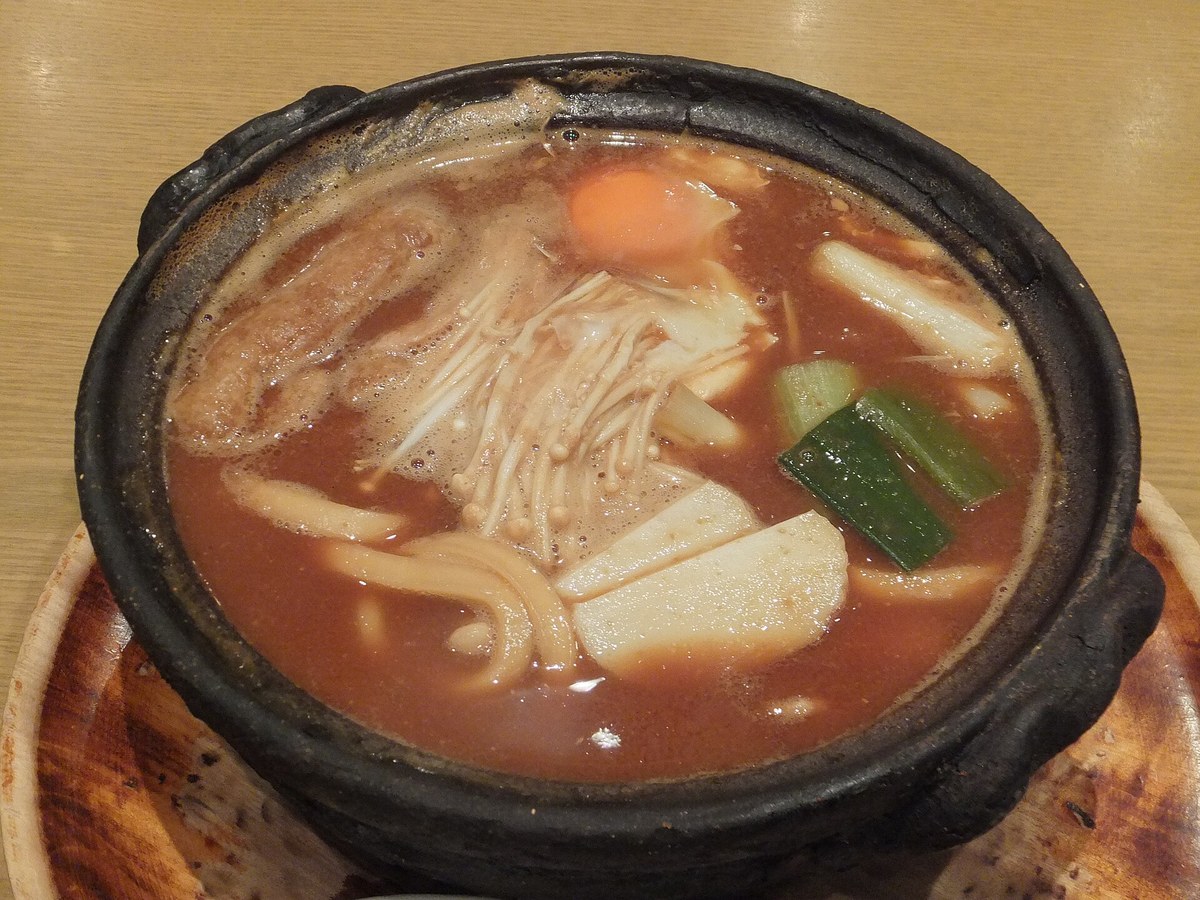
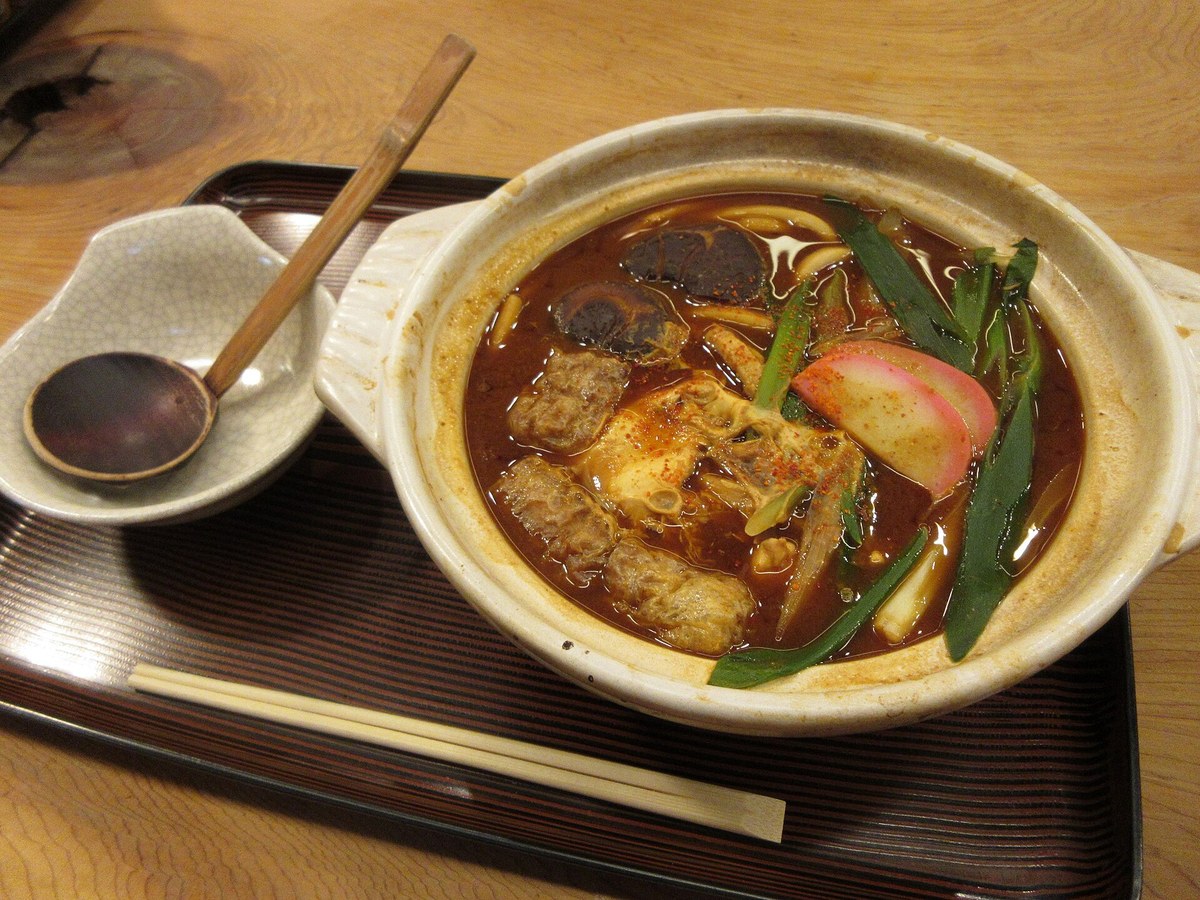
Home cooks, the record concedes, usually start from bought boiled udon, and mushrooms are a welcome addition. But the restaurant form — the one in both of this story’s photographs, black pot and white — keeps the full discipline: raw salt-free noodles, miso broth, clay pot, egg, and a lid with no steam hole, because the lid is your saucer for cooling each scalding mouthful.
From farmhouse pot to Nagoya’s bowl
Miso nikomi began, on the ministry record, as a home dish — the farmhouse way of stretching Aichi’s beloved bean miso into a meal. By the Meiji era it was being served at restaurants in Ichinomiya, and it settled, flourished and became a civic emblem centred on Nagoya, standing beside kishimen as the prefecture’s representative noodle. The dish is eaten all year but belongs to winter: a pot that stays at a rolling boil from first mouthful to last is a heating system as much as a lunch.
Two restaurant houses carry the dish’s fame, and Nagoya insists you know they are rivals, not branches: Yamamotoya Sohonke and Yamamotoya Honten are entirely separate companies. Sohonke — the house in this story’s first photograph — blends Okazaki Hatcho miso with white miso over a katsuobushi dashi for a rounder pot; Honten’s is the punchier bowl. Regulars have a side, and the argument is part of the cuisine.
Hatcho miso and the salt-free noodle
The broth’s darkness is Hatcho miso, Aichi’s great soybean miso: beans and salt alone, no rice or barley koji, aged over two summers and two winters in cedar vats under river stones. It was born in Hatcho village — eight cho, about 870 metres, from Okazaki Castle, the Tokugawa Ieyasu seat — in what is now Okazaki’s Yacho-cho, and its dense, slightly astringent depth is the flavour Nagoya’s whole miso cuisine is built on: miso katsu, miso oden, and this pot above all.
The noodle is the broth’s engineering partner. Made from flour and water with no salt — the same family as Yamanashi’s hoto — it goes into the miso raw and simmers without shedding starch or going slack, which is why the centre stays firm. First-time visitors send it back as undercooked; the kitchen’s answer, in both great houses, is that it is cooked exactly as intended. By the second bowl, most converts stop arguing.
What a bowl costs in Nagoya
The standard bowl is a working lunch price even at the famous houses. A 2026 comparison of the two Yamamotoya lines, read this November, puts the ordinary nikomi at about 1,350 yen at Sohonke and the miso nikomi udon at about 1,480 yen at Honten; the oyako bowl, with Nagoya’s beloved chicken-and-egg topping, runs about 1,950 yen, and the full Nagoya Cochin version about 2,400 yen. Pickles, rice and the lid-as-plate ritual are included in the theatre at no extra charge.
For home cooks, both houses sell take-home sets of hand-made raw noodles with blended miso and dashi at station shops and by mail order, and Aichi’s own Sugakiya even fields an instant version. But the dish’s truth is thermal: it should still be moving when it reaches you. Eat the first bowl in Nagoya, in the pot, in winter, and the souvenir set becomes a souvenir of something real.
Sources — checked 13 November 2026
- MAFF, Our Regional Cuisines — Miso Nikomi Udon (Aichi)
- 2026 Nagoya comparison — the two Yamamotoya houses (prices and styles)
Checked 13 November 2026 (stored links re-fetched and judged per product): reserved where the page says so, with an editorial review note kept per product. Press, PR and travel use stays outside the grant.
Editorial review 2026-11-13