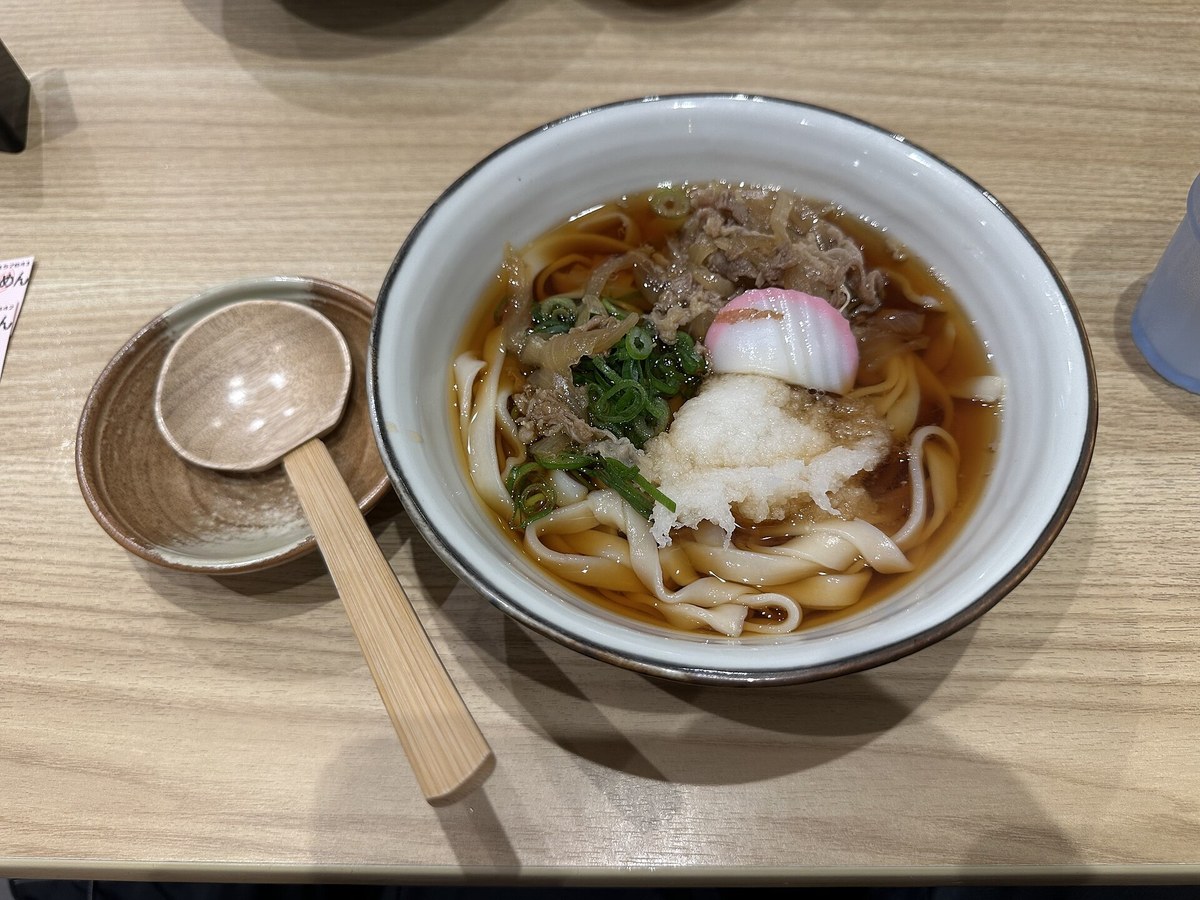
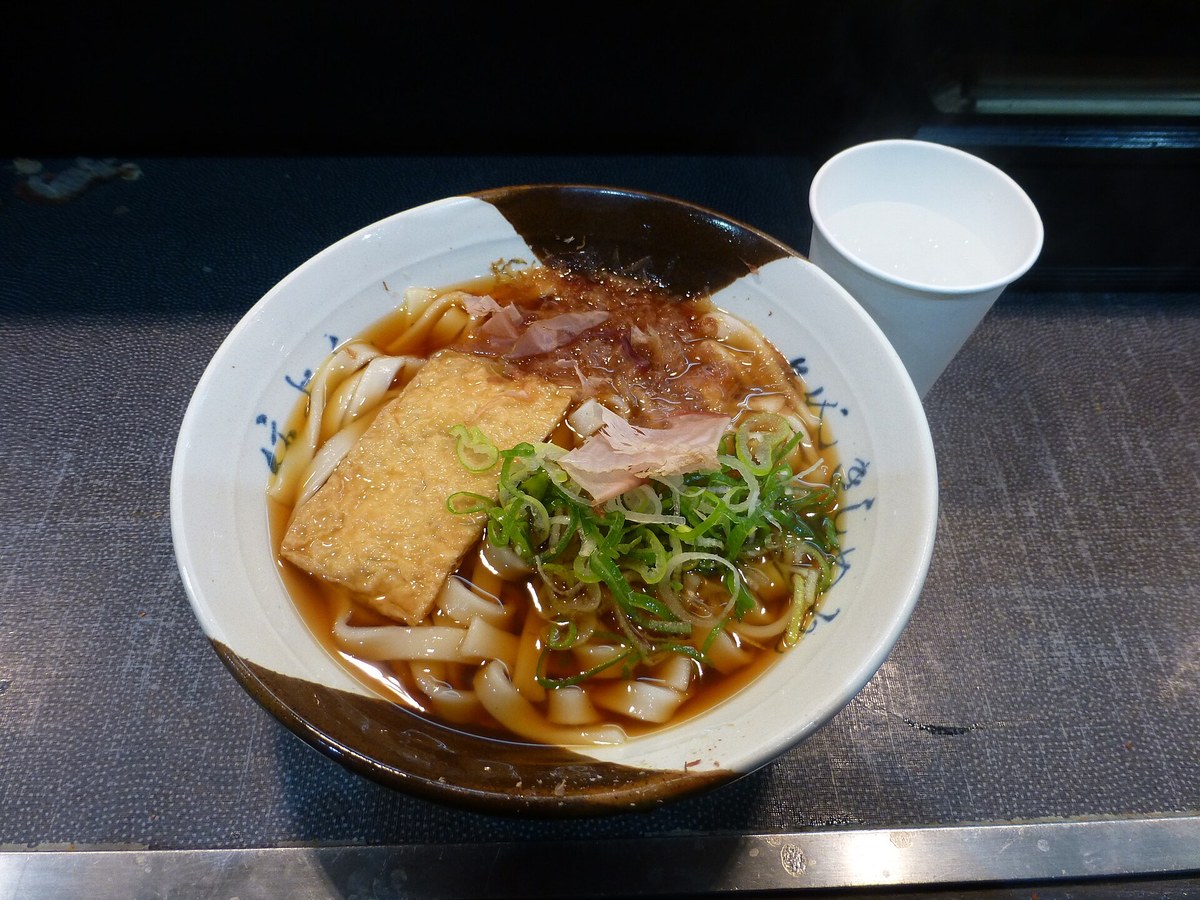
Every noodle city has a shape it refuses to give up. Nagoya's is a ribbon. Kishimen takes the ordinary udon three — wheat flour, salt, water — and rolls the dough flat: a band about a centimetre wide and under two millimetres thick, defined so precisely that the Japanese Agricultural Standard writes the numbers down. The ribbon boils in a minute or two, drinks more broth than a round noodle can, and arrives under bonito flakes and fried tofu in a tamari-soy dashi the colour of strong tea. Nagoya has eaten it since the Edo period, keeps a shrine-side house that has served it since 1923, and — most famously — eats it standing on the platforms of Nagoya Station, between the Shinkansen tracks, in the minutes a timetable allows.
A noodle with a written specification
Kishimen is the rare folk food with a spec sheet. The Nagoya Meshi official record states the JAS definition for the dried noodle — more than 4.5 mm wide, less than 2 mm thick — and the Food in Japan record gives the fresh noodle's working shape, typically about a centimetre wide. Same ingredients as udon, entirely different geometry: the flat ribbon cooks in one to two minutes where a round udon strand needs ten, and its broad faces pick up broth the way a sail picks up wind.
The broth is specified too: tamari soy sauce — the thick, dark soy of the Chubu region — over a stock of frigate mackerel or horse mackerel on the official record, with sodabushi and mackerel the classic base. Over it go the fixed toppings the records repeat like a rubric: bonito flakes, fried tofu, fish cake, greens. Order kishimen anywhere in Nagoya and this is the bowl that arrives; the definition is loose enough for every kitchen and tight enough that nobody argues about what it is.
Four theories for one name
The name is the dish's only unsettled part, and the records are honest about it. The Food in Japan and Nagoya Meshi accounts together carry four candidates: kijimen, pheasant noodles, from an old dish of the Owari domain; Kishu noodles, by way of the Kishu region; the chess-piece theory, from the ribbon's resemblance to a shogi piece laid flat; and imokawa, the flat noodle of Imokawa in present-day Kariya, whose name may have travelled the short road to Nagoya and changed on the way. The dish itself is placed in the Edo period by both records.
What is not theory is the map. The official record closes its account with the dish's territory: kishimen is found mainly in Nagoya and its surroundings. Aichi's noodle did not conquer Japan the way Sanuki udon did; it stayed home and became infrastructure — shrine food, station food, supermarket shelves — which is the pattern of a true regional edition.
The platform stall is the institution
The Food in Japan record names the dish's two cathedrals. Miya Kishimen's Jingu store has stood by Atsuta Shrine since Taisho 12 — 1923 — serving the worship-and-noodle pairing at 2-5-24 Sawakami in Atsuta Ward. And on Nagoya Station's Shinkansen platforms, between tracks 14 and 15, the Sumiyoshi stand-up stalls have served commuters since the 1960s on the Nagoya guide's account, with sister stalls on the conventional-line platforms: a bowl eaten standing, against the clock, as part of the journey itself.
The prices checked in October 2026 keep the stall honest: Sumiyoshi starts at ¥470 for the tororo bowl, with the kakiage-and-egg version around ¥550; the Nagoya guide's wider reading puts a standard kishimen at ¥600 to ¥1,000 across the city. Miya Kishimen's own menu, renewed 1 October 2026, prices the standard bowl at ¥900, and Kishimen Yoshida in the Esca underground mall matches it at ¥900. Kawaiya Honten, the third house the record names, is famous for the fluffy-egg version. This is not a luxury food and never prices itself as one.
Eating it in Nagoya
Eat the platform bowl first — Sumiyoshi, on the Shinkansen side between tracks 14 and 15, from ¥470 on the guide's October 2026 check — because the standing bowl against a departure board is the kishimen experience Nagoya itself would choose. Then eat the shrine bowl: Miya Kishimen by Atsuta Jingu, at ¥900 on its 1 October 2026 menu, where the dish sits in its century-old home. Kishimen Yoshida in Esca, also ¥900, is the underground-mall alternative when the weather argues.
To take it home, the Food in Japan record notes ready-to-cook kishimen sold in stores and supermarkets — the dried ribbon travels exactly as the JAS numbers promise. What does not travel is the stall: the timetable pressure, the steam, the standing counter. Budget ten minutes at Nagoya Station on your next transfer and you will understand the dish better than any description can teach it.
Sources — checked 13 November 2026
- LikeNagoya — Nagoya Kishimen: What It Is and Where to Eat It (updated 3 October 2026; prices checked October 2026)
- Food in Japan — Kishimen: Nagoya's flat noodles (updated 9 November 2026)
- Food in Japan — What to Eat in Nagoya (updated November 2026)
- Nagoya Meshi official site — Kishimen Noodles (checked 13 November 2026)
Original prose and official links only; no source text or maker media reproduced. Photos are credited Creative Commons works, not product photographs.
Editorial review 2026-11-13