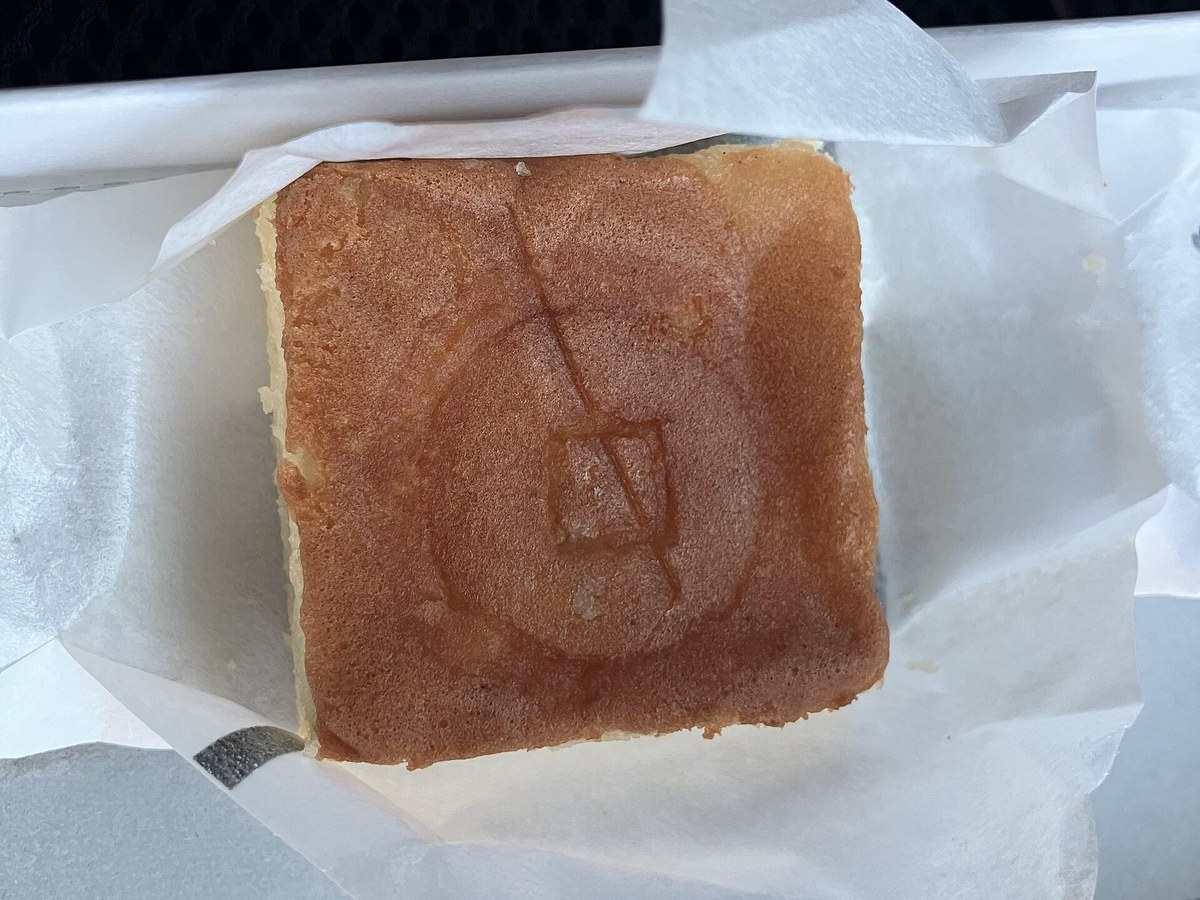
Kannonji is a manju branded with a coin: a square drawn inside a circle, burned into the top of a soft Western-style cake that wraps Hakueido’s special egg-yolk bean paste. The Kannonji City house has made it since 1960, sells it only at its own three shops in the city, and the locals treat it the way other towns treat a station name — as the standard souvenir, the one you simply bring.
A coin you can eat
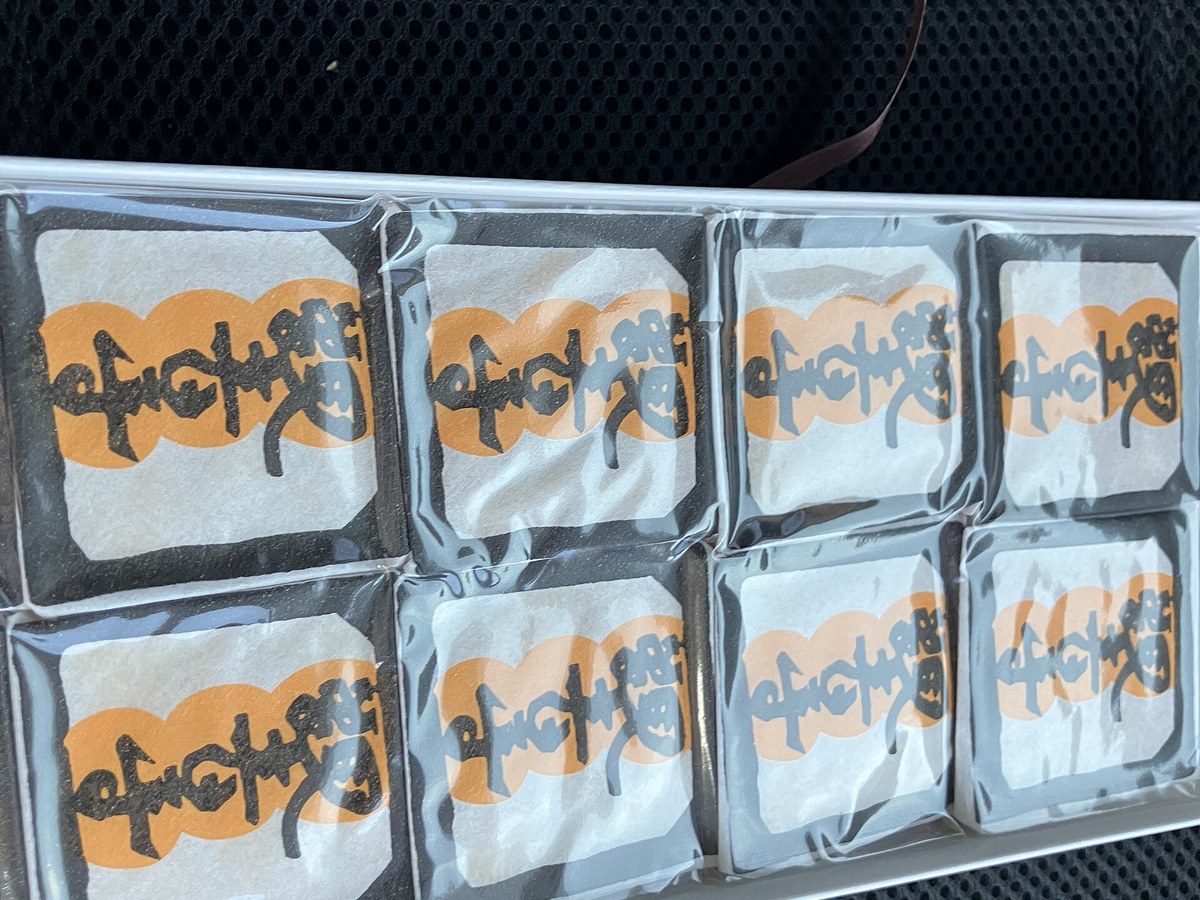
The cake is square, golden and plain to look at — until the top: burned into its surface is a circle with a square at its centre, the silhouette of the Kanei Tsuho, the Edo-period coin. The design copies the coin as the city itself draws it, in the Zenigata suna-e, the enormous sand picture of the coin spread on the beach at Kotohiki Park. The maker reads the mark as a motto: the circle stands for smoothness and harmony, the square for simple sturdiness. Our first photograph shows the brand plainly, on one cake unwrapped from its paper; the second shows the cakes as they are sold, each one sealed in its own wrapper in the tray, the wrappers carrying the product’s bold calligraphy.
Inside, the construction is the Wa-Yo setchu — Japanese and Western in one bite — that the record names as the sweet’s character: a Western-style dough, soft and faintly buttery in the eating, wrapped around kimi-an, a special bean paste made with egg yolk that gives the filling its richness and its pale gold colour. The city tourist association, which lists the cake as the maker’s most popular product, describes the taste the same way: the aroma melts in the mouth, and people travel in from outside the city to buy it.
1897: a Yanagimachi sweet shop; 1960: a signature
Hakueido began in 1897, in Yanagimachi in what is now Kannonji City, and it has dealt in both Japanese and Western confections for over a century. The Kannonji itself is younger: the product was born in 1960, a postwar signature for a much older house, and it grew into the taste the city is known by — the standard souvenir for locals, in the tourist association’s words, the sweet that needs no explaining at home.
The main store’s present building dates to 2005, when the Yanagimachi shopping street’s arcade was taken down and the road widened: Hakueido rebuilt on the site and filled the new shop with works by Wada Kunibo, the Kannonji-born commercial designer whose hand is on the packaging of half the famous sweets of this coast — the Kannonji wrappers in our second photograph, with their sweeping black calligraphy over orange, are that design language at work.
Three shops, one city
The sale is as local as the brand. Hakueido keeps three shops — the Yanagimachi main store, with its own cafe beside it; the Yoshioka store; and the Sakae store — and all three stand in Kannonji City. There is no branch in Takamatsu, no department-store counter in Osaka: the encyclopedia’s shop list and the maker’s own pages agree that the coin cake is bought where it is made, or not at all. That is the whole of its distribution, and it has held since 1960.
The name does double duty in the city. Kannonji the sweet is named for Kannonji the place — a market town since ancient times, named, the maker notes, for the Kannon image Kukai dedicated at Jingu-ji in 807 — and the coin it carries is the city’s own emblem, the same Kanei Tsuho the sand artists rake into the beach a short walk from the main store. A souvenir that carries the town’s name, the town’s coin and the town’s designer is not a product that travels; it is an address.
Buying the coin cake
Buy it loose, the way the city does: the measured price this run is ¥600 for five loose pieces, on the April 2026 record read this run, which points to the maker’s own site for the boxed sizes that run above it. At the Yanagimachi main store the purchase can be a visit in itself — the shop keeps a cafe, and the building is a small gallery of Wada Kunibo’s work.
Judge a Kannonji by its brand: the circle should be clean and the square centred, the dough unbroken and faintly glossy. Eat it the day you buy it if you can; the softness of the Western dough against the yolk-rich paste is the whole point, and it is at its best before the journey home is over.
Sources — checked 15 November 2026
- Kannonji (meika) — encyclopedia record (the Hakueido manju, the coin brand, the 1897/1960 history, the three shops)
- Meika Kanonji — Hakueido official product page (the Kanei Tsuho brand in the maker’s own words)
- Hakueido Yanagimachi Honten — Kannonji Tourist Association (the standard souvenir, the kimi-an description)
- Hakueido Kannonji — Netlabo Research record, 24 April 2026 (the ¥600 five-piece price)
Checked 15 November 2026 (stored links re-fetched and judged per product): reserved where the page says so, with an editorial review note kept per product. Press, PR and travel use stays outside the grant.
Editorial review 2026-11-15