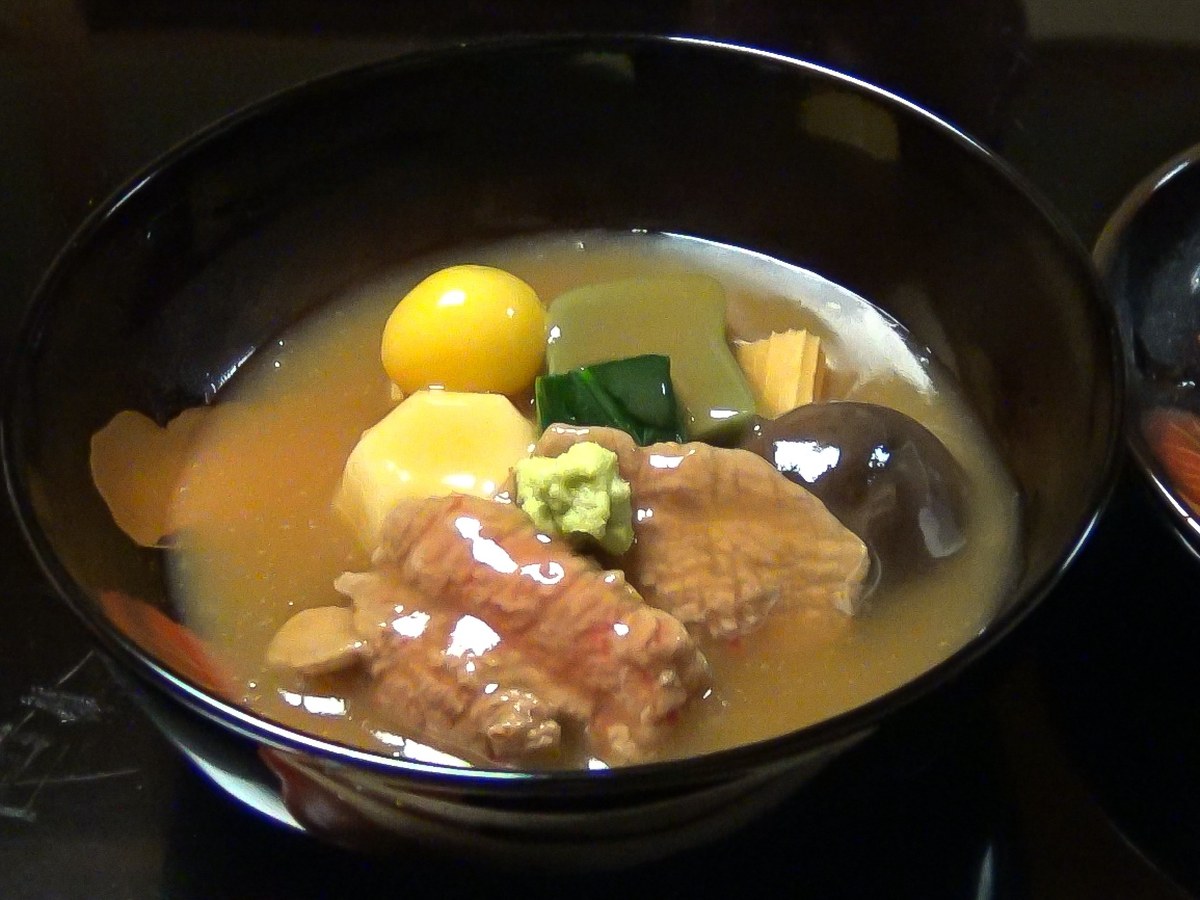
Most Japanese stews keep their broth clear. Kanazawa's does the opposite on purpose. For jibuni, slices of duck are dusted with flour and slipped into a dashi broth with sudare-fu — wheat gluten rolled like a bamboo blind — shiitake and seasonal vegetables; the flour leaves the meat as it simmers and gives the whole bowl a gentle, silken body, and a dab of fresh wasabi is set on top at the end. It is the signature of Kaga cuisine, the refined cooking of the old Kaga domain, and restaurants have served it in Kanazawa for centuries.
A stew thickened by its own ingredients
Jibuni's identity is a method, and the records state it precisely. The meat — duck at restaurants, more often chicken at home — is coated in wheat flour before it meets the broth of dashi, soy sauce, mirin and sake. There is no separate thickener: the coating itself loosens into the liquid as everything simmers, which is why the finished broth clings to the sudare-fu and vegetables instead of running off them.
The garnish is part of the definition, not decoration. Fresh wasabi is served with the stew and stirred in at the table; the regional-cuisine record explains its work directly — it cuts through the richness of duck and thickened broth and keeps the flavour clean. A bowl without the flour body or the wasabi finish is a duck stew, but it is not quite jibuni.
The Kaga domain's table
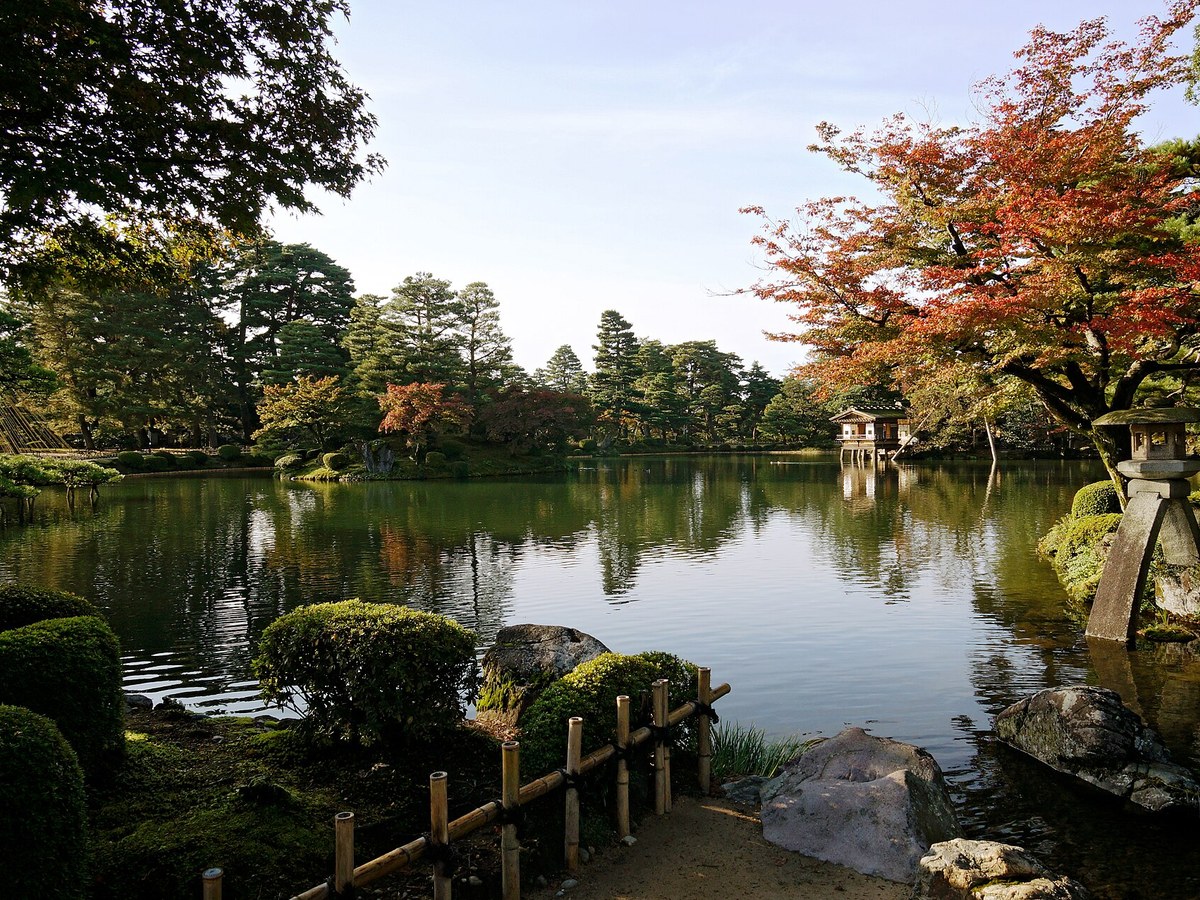
Jibuni is documented as a dish of the Edo period and of samurai households — the cooking of Kanazawa, castle town of the Kaga domain, whose lords were the richest in the country and whose kitchens set the style later named Kaga ryori. Within that repertoire jibuni became the representative simmered dish, served as one course inside formal kaiseki as readily as on its own, in the lacquered bowls the region is also famous for.
Its supporting ingredients are local signatures in themselves. Sudare-fu, the gluten sheet rolled to imitate a bamboo blind, is a Kanazawa wheat-gluten speciality; Kaga vegetables fill out the pot; and the frozen Kagaya set described below pairs the stew with hasu-mushi made from Kaga lotus root, the domain's other famous simmered form.
A name nobody has settled
Ask where the word jibuni comes from and the official-derived record refuses to choose. One theory names Okabe Jibuemon, a provisions officer said to have brought the method back from Korea; another hears the name in 'jibu-jibu', the sound of the pot simmering; a third credits Christian lord Takayama Ukon with a missionary-taught dish naturalised in Kaga. The records carry all three as traditions, and this article does the same.
That honesty is itself a fact about the dish: jibuni is old enough, and was cooked in enough separate great households, that no single kitchen kept the naming rights. What every account agrees on is the place — Kanazawa — and the form, which has survived intact while the etymology dissolved.
Eating jibuni, in Kanazawa and at home
In Kanazawa the stew is found across the Kaga-cuisine world, from counter restaurants near Omicho Market — the record names Tsubotei, Ishiya and Gyohan Bukeyashikimaeten — to the ryotei where it arrives inside a full kaiseki. Expect it as a set-menu course rather than a street food; it is a dish of seated, deliberate eating, priced like the cuisine it belongs to.
For readers nowhere near Ishikawa, the Wakura Onsen house Kagaya sells its supervised version frozen through JR West's WESTER Mall: the 'Bishoku Dayori' set pairs jibuni of duck-meatball tsukune (240 g × 2) — seven ingredients, dashi-soaked sudare-fu, wasabi included — with Kaga-renkon hasu-mushi, at a list price of ¥7,560 including tax and shipping. At this run's check the page showed a product-refresh markdown and no stock, so confirm before relying on it; the list price is the dated anchor.
Sources — checked 12 November 2026
- Food in Japan — Jibuni guide, from the Ministry of Agriculture, Forestry and Fisheries' regional-cuisine record for Ishikawa
- Jibu-ni — dish record (English Wikipedia, after the Ishikawa tourism and regional-cuisine sources)
- WESTER Mall (JR West) — Kagaya 'Bishoku Dayori' frozen set (checked 12 November 2026)
Original prose and official links only; no source text or maker media reproduced. Photos are credited Creative Commons works, not product photographs.
Editorial review 2026-11-12