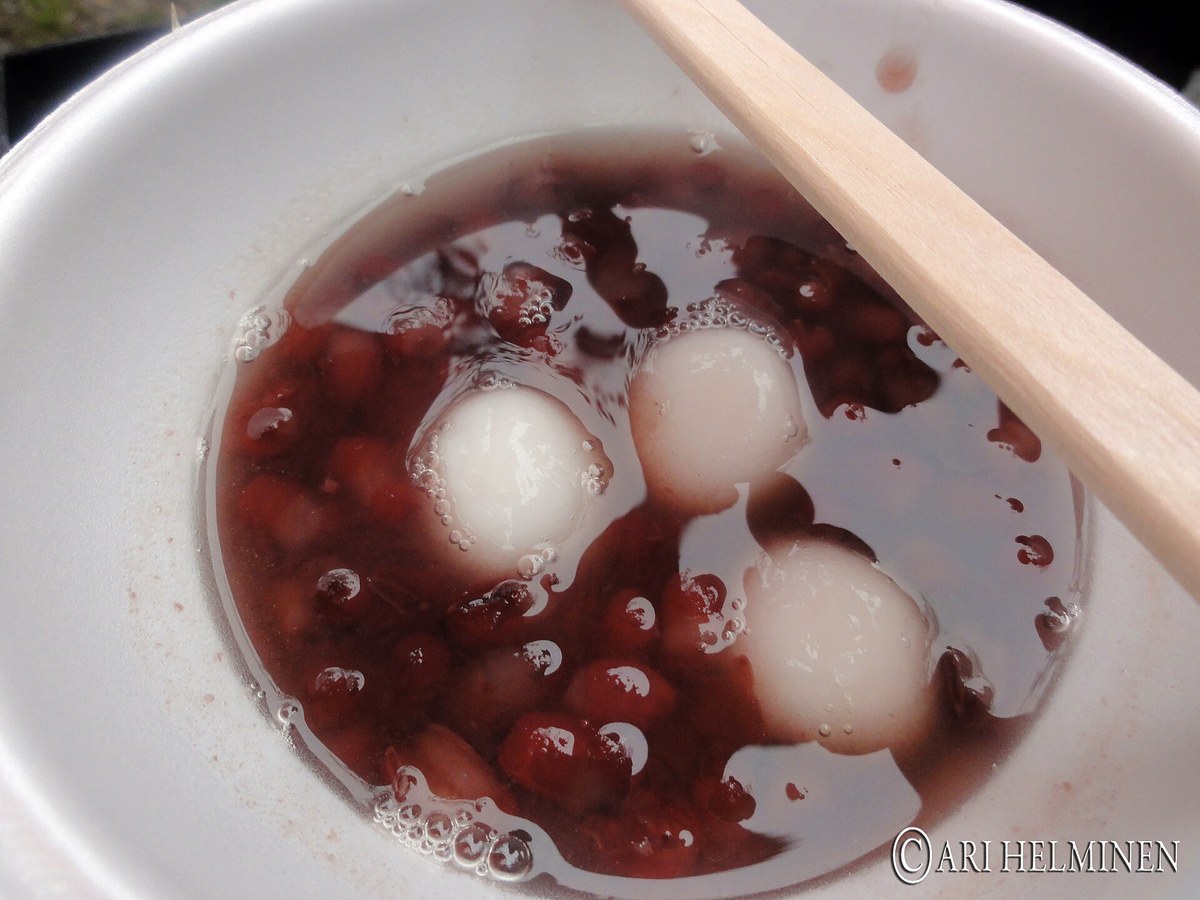
In most of Japan the tenth lunar month is Kannazuki, the month without gods — because the gods are all in Izumo. When they gathered, the shrine town fed its crowds a festival bowl: mochi cooked with azuki, called Jinzai-mochi after the festival of the gods' presence, Kamiari. In Izumo's dialect 'jinzai' softened to 'zunzai' and then 'zenzai' — and, the old texts say, travelled to Kyoto and named Japan's sweet azuki soup forever. Izumo still serves it at the shrine gate, and since 2007 a learned society has existed to prove the pudding.
The bowl that named the sweet
The Izumo claim is unusually well papered for a folk etymology. The regional tourism record lists the early-Edo witnesses by name: the Gion Monogatari of the Kan'ei years, the Confucian scholar Hayashi Razan's Baisson Saihtsu, the Wakun no Shiori of 1670 and the Matsue domain's own gazetteer, the Un'yo-shi of 1717, whose entry for Sata shrine records that on the festival day the common people cook white mochi with azuki at home and call it Jinzai-mochi — 'begun in the land of Izumo', the gazetteer insists, correcting the world's 'senzai-mochi' as an error.
Candour requires the rival. The same encyclopaedia record that preserves the Un'yo-shi quotation also carries the competing derivation from the Buddhist word zenzai, an exclamation of approval. Both theories are printed here because both stand in the record; what belongs to Izumo alone is the festival, the gazetteer, and the unbroken local habit — even Izumo's New Year ozoni is built on azuki soup.
A society for a soup
In 2007 Izumo decided the claim deserved an institution. The Nihon Zenzai Gakkai — the Japan Zenzai Society — held its founding general meeting on 1 July 2007, trademarked its name, put its office inside the Izumo Tourist Association, and registered 31 October, read as the pun 1031 'zenzai', as Izumo Zenzai Day with the Japan Anniversary Association. A bean-industry journal carried a founding officer's full account, ancient texts and all.
The society is not merely ceremonial: it keeps a shop. Its No. 1 store stands on Shinmon-dori, the great approach street between Izumo Taisha's gate and the station, where the touring record describes the signature bowl — local azuki, a sweetness that does not cloy, shiratama so soft they melt — served with a salty tsukudani of Nishihama sweet-potato vine to set the sweetness off.
What is in an Izumo bowl
The current No. 1 shop record describes the modern form precisely. The shiratama are house-made and red-and-white; the azuki are Dainagon, the large premium bean, cooked so the skins do not break; the clear soup is sweetened with four kinds of sugar, rested, and warmed only when an order comes, so the bowl arrives light rather than syrupy. A second form, Enmusubi zenzai, carries grilled mochi — the matchmaking sweet for the shrine of the god of marriage.
Set that against the festival original and the continuity is exact: white mochi, azuki, a town in festival season. The society's shop cooks year-round what the Un'yo-shi describes the whole district cooking at home on the festival day in 1717 — the recipe scaled from a province to a single careful kitchen.
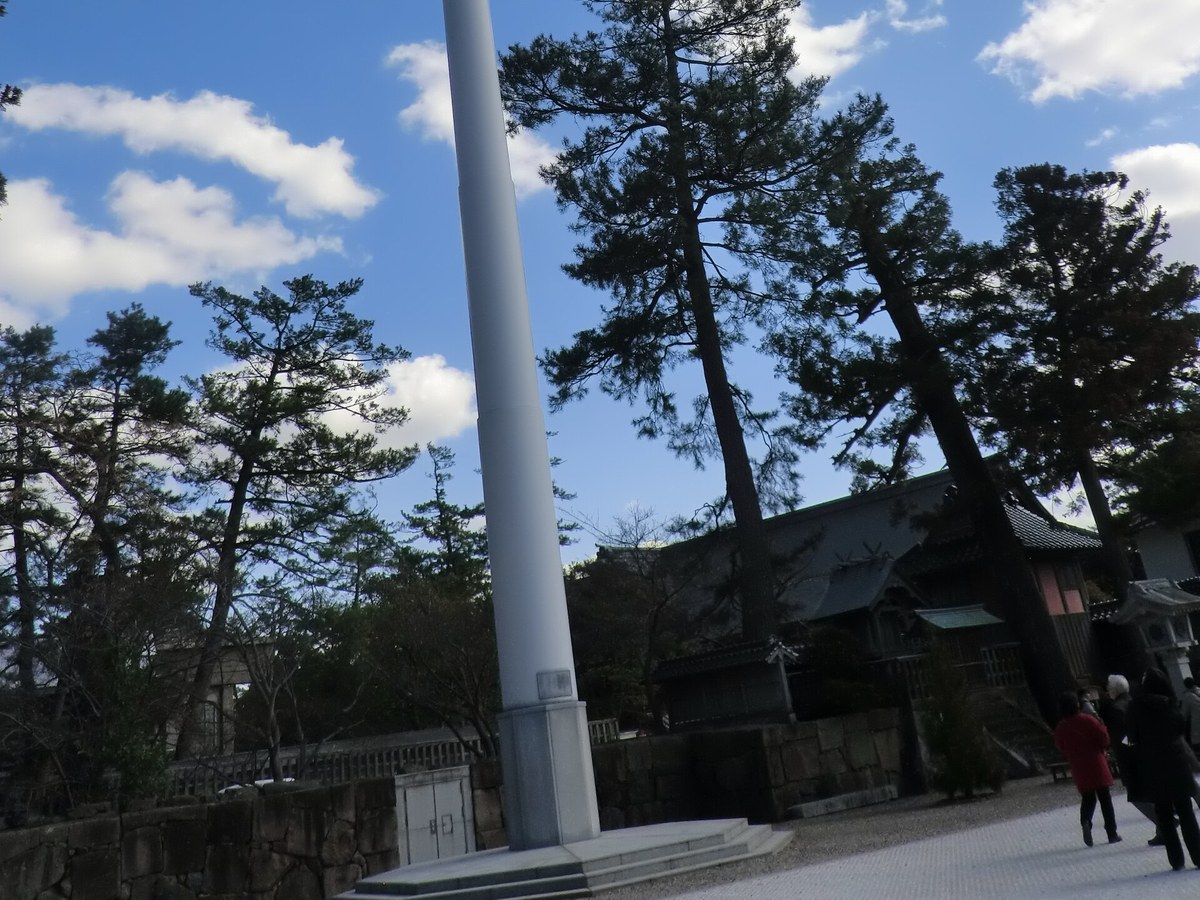
Eating it at the shrine gate
The No. 1 shop — today trading jointly as a Shimane-snacks laboratory on the same Shinmon-dori site in Taisha-cho — lists its Izumo zenzai at ¥770, a price the local-cuisine record states was confirmed against official information in August 2026. Other shrine-town kitchens serve their own readings, including soba-shop variants with soba dumplings, so the bowl is easy to find on any Izumo day trip.
Go in the tenth lunar month if you can: that is Kamiari season, when the festival the dish is named for still fills the town, and the zenzai is eaten in the circumstances that created it. And take home the society's souvenir echo of the original — the Izumo-koku Zenzai Mochi, a single mochi with the azuki folded inside, recorded at ¥105 at the touring record's writing.
Sources — checked 12 November 2026
- Zenzai — sweet record (Japanese Wikipedia, quoting Sata Jinja's official page and the Un'yo-shi)
- Local-cuisine record — Izumo zenzai: the Jinzai-mochi origin, its character and where it is served (checked 12 November 2026)
- Bean-industry journal (Mame-or.jp) — a founding officer's account of the Nihon Zenzai Gakkai and the ancient zenzai texts
Original prose and official links only; no source text or maker media reproduced. Photos are credited Creative Commons works, not product photographs.
Editorial review 2026-11-12