Iwakuni renkon is a lotus root you count before you cook: slice it and most roots show nine holes, one more than the usual eight, which is why the white root of Iwakuni’s reclaimed fields is treated as a lucky food. It is dug by hand from the mud at the Nishiki River’s mouth, boxed with the mud still on it, and eaten all winter — a root that began in 1796 as a rescue crop for salt-sick fields.
Nine holes in the mud
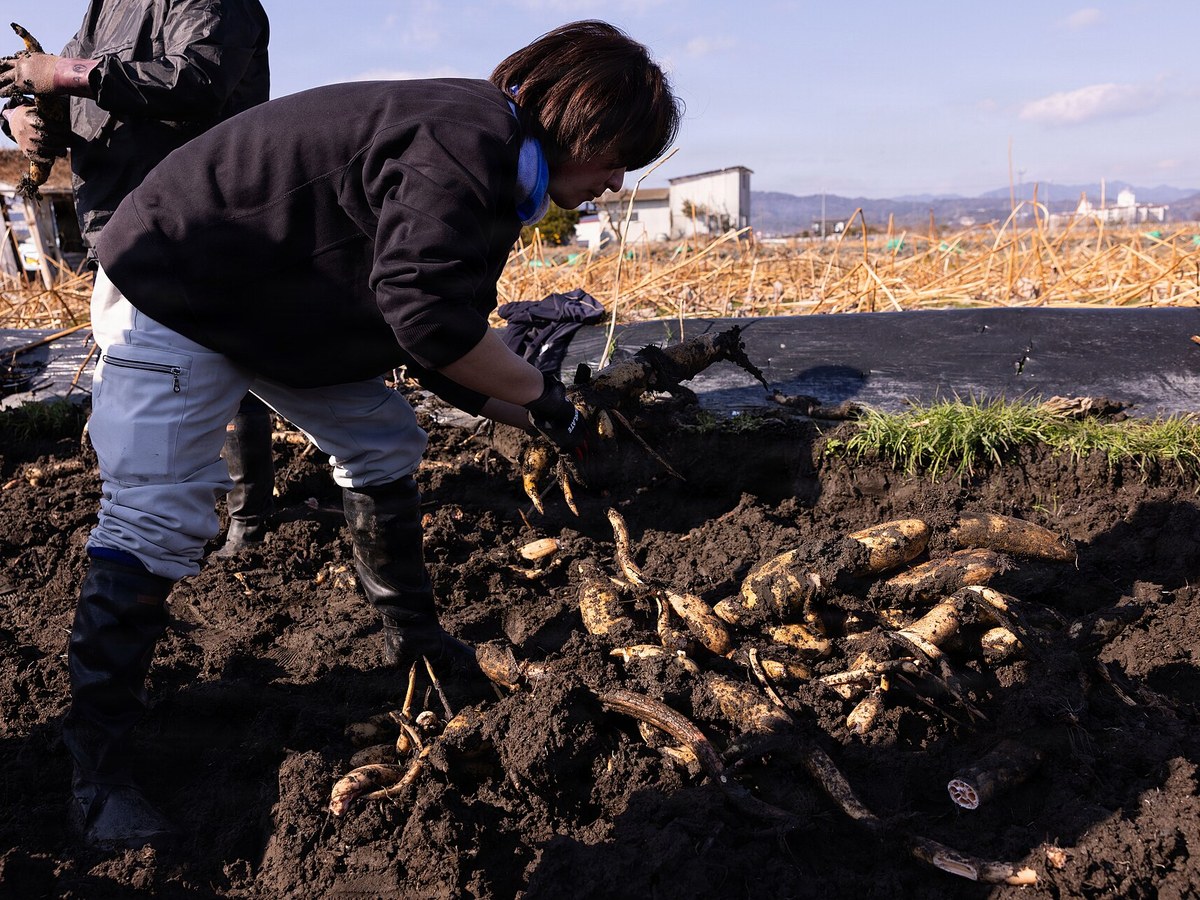
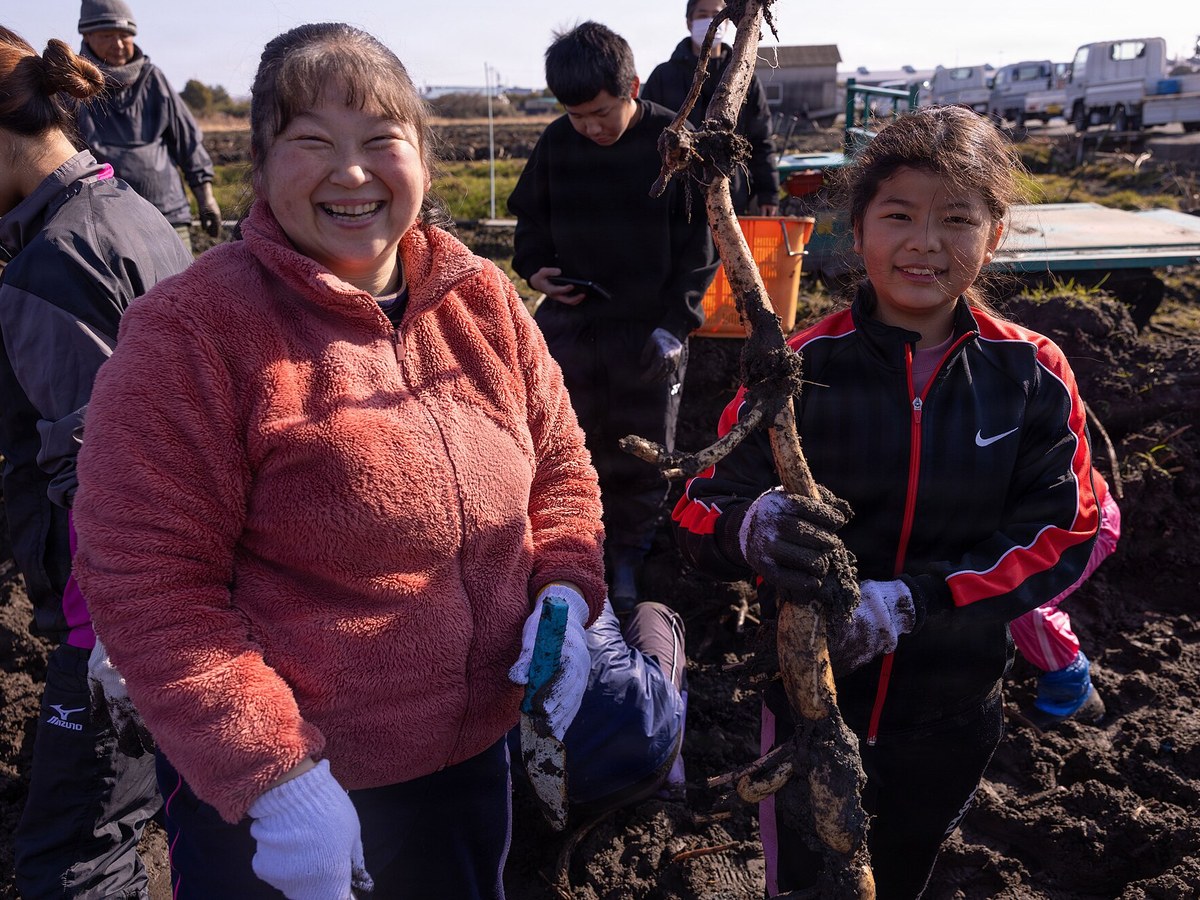
The root is the swollen underground stem of the lotus, and Iwakuni’s is read by its holes: where an ordinary lotus root shows about eight air channels in cross-section, most Iwakuni renkon show nine. The holes carry the old lucky reading of renkon — a food you can see through, and so a food that sees the future — and they make the root a fixture of celebration cooking and New Year osechi. Our two photographs, taken for the US Marine Corps at the community dig in Iwakuni City on 3 February 2026, show the root as it comes out of the ground: in the first, a worker pulls at the mud while a pile of freshly dug roots fills the foreground, one cut end showing its holes; in the second, a single long root is held up whole, still wearing the field.
The flesh is the other half of the name. Iwakuni’s main variety is the Hakka-shu, a late-maturing white-flowered lotus introduced from China in the Meiji period, and its roots are white and soft, combining a firm stickiness — the threads that stretch when a slice is pulled apart — with a clean, crisp bite. The growers’ cooperative rates that stickiness as the variety’s distinction, and the root is shipped with its mud still on, because the mud is what keeps the flavour and the freshness on the journey.
1796: a lord, a farmer and a salt-sick field
The crop exists because reclamation failed politely. In 1796, on the orders of Kikkawa Tsunetada, lord of Iwakuni, the farmer Muramoto Sangoro brought seed lotus of the Bicchu kind from what is now Okayama and planted it in the Monzen district, on land reclaimed from the sea at the lower Nishiki River, to relieve farmers whose fields suffered salt damage. The lotus took to the waterlogged ground that had defeated other crops, and successive lords spread the planting across the domain’s reclaimed fields.
What made a district of it was the ground and the water together: reclaimed clay under a warm Setouchi climate with long hours of sun, and the Nishiki — the prefecture’s largest river — at the door. The producing centre settled in the Ozu and Monzen districts at the river’s mouth, where the pattern set in the Edo period still holds: one named root, from one river mouth, in one city.
Two hundred hectares at the river mouth
The scale is recorded by the growers’ own cooperative: about 200 hectares of lotus fields in Iwakuni City, worked by about 200 growers — the largest lotus-root producing area in the Chugoku region. The city counts the root among its signature products under the Iwakuni brand. In Ozu, the main district, pipelines carry Nishiki River water to each field as needed, and the water is managed as carefully as the soil.
The year runs long. Seed roots go in from March, peaking in April; the Hakka-shu’s leaves — the largest of any lotus, over a metre across, on stems up to three metres — shade the water all summer and feed the stems below. New roots reach market from mid-September. At harvest the water is drawn off, a machine strips the surface soil, and then the digging is hand work, with the special banku hoe and the kaikaki tool, easing each root out unbruised. Shipping peaks in December, on gift and osechi demand, and the harvest continues through winter into spring; the cooperative notes strong gift demand and active home delivery alongside the wholesale markets of Iwakuni, the prefecture and Hiroshima. At home the root is indispensable twice over: scattered through Iwakuni-zushi, the layered celebration sushi, and simmered in Ohira, the festive stew.
Buying the nine-holed root
Buy it in season and buy it muddy: the mud coat is the freshness seal, not dirt to apologise for. The measured prices this run are ¥616 for a 220 g bag on the Oisix listing read this run, and ¥4,320 including tax and shipping for the fresh-root mail-order box in Japan Post’s net shop, sold for the autumn 2026 season with chilled delivery into December. At the counter, judge a root by its white skin, its weight in the hand and a cut face that shows the holes clean and un-browned.
Cook it both ways the variety invites: sliced thick and simply grilled or tempura’d for the crisp bite, or simmered until the starch turns and the stickiness takes over. The season runs from September into spring, and the December peak is the gift season — a root that lets you see through it is a well-wishing present in Japan, and Iwakuni’s carries one hole more of luck than most.
Sources — checked 15 November 2026
- Iwakuni Renkon — JR West Blue Signal “Shunzen-reki” feature, vol.168 (the 1796 origin, the Hakka-shu, the nine holes, the hand harvest)
- Local schoolchildren plant Iwakuni renkon — JA Yamaguchi press release, 24 April 2024 (the 200 ha, the 200 growers, the Hakka-shu rating)
- Iwakuni Renkon — City of Iwakuni brand page (the city brand, the reclaimed clay, mud-on shipping)
- MCAS Iwakuni community lotus-root dig, 3 February 2026 — DVIDS captions via Wikimedia Commons (the photographs’ own product record)
- Iwakuni renkon (220 g, Yamaguchi; Shimura Noritoshi and others) — Oisix listing (the ¥616 bag price)
- Umamon: Yamaguchi Iwakuni fresh renkon — Japan Post net shop (the ¥4,320 mail-order box)
Checked 15 November 2026 (stored links re-fetched and judged per product): reserved where the page says so, with an editorial review note kept per product. Press, PR and travel use stays outside the grant.
Editorial review 2026-11-15