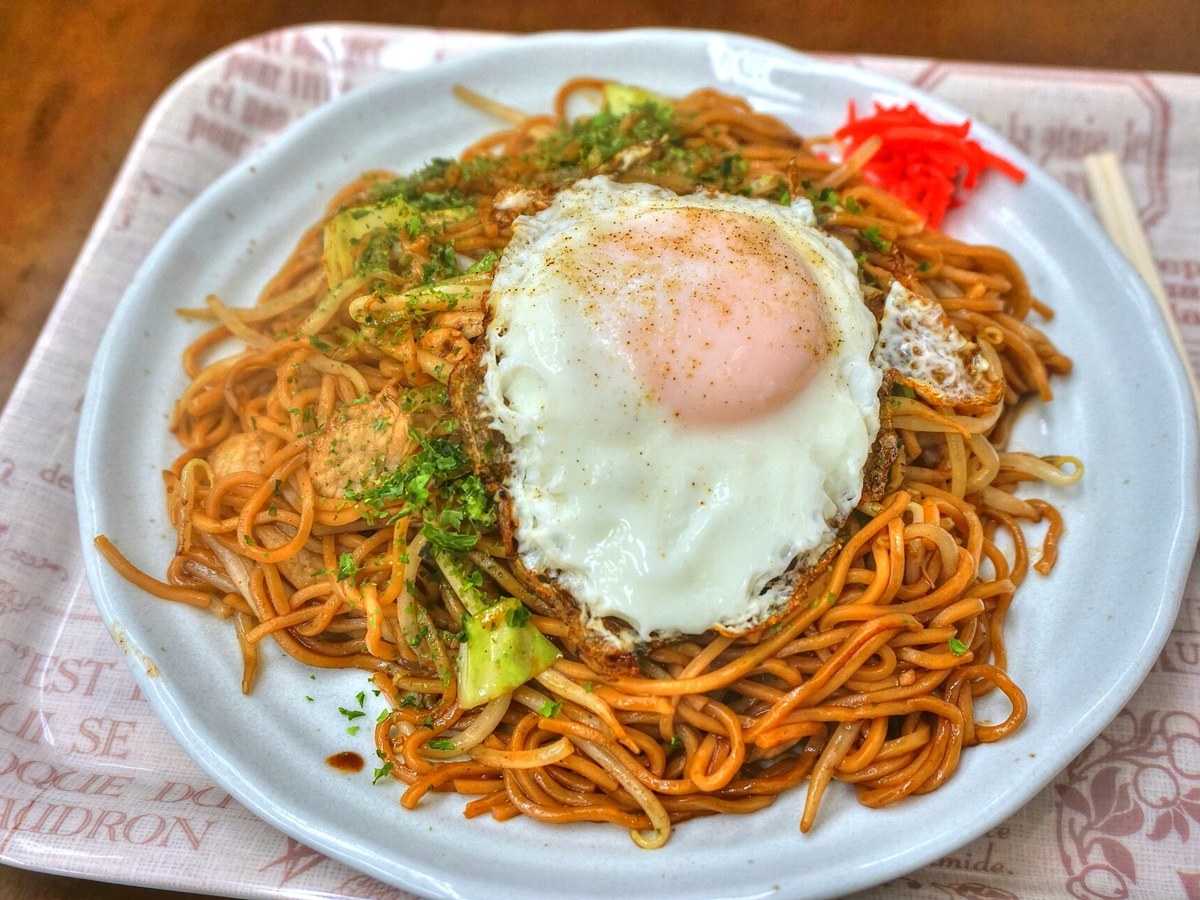
Every other yakisoba in Japan is pale until the sauce hits it. Ishinomaki’s noodles arrive already brown — steamed twice before they ever see a griddle, so they drink up dashi as they fry. The plate is finished with a fried egg, and the sauce goes on at the table, by your own hand, as much as you like: that is the Ishinomaki way.
1950: the noodle that would not go sticky
About 1950, a noodle maker who had moved to Ishinomaki from Maesawa in Iwate — later the founder of Harumoto Seimen — set out to make a noodle that would not turn sticky on the griddle. His answer was to change the flour and double the steaming: medium-strength flour instead of the strong flour of Chinese noodles, steamed once until yellow, washed, then steamed again — and the second steaming turned the noodles brown, an effect the record attributes to the kansui in the dough reacting with the heat, its details still not fully explained.
He did not keep the method. In the 1950s he taught it to Ishinomaki’s other noodle houses, and the brown noodle became the city’s standard: the supermarkets of Ishinomaki still sell the brown yakisoba noodle as an everyday item, and about fifty shops serve the dish.
Brown first, sauce last: the method is the dish
The twice-steamed noodle is plumper than a once-steamed one and thirstier: it absorbs liquid as it cooks. Ishinomaki cooks exploit exactly that — at the final frying, dashi goes onto the griddle and the noodles steam-fry in it, taking the broth’s depth into the strand. The result tastes milder than its dark colour promises, which is why the custom is to sauce it yourself at the table, generously — the record calls a heavy hand with the sauce the Ishinomaki style.
The standard plate carries a fried egg (ham-and-egg and bacon-and-egg variants stand on the same record). The three marks the city’s academy teaches are the brown twice-steamed noodle, the dashi steam-fry, and the egg on top.
The Academy and chacha-maru
When the B-1 boom put regional yakisoba on national television, Ishinomaki’s noodle makers and volunteers moved to name what the city already ate. The Ishinomaki Chairoi Yakisoba Academy — the Brown Yakisoba Academy — was founded on 25 June 2008, unifying the name and the promotion; its mascot chacha-maru, a yakisoba spirit with a fried egg on his head, was chosen that September.
The Academy joined the B-1 league in 2010, exhibited at Yokote that year, and at Himeji in 2011 the dish placed sixth — a respectable line on the record for a noodle whose fame had never left the prefecture. The noodle makers who kept the method through the 2011 disaster are the same houses whose sets now travel by mail order.
Eating it in the port city
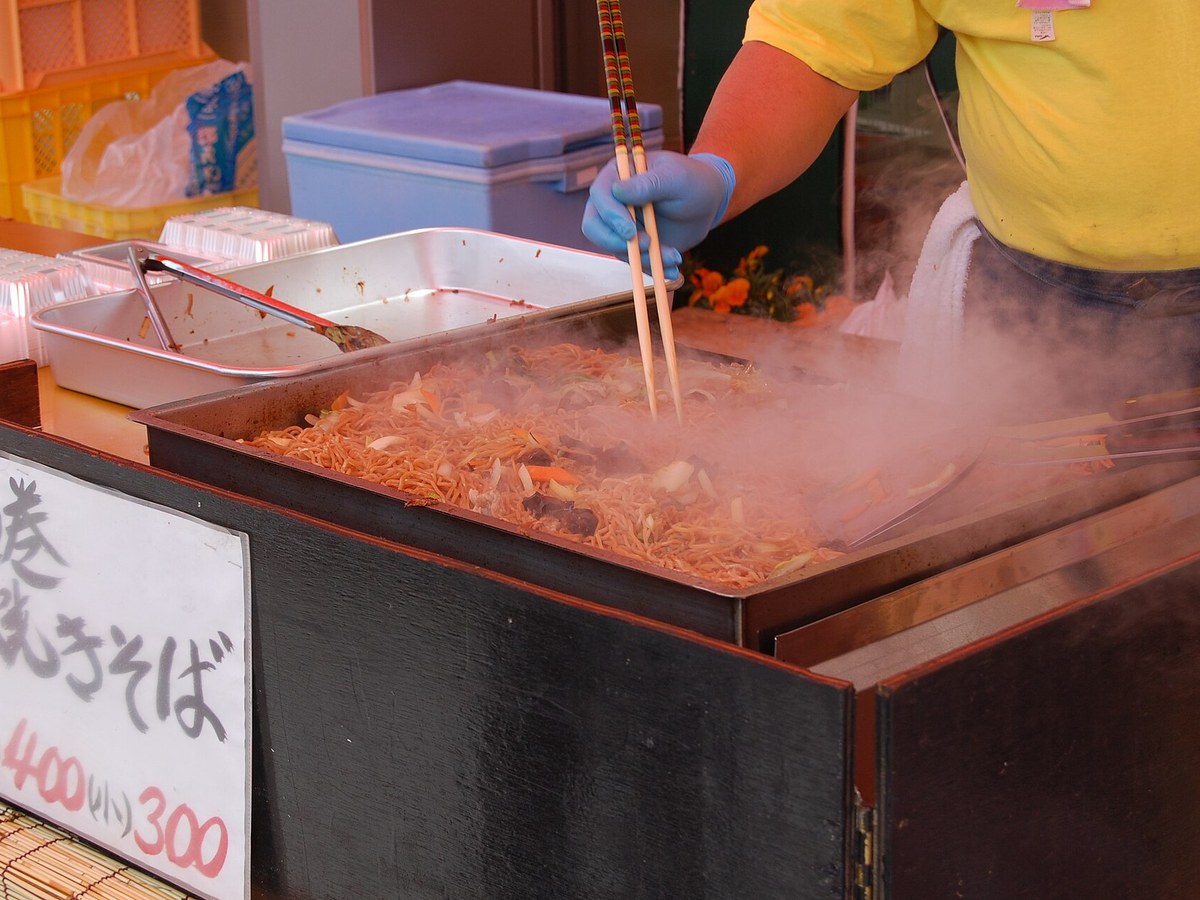
In Ishinomaki, order it where the griddle is: the diners and noodle shops of the city serve the brown noodle with its egg, sauce bottle on the table, and festival stalls fry it to order under the dish’s own sign. The take-home forms are Shimakin Shoten’s seiro-steamed sets — the JAL Furusato listing describes the same twice-in-the-steamer method — and, since March 2025, Aeon’s Top Valu Best Price cup, which reproduces the brown noodle by saucing the strand in advance and adds a seafood-dashi powder to the Worcestershire base.
The cup is a portrait; the city plate is the original — brown before sauce, mild before seasoning, and finished by the eater, not the cook.
Sources — checked 14 November 2026
- Ishinomaki yakisoba — encyclopedia record (method, history, Academy)
- Aeon Tohoku press release — Top Valu Best Price Miyagi Ishinomaki sauce yakisoba (2025)
- JAL Furusato — Shimakin Shoten seiro-steamed Ishinomaki yakisoba sets
Checked 14 November 2026 (stored links re-fetched and judged per product): reserved where the page says so, with an editorial review note kept per product. Press, PR and travel use stays outside the grant.
Editorial review 2026-11-14