In most of Japan, beef tongue is a yakiniku course you grill yourself, thin as a coin. In Sendai it is a lunch: thick scored slices, aged for days, blistered over charcoal by a specialist, and set down with barley rice, a clear oxtail soup and pickles. The city did not adopt this dish. It invented it, in 1948, and then built a street of it inside its own station.
1948: a yakitori cook bets on a cut nobody wanted
The documented history, on the checked specialist guide, begins with Sano Keishiro, a Sendai yakitori owner who in 1948 opened Tasuke, a restaurant dedicated to beef tongue. Tasuke still operates, and diners regard it as the dish's birthplace. There is a famous story about tongue and tails left behind by the occupation forces; the guide itself flags it as popular history rather than settled fact — accounts tied to Tasuke describe Sano travelling to neighbouring Yamagata to source tongue — and this page keeps the distinction the source makes.
What is not in dispute is the form he fixed: tongue cut thick, scored so the heat enters, seasoned — salt at the classic houses — and grilled over charcoal, served not as a snack but as a meal. Disciples and rivals multiplied the form across the city, transferred workers carried its reputation across Japan, and when beef imports were liberalised in 1991 the supply widened with it. The BSE shocks of the 2000s, which cut off the American tongue most shops relied on, proved how completely Sendai had specialised: the whole city's signature dish hung on one imported cut.
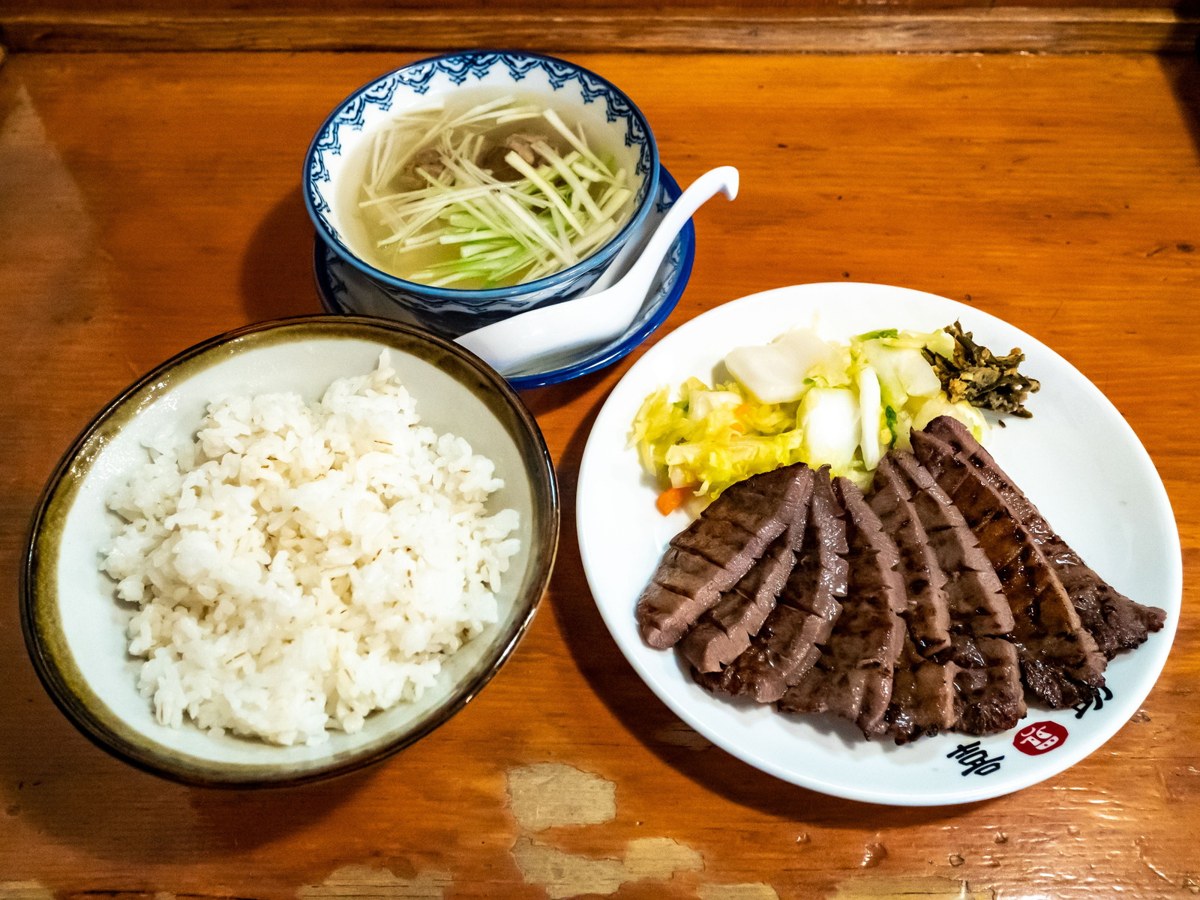
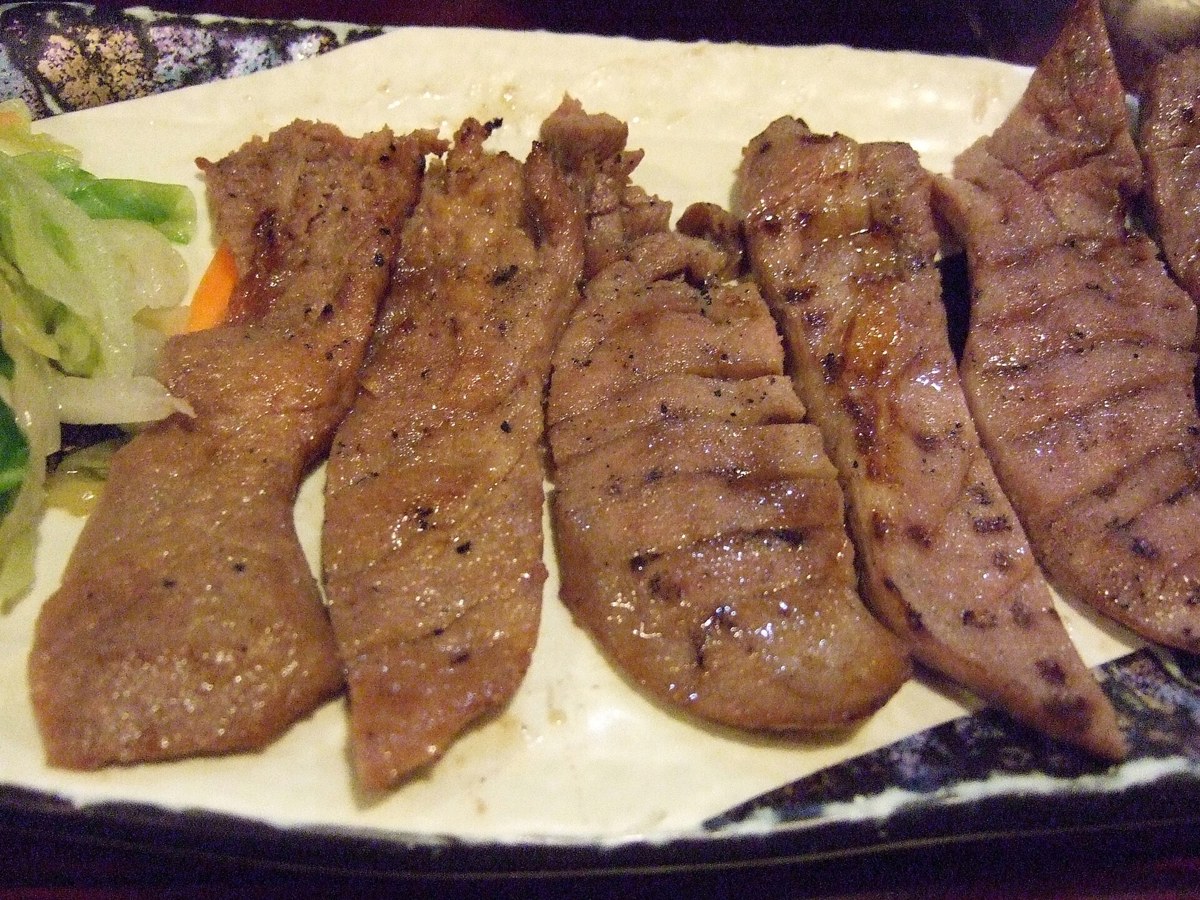
The set is the dish
Order gyutan in Sendai and you are ordering a grammar. The tongue comes thick — the base of the tongue, tanmoto, is the soft, fatty premium cut, cut about a centimetre thick at the thick-cut houses, scored, aged for several days and grilled over binchotan charcoal until the edges crisp. Around it, always: mugi-meshi, rice cooked with barley, which lightens the fat; a clear oxtail soup with tender pieces of tail; lightly pickled cabbage and cucumber; and, at many houses, green chillies pickled in miso for heat. Shops differ in cut, scoring, aging and salt — comparing them is the local sport — but the set itself does not change.
The density is the other half of the story. About 100 beef-tongue specialty restaurants stand in Sendai City on the checked guide's count, and Sendai Station's third floor holds Gyutan-dori — 'beef tongue street' — where six specialists line up inside the station building, with more in the S-PAL basement. A traveller with twenty minutes between trains can eat the canonical version without leaving the station; a traveller with a week can eat a different house's interpretation every day.
What the founding line charges
The founding generation's own house is the price anchor: Umami Tasuke, run in the founding line's tradition — salt only, binchotan charcoal — lists its classic set A, three pieces of tongue with barley rice, tail soup and pickles, at ¥2,400 in the checked guide's current readings. Gyutan Ryori Kaku, founded in 1988 and the first in Sendai to serve tongue tataki and sashimi, lists its grilled set A (four pieces) at ¥2,500; Tanya Zenjiro's premium thick-sliced centre-cut set — three pieces, nine slices, from the part of the tongue that yields only one or two slices per animal — is ¥3,960. Across central Sendai, a standard set generally runs ¥1,500-3,000 on the official menus the guide checked.
For the road, the shops sell vacuum-packed and frozen gyutan at the station and in department-store food halls — with the guide's plain caution that many countries restrict meat imports, so the souvenir is for eating in Japan unless your destination's rules say otherwise. Miyagi's standing stories are two Sendai sweets and a squeaking kokeshi doll; gyutan is the prefecture's first savoury main, and the meal the city itself would name first.
How to eat it like the city does
Start with salt. The tare (sauce) and miso versions exist and have their houses, but the founding form is salt-grilled, and it is the version every comparison is measured against. Eat a slice plain, then with the barley rice, then cool the fat with the pickles and the miso chilli, and finish with the tail soup — the set is sequenced, even if no menu says so.
And if you eat only once, eat thick-cut. The thin yakiniku slice is a different pleasure; the Sendai claim rests on the thick one — scored, aged, springy, with the charcoal still on it. That is the bite Sano's 1948 shop was selling, and the bite a hundred shops still compete to perfect.
Sources — checked 10 November 2026
- Food in Japan: Gyutan — Sendai's famous grilled beef tongue (checked specialist guide)
- Hoshino Resorts Michikusa Guide: beef tongue lunches in the Sendai area (checked guide)
Original prose and official links only; no source text or maker media reproduced. Photos are credited Creative Commons works, not product photographs.
Editorial review 2026-11-10