No rolling pin, no knife, no board. Hittsumi is made with two hands: a rested wheat dough is held in the left hand, pulled thin with the right, and torn — hittsumu, in the Iwate dialect — straight into a pot of chicken, burdock and mushroom broth. It is the winter soup of the old Nanbu domain, a dumpling by pinch, and one of the agriculture ministry’s hundred chosen regional dishes of Japan.
Torn, not cut: the name is the method
The agriculture ministry’s Iwate record, whose recipe comes from the prefecture’s own agriculture department, gives the method in full. Wheat flour is kneaded with water to the firmness of an earlobe and rested, wrapped, for one to two hours. Meanwhile a dashi broth is built with chicken, daikon, carrot, burdock and shiitake, seasoned with salt, soy sauce and sake.
Then comes the gesture the dish is named for. The cook holds the dough in the left hand, pulls it thin with the right, and tears off pieces of just under five centimetres square directly into the broth, finishing the pot with negi. In the Iwate dialect, to pinch and tear like that is hittsumu — hence hittsumi. No two pieces are the same shape, and that is the point: the irregular sheets drink the broth unevenly, thick at the fold, silky at the edge.
The Nanbu domain’s flour country
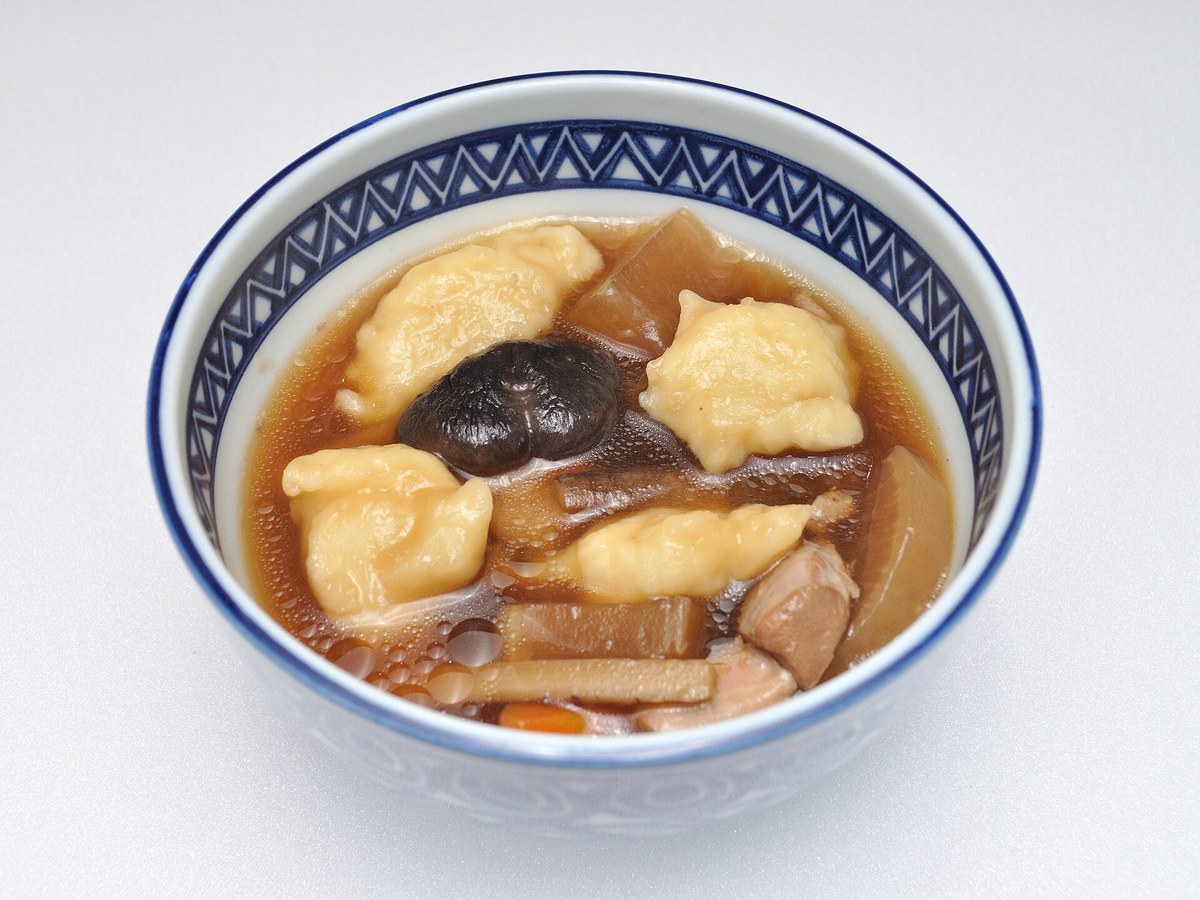
Hittsumi belongs to the country of the old Nanbu domain — northern Iwate and into southern Aomori — a cold region where rice was never guaranteed and wheat-flour cooking became a culture of its own. The Morioka-centred form, sometimes called Nanbu hittsumi, carries chicken, burdock and mushrooms in a soy-based broth; coastal and mountain districts answer with their own pots. It is recognisably kin to the suíton dumpling soups found across Japan — one of this article’s photographs is a suíton bowl — but in Iwate the torn sheet, the name and the broth are its own.
The dish’s standing is official as well as domestic: it stands in the agriculture ministry’s hundred chosen regional dishes, and the Iwate raw-noodle cooperative keeps 3 December as Hittsumi Day. It remains, above all, a home pot — which is why the surest places to meet it are station-front diners, regional-cuisine restaurants and Morioka’s morning markets rather than souvenir shelves.
A set meal, priced
Hittsumi is priced like the everyday food it is. A Morioka restaurant group’s current menu lists a hittsumi-jiru set meal at 2,000 yen including tax, served as a full tray; a November 2026 Iwate gourmet guide prices hittsumi set meals from 900 yen at Morioka’s regional diners.
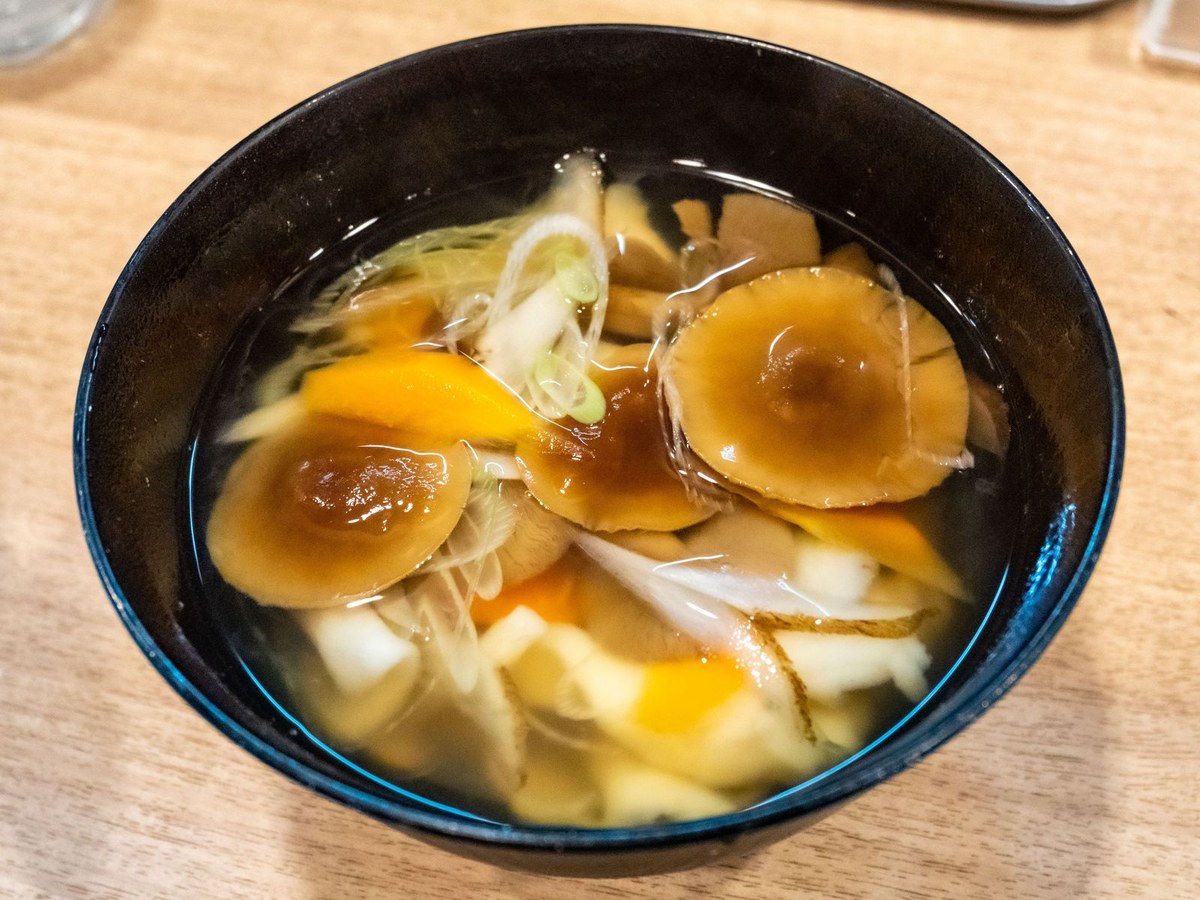
Among those diners is Momodori Ekimae Shokudo, the station-front canteen in front of Morioka Station — and the bowl in this article’s first photograph is its hittsumi, mushrooms and hand-torn sheets in a dark broth. The guide, the diner and the photograph all name the same pot.
Why hittsumi belongs to Iwate
Dumpling soups are made all over Japan, and this article does not claim them. The article documented here is the specific northern form: a rested wheat dough torn by hand — never cut — into a chicken, burdock and mushroom soy broth, under a name that is itself Iwate dialect, inside the borders of the old Nanbu domain, with a ministry record kept by Iwate’s own agriculture department. The chain exists in one place.
It is also a dish that refuses equipment. A pot, flour, water and two hands are the whole kitchen; the technique is the tearing, judged by eye at five centimetres, learned at a grandmother’s side of the irori hearth. Hittsumi is Iwate’s winter, served by the pinch.
Sources — checked 13 November 2026
- MAFF, Our Regional Cuisines — Hittsumi / Hittsumi-jiru, Iwate (record provided by Iwate Prefecture)
- Hittsumi — name, Nanbu-domain ground and standing (Cookpad News; Kankoujp regional-dish record)
- Hatsukoma group (Morioka) — current group menu: hittsumi-jiru set meal
- Iwate gourmet guide — hittsumi set meals in Morioka (updated November 2026)
Checked 13 November 2026 (stored links re-fetched and judged per product): reserved where the page says so, with an editorial review note kept per product. Press, PR and travel use stays outside the grant.
Editorial review 2026-11-13