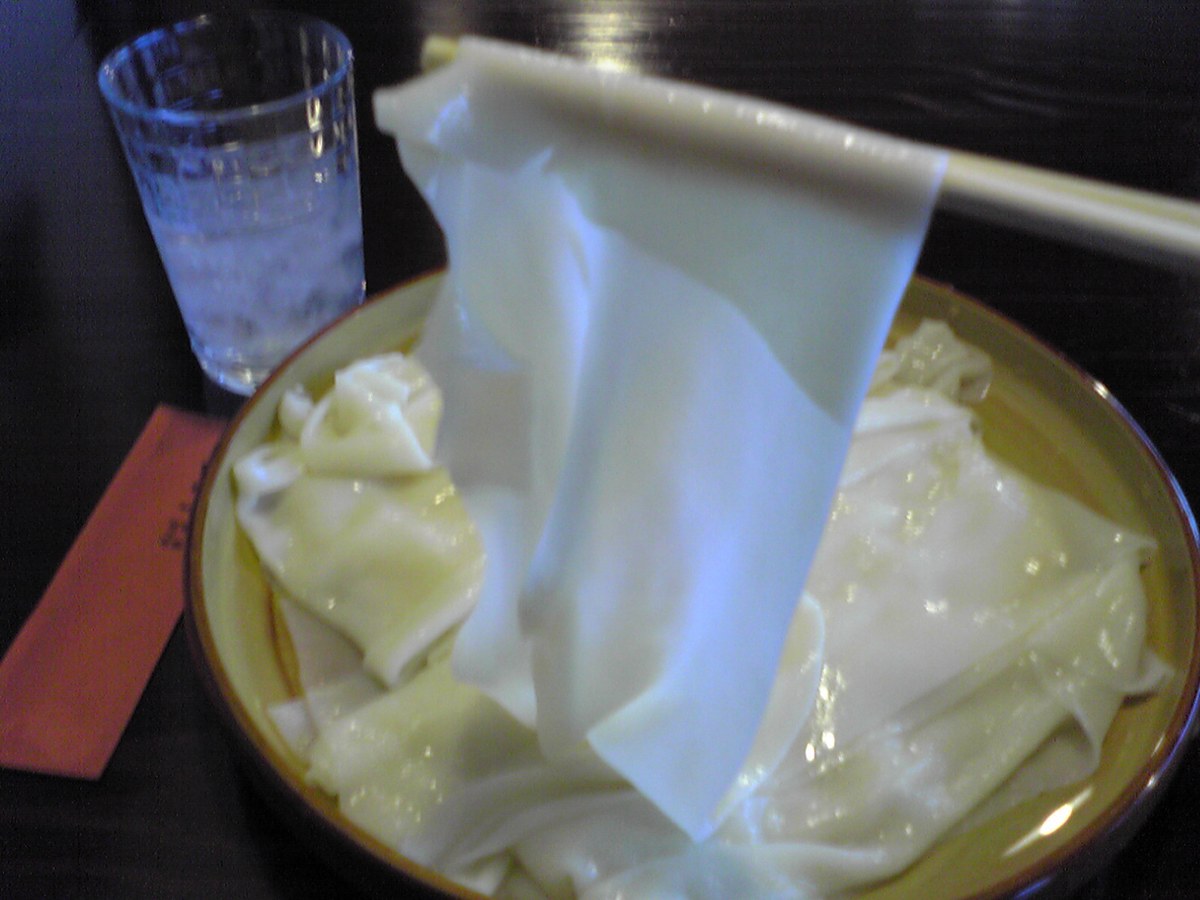
Lift a single himokawa noodle and it unfolds like a strip of pale silk — which is the right image, because this noodle belongs to a silk town. In Kiryu, Gunma's historic weaving city, udon dough is rolled tissue-thin and cut not into strands but into sheets: ribbons a few centimetres wide as a rule, wider than the chopsticks holding them at the famous shops, and a full fifteen centimetres across at one maker's counter. It eats soft, smooth and slippery, carrying sauce on its broad surface the way cloth carries dye. In September 2026 the Agency for Cultural Affairs wrote himokawa into Japan Heritage, as part of the national story of Gunma's silk.
A noodle measured in centimetres of width
Everything about himokawa is a refusal of the strand. The dough is the usual udon three — wheat flour, water, salt — but it is rolled much thinner than standard udon and cut into broad ribbons, so a bowl holds a few folded sheets rather than a tangle. The agriculture ministry notes Kiryu shops serving noodles over 10 cm wide; the Kiryu maker Furukawa describes its own house style at about 15 cm. Between those poles sits every shop's own choice — there is no Kiryu-wide standard, and narrower ribbons are honestly himokawa too, which is why the guides tell you to check photographs or ask.
Thinness does the culinary work. The sheets boil fast — Fujiya Honten, the city's long-established shop, gives six to eight minutes for its himokawa against ten to thirteen for its regular udon — and they present an enormous surface to whatever they meet: cold dipping sauce, hot soy broth, a simmered pot of vegetables, or a Japanese curry that clings to every fold. Cold, the sheets firm up and show their shape; hot, they soften quickly and turn silky. The texture is the opposite of the firm chew Japan prizes in Sanuki udon — and that is exactly the local taste.
The name nobody can prove
For a noodle this documented, its name is remarkably unsettled. One theory derives himokawa from imokawa, a flat udon associated with Imokawa in present-day Kariya, Aichi, placed by some accounts in the Edo period; another local explanation simply compares the broad sheet to an obi, the wide sash of a kimono — a textile town reaching for a textile metaphor. The Food in Japan record is plain that neither is conclusively documented: the theories are carried here as theories.
The silk connection itself stands on firmer paper. Japan Heritage materials describe Kiryu's looms running day and night at the weaving industry's peak, from the Meiji era into the early Showa era, and the women at those looms valuing udon because they could eat it quickly between work — Kiryu udon as an everyday food that developed alongside the textile industry. The materials do not show that mill workers invented himokawa itself, and the article does not claim they did; but the city's noodle culture and its cloth culture are documented as one story, and on 1 September 2026 the Agency for Cultural Affairs made it official, adding himokawa (Kiryu udon) as a component cultural property of the existing Japan Heritage story about Gunma's silk, on Kiryu City's announcement.
Wheat country, flour food
Kiryu's noodles sit inside a prefecture built on wheat. Gunma ranked seventh in Japan for wheat harvest in 2021, on the prefecture's own figures, and its flour foods are a small atlas of shapes: the firm, glossy strands of Mizusawa udon, Tatebayashi udon, the simmered pot of okkirikomi — and himokawa, the sheet. Locals traditionally ate the wide noodles in autumn and winter, the guide record notes, though Kiryu's shops serve them all year now.
The comparisons a visitor actually needs are three. Kishimen, Nagoya's flat noodle, is a slimmer ribbon in a different tradition. Hoto, from Yamanashi, is broad too, but its unsalted noodles simmer raw in the miso pot until soft. Himokawa is boiled on its own — separately, like any udon — and arrives with its shape intact: the sheet is the serving, not an ingredient in a stew. Order it cold, zaru-style, the first time: that is the form where width, thinness and silkiness are all on show at once.
Eating it in Kiryu
Go to Kiryu. Fujiya Honten, in the historic preservation district at 1-6-35 Honcho, is the traditional first stop — about 120 years old on Gunma's tourism site, serving himokawa alongside Kiryu's other famous plate, sauce katsu don, and closing early when noodles or broth run out. For the widest sheets, Furukawa's Aioi shop (2-735-15 Aioicho) is the name the record gives, at about 15 cm; the same maker is the take-home route, selling frozen himokawa online — three servings with sauce at ¥2,832 tax included, six servings without sauce at ¥4,290, as checked on 27 October 2026 (international frozen delivery was not established on the page reviewed, so overseas buyers should confirm with the seller).
Kiryu's own souvenir shops sell packaged himokawa in fresh, frozen, semi-dried and dried forms, and gift boxes are a noted seasonal present. In the restaurant, take the very wide sheets in two or three bites rather than attempting the heroic slurp; the bowl holds only a few of them, and each one is a mouthful by design.
Sources — checked 12 November 2026
Original prose and official links only; no source text or maker media reproduced. Photos are credited Creative Commons works, not product photographs.
Editorial review 2026-11-12