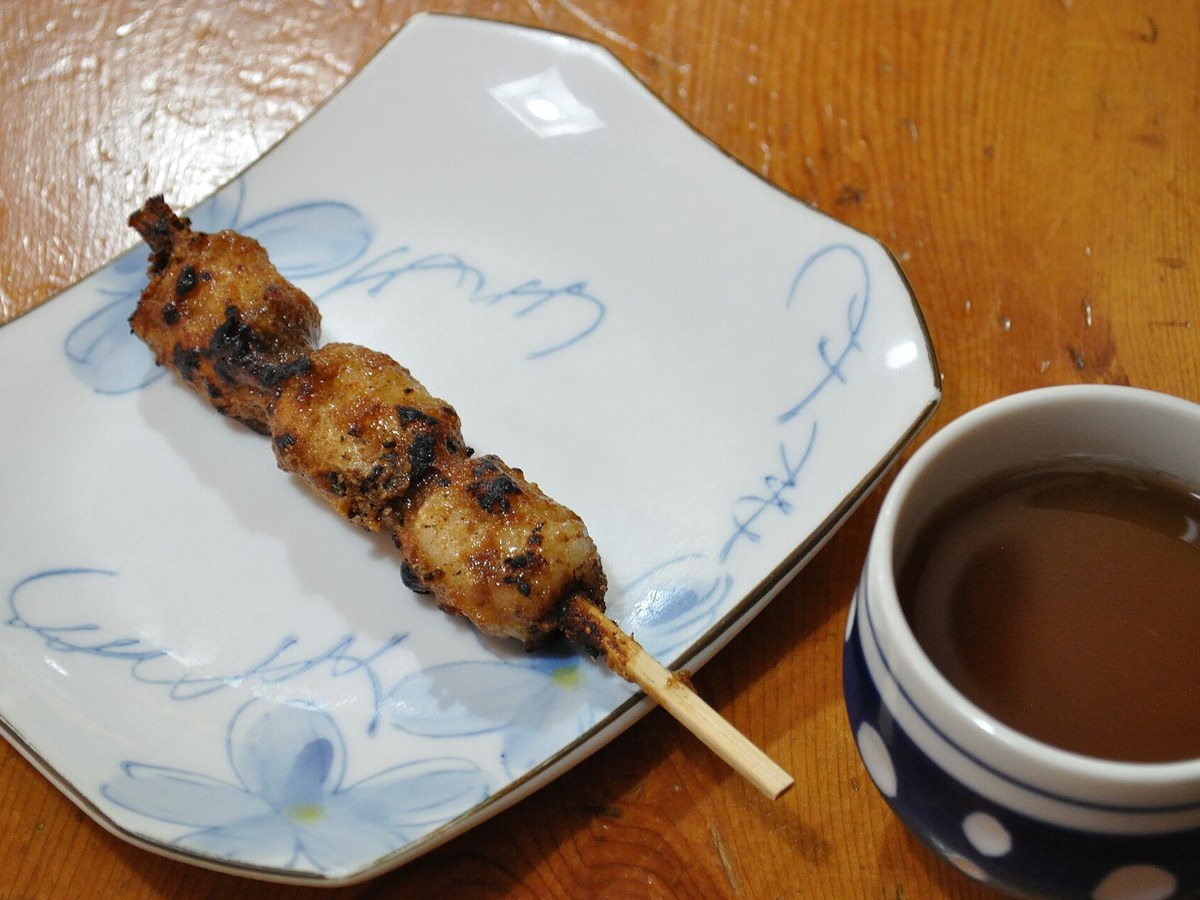
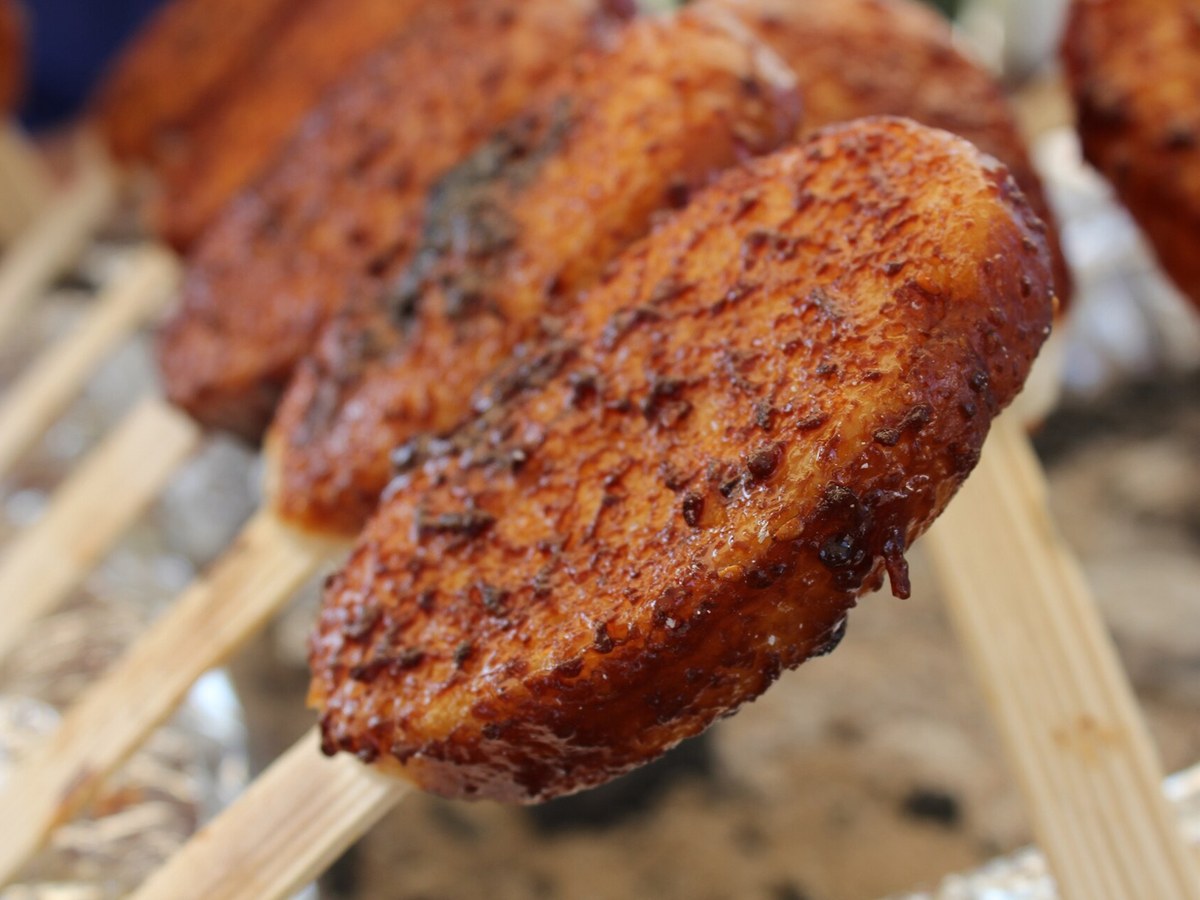
On the old Nakasendo, the mountain road that linked Edo to Kyoto through Gifu's high country, the snack at the post-town stalls is rice on a stick. Gohei mochi is cooked non-glutinous rice, pounded part-way — never smooth like mochi — shaped flat around a skewer, brushed with a dark, sweet-savory sauce and grilled until the edges catch and the walnut or miso in the sauce turns fragrant. It costs a few hundred yen, it is eaten standing up, and it has been mountain food since before the Edo period: preserved, portable and festive all at once. In Ena's Oi-juku, one house has grilled it for over sixty-five years with rice grown in the same valley.
Rice, pounded halfway
The JeePe Gifu guide defines the dish by its texture first: partially mashed non-glutinous rice shaped around a skewer, coated with a sweet-and-savory sauce and grilled until fragrant. The half-pounding is the point — the grains stay partly whole, so the skewer eats with chew and body rather than as a paste. The shapes map the region: waraji, the flat oval named for a straw sandal; dango, small round balls along the stick; and slender tawara forms, varying by region and shop.
The sauce is where each house signs its work, and the guide lists the families: miso-based, walnut-miso and soy-sauce based. Walnut is the mountain signature — the high country grows walnuts, sesame and e goma where it cannot grow much rice — and the named Gifu stops follow the sauce: walnut miso at Ena's Gin no Mori, the old-town stall of Gohei Mochi Wakabaya in Takayama, the roadside station at Mino Niwaka Chaya. The name itself carries two theories, the guide notes: a man called Gohei, or the gohei wand of Shinto ritual, whose zigzag paper the flat skewer is said to echo.
A mountain food older than the road's fame
The guide dates the custom plainly: gohei mochi has been enjoyed since before the Edo period as a mountain-region preserved food and a celebratory dish, served at festivals and gatherings, in country where flat rice fields were scarce and every bowl of cooked rice counted. Pounding and grilling turned a staple into a treat; the skewer turned it into street food. When the Nakasendo's post towns filled with travellers, the treat was already there waiting for them.
It remains, on both records, a living everyday food rather than a heritage exhibit: the guide notes souvenir and frozen versions at roadside stations and supermarkets across the region, and the prefecture still sends its makers out to demonstrate — Gifu Prefecture's own fair listing for January 2026 advertises live gohei-mochi grilling by a Nakatsugawa house as one of the fair's draws. Mountains keep their snacks.
Amakara: sixty-five years in Oi-juku
Ena's Oi-juku is one of the Nakasendo's preserved post towns, and its gohei-mochi house is in the directory: Amakara, open over 65 years, two minutes from JR Ena Station at 295-12 Oicho. Its record is a small manifesto of the form — 100 percent locally grown uruchi rice, shaped into small balls on the skewer, and a secret sauce of sugar and soy sauce loaded with sesame seeds and high-quality walnuts. Takeaway starts from a single skewer.
Eat in, and the menu shows how a snack becomes a meal in the mountains: a six-skewer set with pickles, and a full gohei-mochi set meal — six skewers with miso soup, wild vegetables, pickles and fruit. The house also sells the means of production: plain white gohei-mochi dough and its homemade sauce, for travellers who want to grill their own. Hours are 9:30 to 18:30, closed Mondays, and the directory's budget for the house is ¥90 to ¥1,000 — the whole experience, snack or set meal, inside a thousand yen.
What a skewer costs
The dated anchor is a fair listing with a named house: the Gifu Marugoto Fair at Abeno Harukas Kintetsu Honten, organised by Gifu Prefecture and held 7–13 January 2026, listed a live demonstration by Nakatsugawa's gohei-mochi house Kiraku — a specialty shop that has inherited the taste for 83 years in the post town of Nakatsugawa-juku — at **one skewer for ¥250, tax included**, on the listing published 25 December 2025. Eighty-three years of inheritance, priced like a coffee.
The guide's general range agrees: typically around ¥200 to ¥400 a skewer across the region's stops, with Amakara's own budget band of ¥90 to ¥1,000 covering everything from a single stick to the set meal. This is the cheapest article in the batch and deliberately so — gohei mochi is priced as what it is, a mountain snack — and the correct order is more than one: a walnut-miso skewer and a soy skewer, eaten hot at the stall, is the whole argument of the dish in two sticks.
Sources — checked 13 November 2026
- JeePe — Gifu Goheimochi: Grilled Rice on a Stick with Sweet Sauce (checked 13 November 2026)
- GOOD LUCK TRIP — Amakara, Ena store (directory record, checked 13 November 2026)
- Holiday Travel (Kintetsu Group) — Gifu Marugoto Fair at Abeno Harukas Kintetsu Honten (published 25 December 2025; fair 7–13 January 2026)
Original prose and official links only; no source text or maker media reproduced. Photos are credited Creative Commons works, not product photographs.
Editorial review 2026-11-13