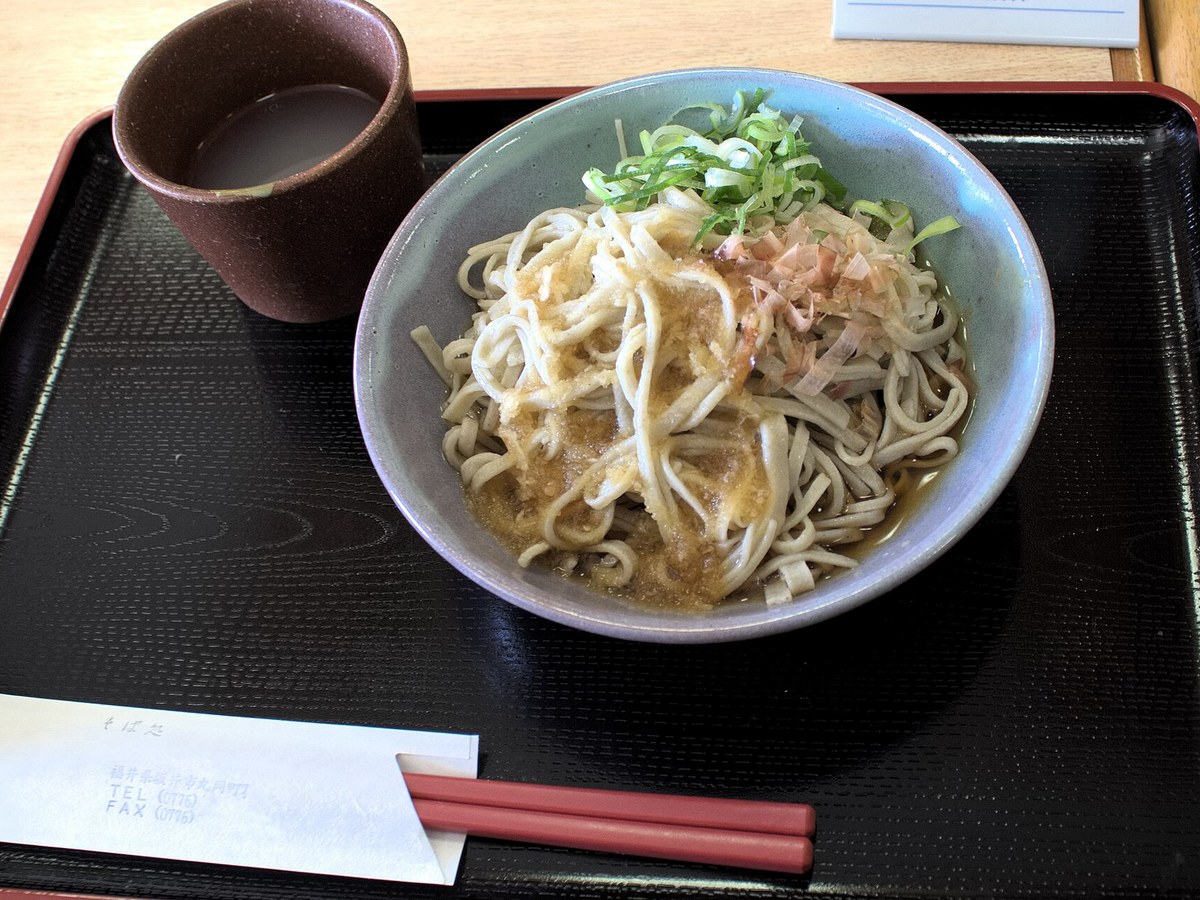
In Fukui, grated daikon is not a garnish — it is the broth. Echizen oroshi soba pours dashi and a mound of sharp grated radish over dark, thick noodles milled with their husks, and you chew it rather than slurp it. The pairing of soba and grated daikon is documented to 1601, and the prefecture still grows the heirloom buckwheat the dish was built on.
A famine crop becomes a prefecture’s noodle
Fukui’s soba starts as insurance. The warlord Asakura Takakage, seventh head of the Echizen Asakura, is said to have encouraged buckwheat growing as an emergency crop — it ripens in about 75 days — against famine and siege; the agriculture ministry’s traditional-foods register dates the start to 1471, when it was eaten as kneaded soba-gaki, not noodles. The noodle form came with a lord’s household two centuries later.
In 1601 Honda Tomimasa, the celebrated Fukui-domain elder who became lord of Fuchu (today’s Echizen City), brought a soba craftsman from Fushimi in Kyoto, and had grated-daikon soba made by his physicians and noodle men — the documented origin account of the pairing, carried by both the encyclopedia record and the ministry register. Tomimasa also had his people plant soba on poor land, where little else would grow.
The radish is the broth
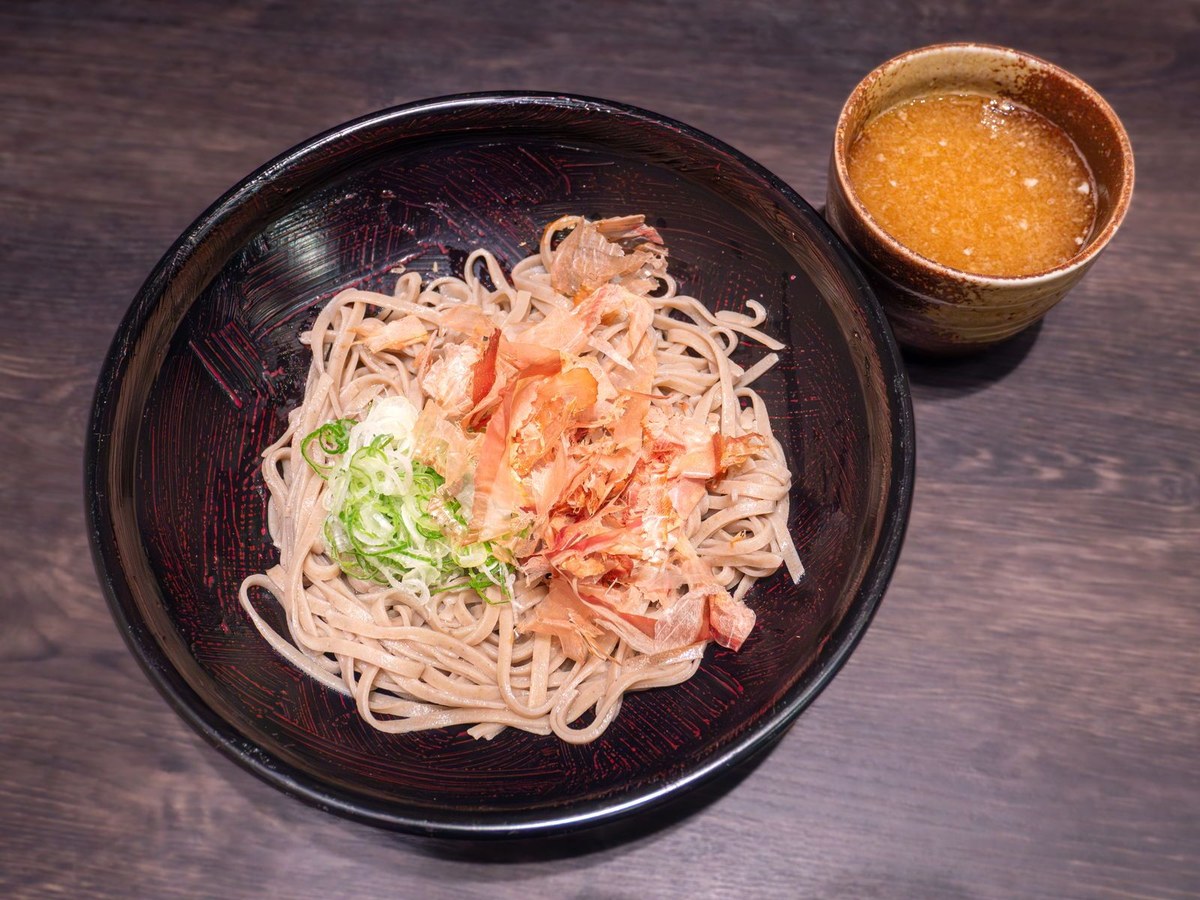
The definition is functional: grated daikon must be used, and in Fukui it is used as dashi, not as a condiment. In the bukkake (mizore) form, dashi mixed with grated radish is poured over the noodles; in the shibori form, the noodles are dipped in radish juice sharpened with raw soy sauce or dashi. Shops grate the radish to order and choose which part of the root to use to tune the heat — the standard root is a sharp-flavoured daikon, and its bite is the dish’s seasoning.
The noodle matches it: Fukui buckwheat milled with the husk in (hikigurumi), so the flour is dark and strongly flavoured, bound with strong flour and cut thick. It is a soba you chew — the record is explicit that this is not a throat-feel noodle — served cold even in winter in most of the prefecture, topped with chopped negi and katsuobushi.
An emperor’s compliment, handled carefully
The name “Echizen soba” spread after the war, and the story told for it is imperial: on his 1947 tour the Showa Emperor ate soba at Urushiya in Takefu (today’s Echizen City), praised “Echizen’s soba”, and kept mentioning it afterwards. The anecdote is carried here as the record carries it — with its correction attached: what Urushiya served him was matcha-kneaded mori soba, and the version in which he ate oroshi soba is, on the encyclopedia record, a later creation.
The documented honours need no embroidery. In December 2007 Echizen oroshi soba was chosen among the agriculture ministry’s 100 regional dishes of farming and fishing villages. And the grain itself holds a current title: Fukui-zairai, the prefecture’s heirloom buckwheat, took first place in the soba preservation society’s producing-district award three times running from 2020.
Eating it in the Reihoku plain
Order it where the radish is grated to order — the soba houses of Echizen City and Fukui City, many working in Fukui-zairai flour. The plate is modestly sized by design, and the local habit of two plates, or a plate beside a sauce katsudon, is a compliment to the kitchen, not an excess. At Moriroku in Echizen City, on the travel record read for this story, the Echizen oroshi soba in a chewy nihachi blend is ¥680 — its juice-and-raw-soy form is the purist’s order.
Ask which part of the radish today’s grating came from if you want the heat conversation every Fukui soba cook is ready to have. The dish is four centuries old and still argued at the level of a single root.
Sources — checked 14 November 2026
- Echizen soba — encyclopedia record (definition, Honda Tomimasa, the 1947 anecdote and its correction)
- MAFF Traditional Foods Register — Echizen soba (Fukui)
- Yomiuri Travel — Echizen soba, to the home of new soba (Fukui)
Checked 14 November 2026 (stored links re-fetched and judged per product): reserved where the page says so, with an editorial review note kept per product. Press, PR and travel use stays outside the grant.
Editorial review 2026-11-14