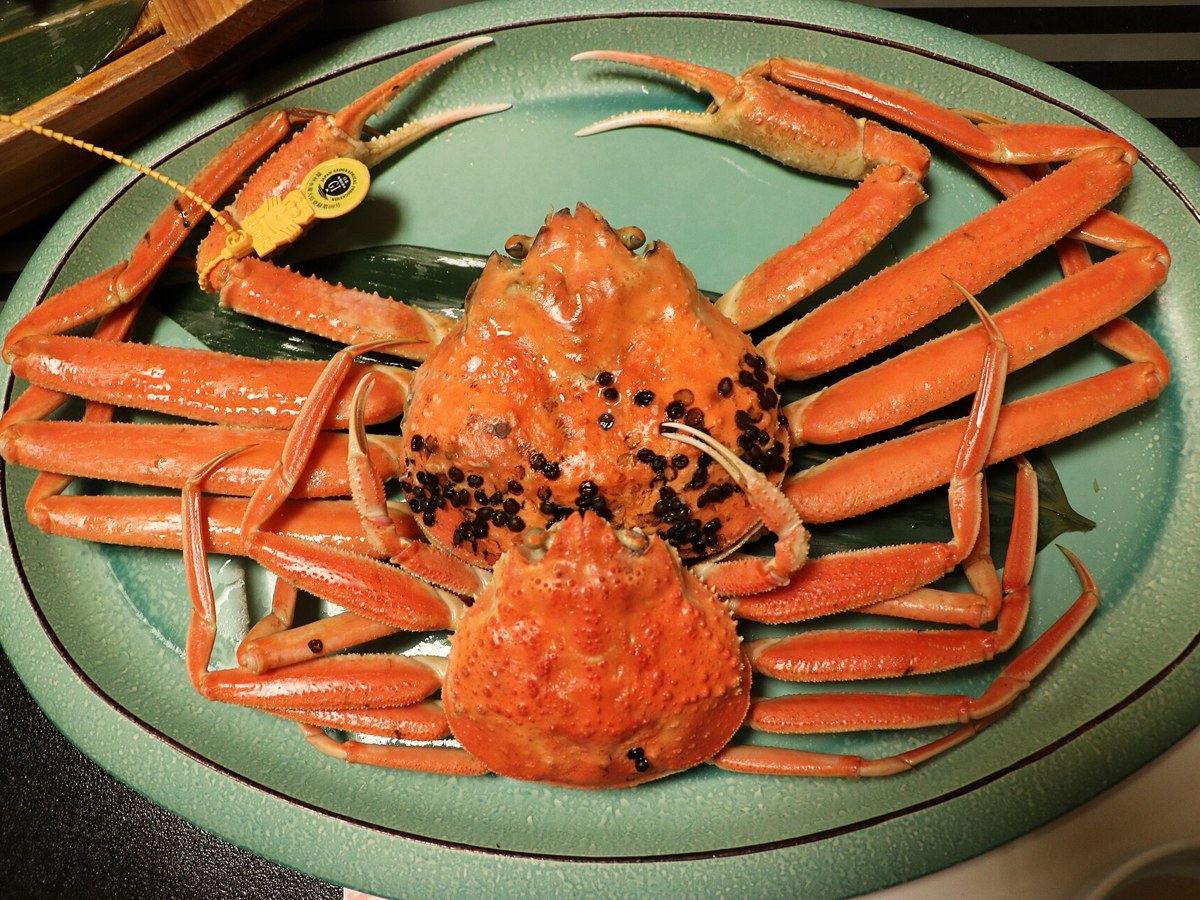
In Fukui, a crab carries its passport on its leg. Echizen crab is the prefecture's male snow crab, landed on the Echizen Coast each winter, tagged yellow at the port and protected since 2018 by Japan's first geographical-indication registration for a snow crab. It is the winter counterpart to Tottori's Matsuba crab elsewhere in this collection — and it gives Fukui its third story.
One crab, many names — Fukui's is the tagged one
Snow crab is snow crab: the same animal is landed all along the Sea of Japan coast and takes the name of its port — Matsuba in Tottori and Kyoto's north, Kano in Ishikawa, Echizen in Fukui. What separates the brands is the proof. Fukui's fishing cooperatives began attaching a yellow identification tag to each crab in 1997, the first such scheme in Japan, printed with the brand name and the landing port, so that a crab in a Tokyo restaurant can be traced back to the cooperative and the boat that landed it.
In September 2018 the name itself was locked in: Echizen-gani became the first snow crab registered under Japan's Geographical Indication system, and the tag now carries the GI mark. Fukui Prefecture calls its crab the most treasured brand-name snow crab in the country and notes that it is the only brand crab presented to the Imperial Family — the prestige claim the prefecture itself puts first.
A season with three calendars
The season is fixed by the fishery and short enough to plan a winter around. Male Echizen crab — the big animal the name properly means — is landed from 6 November to 20 March, about four and a half months. Inside that window run two shorter ones: the smaller egg-bearing female, seiko-gani, is legal only from 6 November to 31 December, fifty-six days prized locally for her roe; and mizugani, the soft-shelled male taken just after moulting, opens only in the season's final month, from mid-February in checked accounts.
At the top of the male catch sits a grade of its own. Kiwami — 'the ultimate' — is reserved for crabs of 1.5 kilograms or more when landed, with a shell 14.5 centimetres or wider, claws three centimetres or wider and no flaw anywhere; fewer than half of one percent of all Echizen crab qualify in a season. A Kiwami crab carries a second tag, and at auction and at table it prices like the rarity it is, as the practical box shows.
Prices at the port
The clearest published prices come from Uminosachi Shokudokoro ECHIZEN, a fisherman-owned restaurant on Echizen Port whose owner buys at the port auction — its page was read in full for this story. A single whole Echizen crab, ordered on arrival and cooked whole-boiled or several ways, is market price from ¥28,000 (¥30,800 including tax), with prices stated to change daily. Fukui's own official figures put a whole crab of 1.0 to 1.1 kilograms at direct-sale prices around ¥38,300, and the restaurant's graded singles run from ¥50,380 at that size up to ¥67,100 for 1.2 to 1.3 kilograms.
Courses are the predictable way in. The same restaurant's Umi-no-Sachi full course — one live crab of 700 to 800 grams per person, served four ways including miso grilled in the shell — is ¥29,480 including tax, and its winter special shares one 900-gram-plus live crab at ¥42,680. Kiwami, by contrast, is market price from ¥440,000: a figure worth reading as the brand's ceiling, proof of what the yellow tag can be made to mean at the very top of one winter's catch.
How to buy it honestly
Ask for the tag. At a market, an inn or a restaurant, asking to see the yellow tag is the simplest check that the crab in front of you is Fukui-landed Echizen crab and not another prefecture's snow crab wearing the famous name — the prefecture itself recommends exactly that. Out of season, be sceptical of the name on a menu: the fishery is closed from 21 March to 5 November, and what is served then is not that winter's Echizen catch.
Time the trip to the form you want. Come before New Year for seiko-gani and her roe; come in the season's second half for males at their fullest; come in the last month for mizugani, the soft, sweet, cheaper alternative the locals keep for themselves. Echizen Port, Mikuni and Tsuruga are the working faces of the brand — the places where the tag is attached, the auction runs, and a whole crab can still be ordered from the tank.
Sources — checked 10 November 2026
- Uminosachi Shokudokoro ECHIZEN (Echizen Port): live Echizen crab courses and prices
- Jeepe guide: What is Echizen crab? Fukui snow crab season
- Know Japan guide: Echizen Gani, Fukui's winter snow crab
- Glos Travel: Snow crab season in Japan — Matsuba, Echizen and the brand crabs
Original prose and official links only; no source text or maker media reproduced. Photos are credited Creative Commons works, not product photographs.
Editorial review 2026-11-10