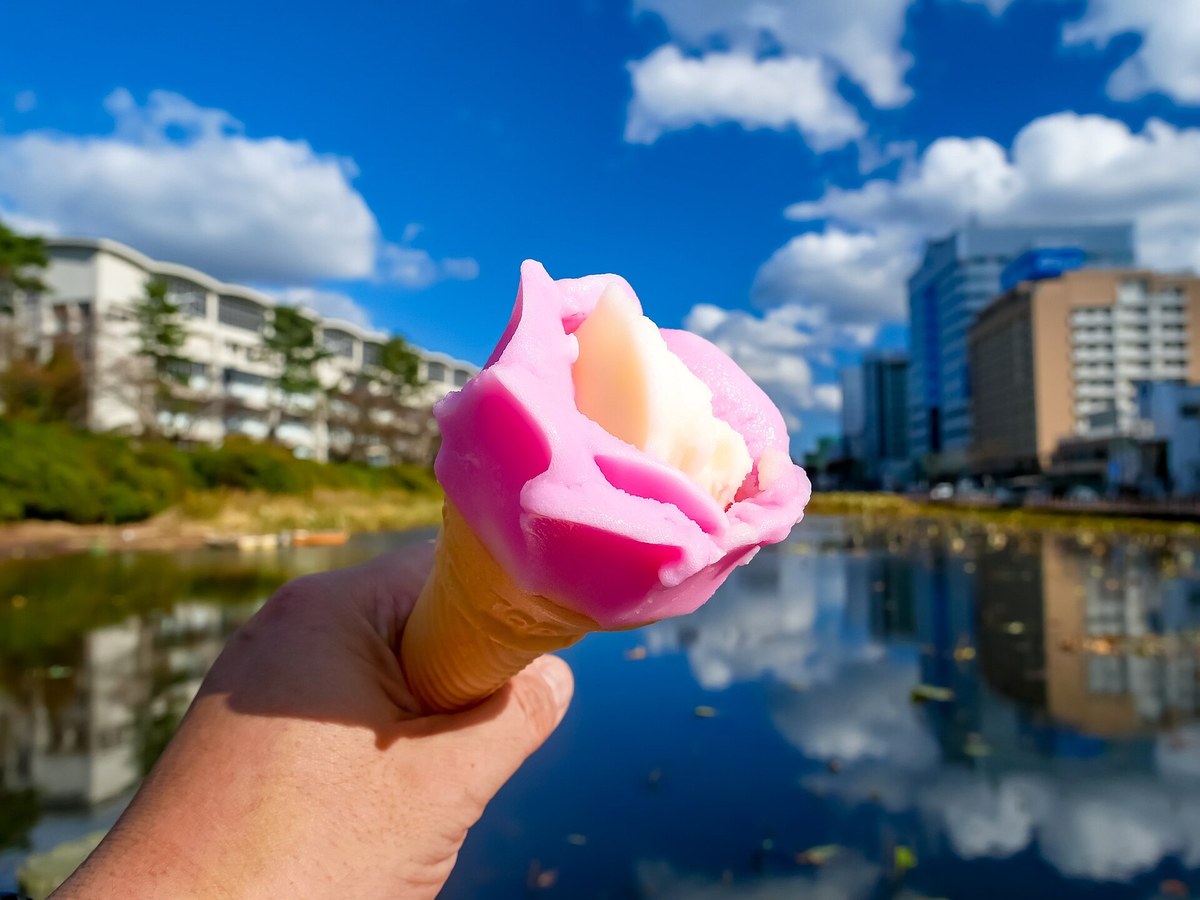
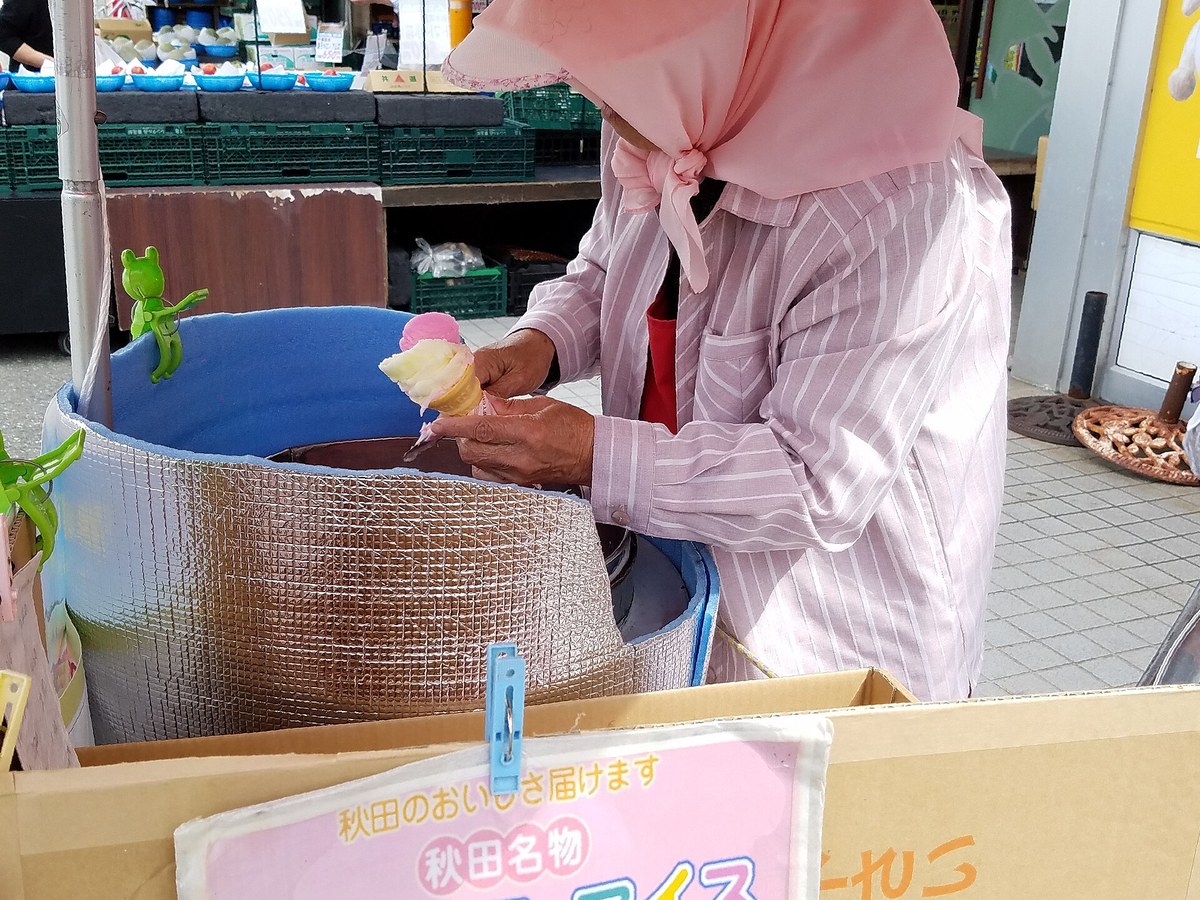
Babahera is half sweet, half street theatre: an older woman in farm dress, seated under a beach parasol beside an Akita road, scooping pink strawberry and yellow banana ice onto a cone with a metal spatula — a master hand finishing it as a rose. The name is simply the cast and the tool: baba, the grandmotherly sellers, and hera, the spatula they wield.
The parasol at the roadside
The classic pitch needs no shop: a beach parasol for shade, a seat, and a stainless insulated can at the seller’s feet, set up beside a main road, at a roadside station, in a supermarket car park or at the edge of an event ground. The seller wears her cheek-cover and long sleeves — farm dress, kept because it is also the best uniform for a day in the sun — and opens the can only when a customer stops.
Inside the can are two ices, banana (yellow) and strawberry (pink), and the tool is a flat metal spatula, the hera. The scoops alternate as they are laid on the cone, plain by default — but the hands Akita calls masters finish the cone as a bara-mori, a rose, petal by petal. The trade runs from spring to autumn outside the snow season, and peaks in high summer: it is, on the record, Akita’s summer institution.
Farm women, fish routes, and a foam box
The sellers were farm women first. The trade’s background, on the record, is the off-season side job: farming households sent their women out to sell, in their working clothes, which is why the uniform is farm dress to this day. The makers cluster around Hachirogata, the great lagoon — a trace, the record says, of the days when the selling routes were the fish-sellers’ routes.
One origin account is dated 1948, when Kodama Reika’s founder, having installed a freezer, began ice-candy making and entrusted the peddling to fish merchants — men who, in the local phrase, knew how to sell a thing before it spoiled. The technical breakthrough came in 1958: a cooler insulated with styrofoam, then the steel can form, made all-day roadside selling possible. Roadside pitches spread from about 1974 along Route 7, as motorisation arrived.
A name nobody used to say aloud
“Baba” began as a word with an edge — at first, on the record, customers did not say it to a seller’s face, and a careless use could start an argument; the sellers themselves went years without knowing the name the public had given them, which spread about 1979, perhaps from schoolchildren, perhaps from a tour-bus guide’s quick answer. The word was nobody’s brand: it grew out of the crowd.
That is what makes the ending good. When a national maker’s enquiry about a “babahera flavour” gum showed the name could be registered away from Akita entirely, Shindo Reika registered “Babahera” as a trademark in 2002 to keep it at home — and the babas, the record says, now call themselves by the name with pride. At Osaka’s 2005 ice-cream exposition the visiting stall took the event’s top sales.
Buying the rose
In season, no planning is needed: drive an Akita main road in summer and the parasols find you. Pay at the can, watch the hera work, and ask — if the hand looks practised — whether a rose is possible; the bara-mori is the souvenir photograph of Akita summer. The sellers are bussed out at dawn to their pitches by the makers and collected before dark, so the stands keep daylight hours and fair weather.
Out of season or out of prefecture, the cups carry it. On the primary retail record read for this story, JR East’s official mall sells Kodama Reika’s babahera as a bara-mori cup set — eight cups at ¥4,300 including tax, shipping included — the roadside rose, frozen into a cup by one of the founding houses.
Sources — checked 14 November 2026
- Babahera — encyclopedia record (the stall form, the name, the trademarks)
- JRE MALL (JR East) — Kodama Reika babahera bara-mori cup set, 8 cups
Checked 14 November 2026 (stored links re-fetched and judged per product): reserved where the page says so, with an editorial review note kept per product. Press, PR and travel use stays outside the grant.
Editorial review 2026-11-14