Every shibori pattern is a record of pressure: cloth pinched, sewn, folded or bound so the dye cannot reach it, then released into flowers, spider-webs and snowflakes. Aichi's fifth story is the town that made that squeezing an industry — Arimatsu, where more than a hundred binding methods survive and most of Japan's tie-dye is still made.
Born at a castle site, named on a highway
The craft account dates the beginning to the years Nagoya Castle was rising, between 1610 and 1614. Workers from Bungo, in present-day Oita, came to help build the castle wearing shibori kimono; Shokuro Takeda, who had settled in Arimatsu, saw the cloth, and made a towel using the technique with Mikawa cotton, the cotton of Aichi itself. That towel, the account says, marked the beginning of Arimatsu Narumi Shibori.
The double name came from the road. Travellers on the Tokaido began buying the dyed cloth as souvenirs at Narumi-juku, one of the highway's fifty-three stations, and the names Arimatsu Shibori and Narumi Shibori were established together; when Arimatsu and Narumi were incorporated into Nagoya City, the product took its combined name. In 1655 a woman from Bungo conveyed the Bungo technique that changed the craft again — it is still practised as Miura shibori, named for her. The craft account is exact about what the name now covers: a tie-dye fabric produced in the area surrounding Nagoya, in Aichi Prefecture — and it adds that many of the tie-dye products in all Japan are produced here.
A hundred ways to keep dye out
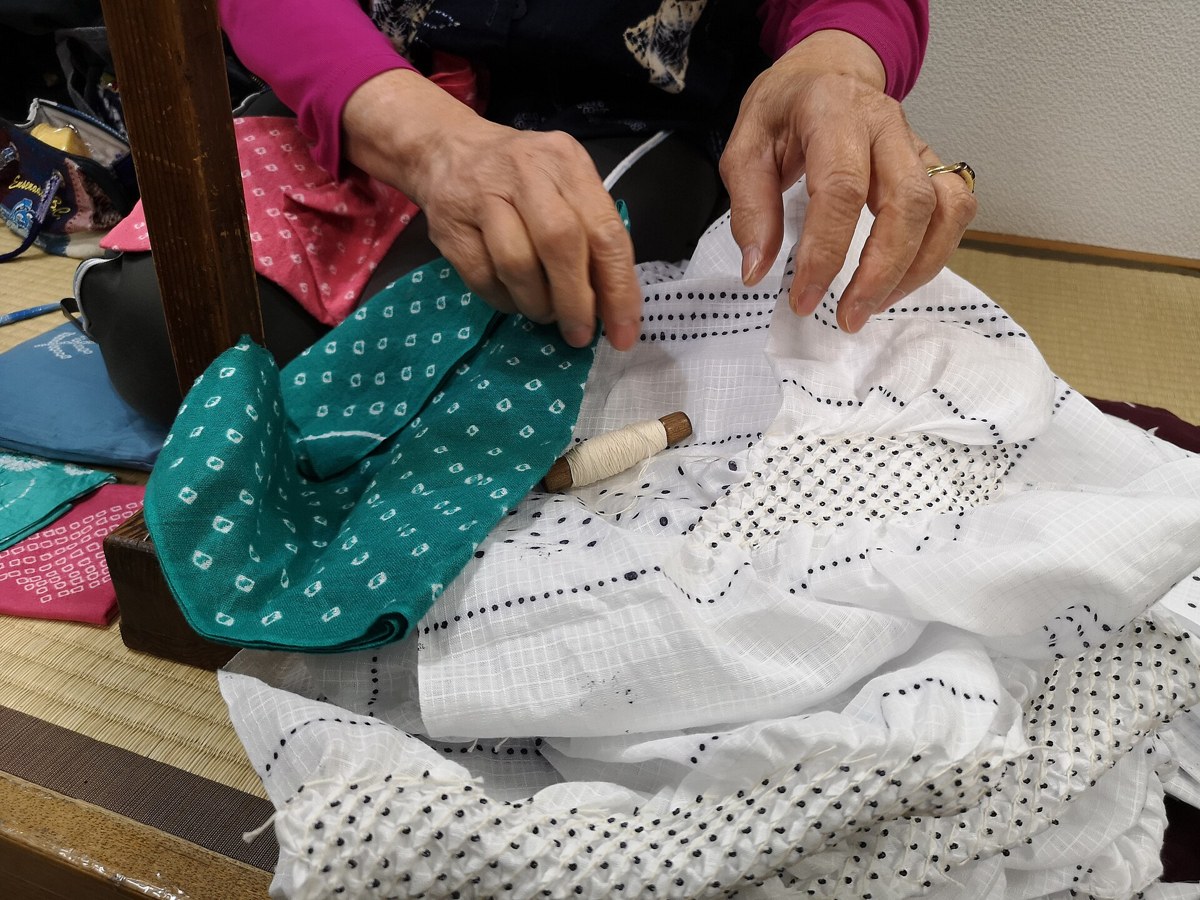
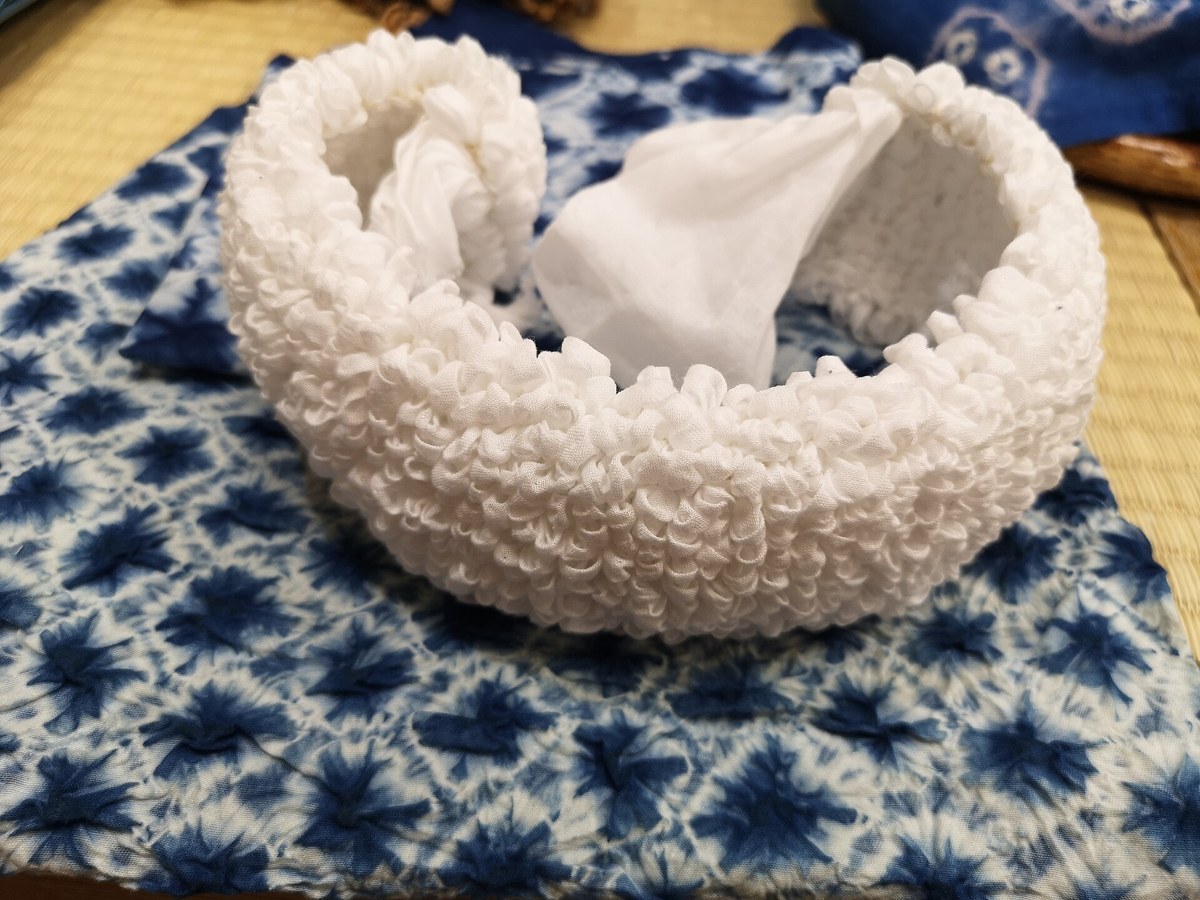
Shibori is resist by force. The craft account counts more than a hundred kinds of tie-dyeing method in Arimatsu hands: nuishibori, sewn and gathered before dyeing; kumo shibori, pleated into spider-web rings; sekka shibori, folded into snowflake geometry; kanoko shibori, pinched into the dappled spots of a fawn. The prefecture's own description counts about seventy binding techniques — kumo, arashi, sekka among them — and a product range running from silk furisode and homongi down to cotton yukata, dress fabrics and interiors.
The work is divided like the pattern. On the prefecture's account, the design is printed on the cloth with aobana-eki, Asiatic dayflower ink; the cloth is bound with cotton thread by one specialist, dyed by another, the threads removed, and the piece steamed and finished — passing through specialist craftsmen at every stage and taking on average fifty to sixty days. The craft account adds the scale inside one bolt: removing the threads alone can take three to four days, and the dyeing and resist are repeated more than twenty times.
The town that farming could not feed
Arimatsu exists because its fields failed. The town was constructed in 1608 by the old Owari province, the prefecture's travel guide records, and arable land was scarce — so as a side job to what farming they could do, many residents took up tie-dyeing. A fire in 1784 burned more than half the town; the rebuilding, in thick fire-retardant plaster walls and tiled roofs, is the streetscape visitors walk today.
The state has since wrapped the whole district in protection and titles. Arimatsu-Narumi shibori was designated a Traditional Craft on 4 September 1975, in the third national designation round, and its industry is administered from inside the town by the Aichi Prefecture Shibori Industrial Cooperative — forty members, headquartered in Arimatsu. The district became Nagoya City's first Important Preservation District for Groups of Historic Buildings in 1984, and a national one in 2016.
The Kaikan, and the mecca of shibori
The craft's front door is the Arimatsu-Narumi Tie-Dyeing Museum — the Shibori Kaikan — established in the heart of Arimatsu in 1984 to introduce the town's traditional industry. It opens 9:30 to 17:00 with admission at 300 yen for adults; demonstrations run on the second floor, and the ground floor sells the craft in every size, from kimono and fabrics to handkerchiefs, neckties, scarves, yukata, noren and bags. Its hands-on course lets a visitor bind a handkerchief for 1,800 yen including tax; the piece is dyed afterwards and mailed, generally ten days to three weeks later.
Arimatsu's reach is now global on the craft account's telling: the first International Shibori Symposium was held there in 1992, the shibori network has spread around the world since, and the Arimatsu and Narumi area is regarded as the mecca of shibori. The museum is twenty-two minutes from Nagoya Station on the Meitetsu line — close enough that the prefecture's own souvenir guide lists the cooperative's sekka-shibori tenugui, below, among Aichi's official gifts.
Sources — checked 11 November 2026
- KOGEI JAPAN: Arimatsu Narumi Shibori
- Aichi Prefecture: designated traditional crafts — Arimatsu-Narumi shibori
- Aichi Now (Aichi Prefecture): Arimatsu shibori tenugui
Original prose and official links only; no source text or maker media reproduced. Photos are credited Creative Commons works, not product photographs.
Editorial review 2026-11-11