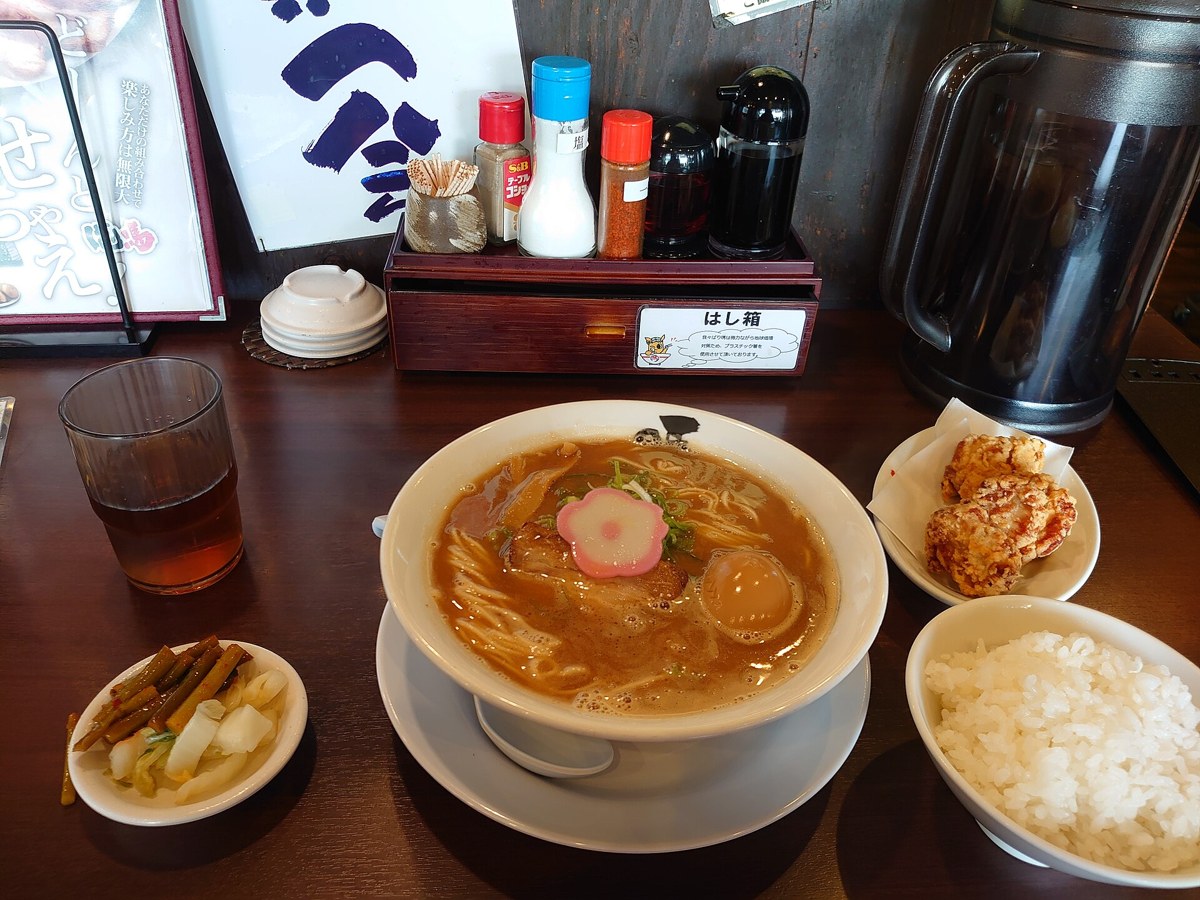
Ask for Wakayama ramen in Wakayama and you may be corrected: the bowl is chuka soba here, and it was Tokyo that invented the famous name, in the late 1990s, when a television championship crowned a small Wakayama shop the best in Japan. What the camera found was half a century old — thin noodles in a brown pork-bone soy broth, a slice of spiral fish cake, pressed mackerel sushi stacked on the counter, and a city that had never thought its lunch was anything special.
Two lineages from the tram depot
The style begins at a tram stop. Around Shakomae, the depot-front stop of Wakayama's old tram line, postwar food stalls gathered to serve chuka soba in a clear, sharp soy-sauce broth — the line that began with Marutaka's stall in 1940 and left its mark in the maru-prefixed shop names (Marusan, Marumiya, Maruki) the city still carries. When the trams vanished in 1971 the stalls moved into fixed shops, and their clearer bowls are now labelled shakomae-kei, the depot-front lineage.
The second lineage was an accident that a shop decided to keep. Ide Shoten began as a stall in 1953, founded by Tsuyako Ide, serving the depot-front style; under her son Norio, in the late 1970s, a batch of pork bones boiled too long and clouded the soup — and instead of discarding it, the shop tasted it and kept it. That emulsified, creamy tonkotsu-shoyu broth became ide-kei, and the two lineages have sat side by side in one small city ever since, with locals arguing happily over which is the real thing.
1998: the year Tokyo named it
On New Year's Day 1998, a TV Tokyo ramen championship named Ide Shoten's bowl the best in Japan. The shop — still its founder's family's single shop, with no branches — was suddenly the epicentre of a national boom, drew daily queues, and carried the style to a temporary home at the Shin-Yokohama Ramen Museum. It was in that moment that the name Wakayama ramen, born in the capital's coverage, attached itself to a dish its hometown called simply chuka soba.
The name is not just journalism. In 2006 the Wakayama Prefecture Noodle Manufacturers Cooperative registered Wakayama ramen under Japan's regional collective trademark system — Registration No. 5004520, covering Wakayama-made chuka soba noodles sold together with soup. A ramen style with a trademarked name and a cooperative standing behind it is a scope this collection can state exactly: the bowl belongs to one city's noodle makers, in law as well as in habit.
Haya sushi and the honour system
The bowl is small by design — stall customers arrived after drinking — so the counter carries the rest of the meal. Stacked in front of you are haya sushi, pressed mackerel sushi whose vinegar cuts the broth's fat, and plain boiled eggs. Neither is free, and there is no ticket for them: you help yourself while the noodles cook, keep your own count, and declare it at the till when you pay for the ramen. The honour system survives from the stall era, when owners had no time for paperwork, and few ramen regions in Japan still work this way.
The bowl itself keeps its own small rules. The noodles are thin, straight and boiled softer than fashion elsewhere allows, so they drink the broth; the gauge the city's tourism material names as standard is a fine No. 22. The kamaboko slice is chiyomaki, a swirl-patterned fish cake — Wakayama City makes kamaboko, so the local slice replaces the usual naruto. White pepper is commonly the only seasoning on the table. Restraint is the point.
What a bowl costs
The benchmark bowl is also a modest one. Ide Shoten's signature chuka soba lists at ¥880, reported by the Japan News in March 2026 — under a thousand yen for the bowl that was once voted the best in the country, at the shop's only address, 4-84 Tanakamachi, about five minutes from JR Wakayama Station, open from 11:30 with last orders at 21:30 and closed on Thursdays. Add the haya sushi you took from the counter, declared honestly, to the total.
For the wider map, Wakayama City and its tourism association publish a free pamphlet, 'Wakayama ramen: a taste tour map', featuring 35 eateries — the city's own count of its style's strongholds. Wakayama's standing stories in this collection are a plum and a lacquerware; the ramen gives the prefecture its noodle, and its most democratic one: a trademarked regional icon that still costs less than a station lunch.
Sources — checked 10 November 2026
- Wakayama Ramen: Chuka Soba, History & Best Shops (checked guide)
- The Japan News (Yomiuri): Ide Shoten — the shop crowned Japan's best
- Wakayama City tourism: Wakayama Ramen
Original prose and official links only; no source text or maker media reproduced. Photos are credited Creative Commons works, not product photographs.
Editorial review 2026-11-10