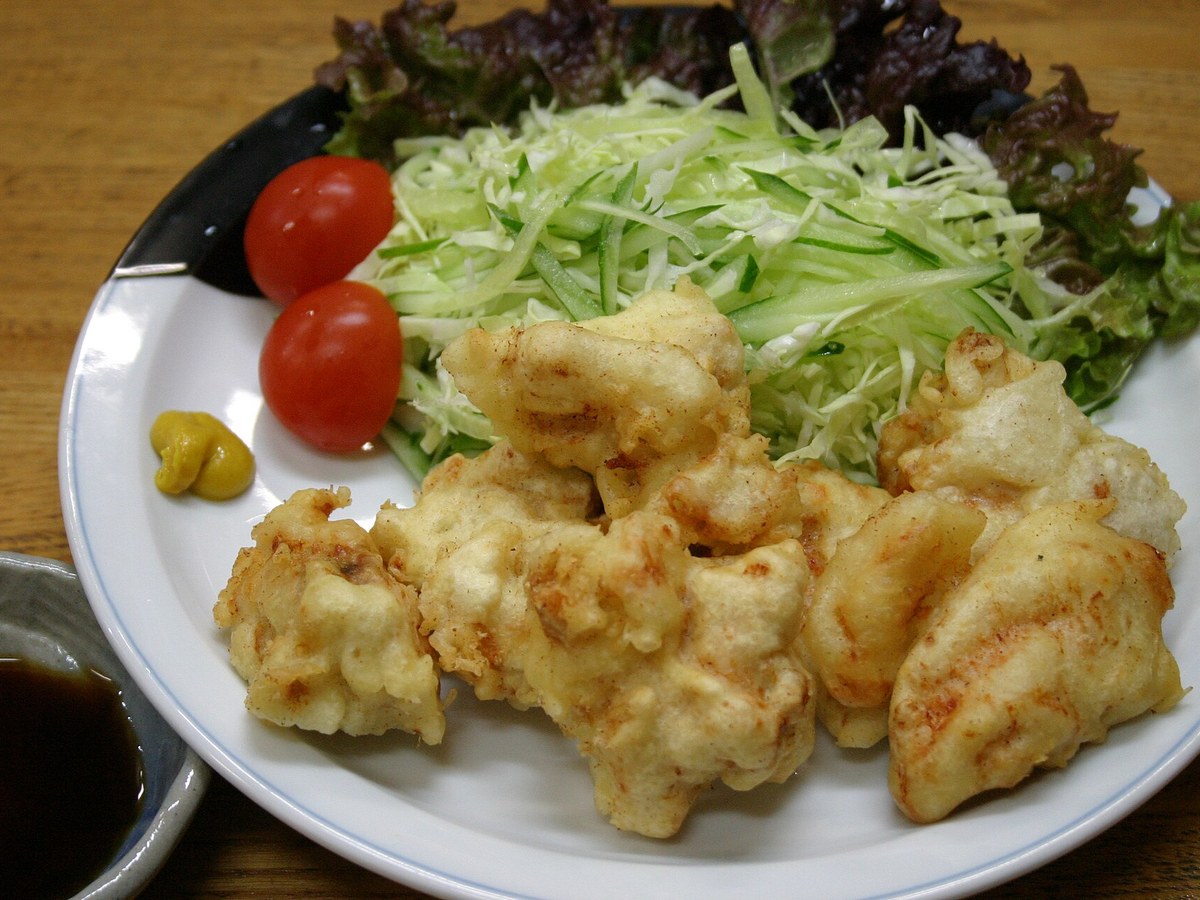
Ask Oita what its dish is and the answer comes back in batter. Toriten — tori, chicken; ten, tempura — takes bite-size pieces of chicken, marinates them in soy, garlic and ginger, wraps them in a tempura batter and fries them until the coating puffs light and crisp. It is served with ponzu and mustard, sometimes with the juice of Oita's own kabosu citrus, and locals are precise about what it is not: not tempura, because the chicken is seasoned; not karaage, because the batter is tempura's. Two cities still argue about whose restaurant thought of it first.
Seasoned where tempura is plain
The distinction Oita insists on is in the marinade. Ordinary tempura is unseasoned — the flavour lives in the dipping sauce. Toriten's chicken is soaked first in soy sauce, mirin, garlic and ginger, so the meat itself carries the seasoning, and then dressed in a tempura batter rather than karaage's starch coating. The result sits between the two families it is always compared with: a chewy, puffed crust, juicy seasoned meat, and a plate that needs nothing more than ponzu, mustard and shredded cabbage.
The cut is part of the definition. Pieces are bite-size and easy to eat, the skin is usually removed before battering, and shops and homes choose their own meat — thigh for richness, breast for lightness. At Kitchen Maruyama in Oita City, one of the shops in the founding story, a plate carries seven bite-size pieces. Eaten straight from the fryer, toriten is a set-meal staple, an izakaya plate and a home dinner all at once — which is why Oita calls it soul food.
Two cities, two founding shops
Beppu's claim, carried by its City Tourism Association, names Toyoken: a Chinese restaurant founded in 1918 whose founder, Shiro Miyamoto — a cook who had served as an imperial chef — arranged a Chinese fried chicken in Japanese style. It began, the account says, as a staff meal, then reached the menu under the name 'Deep-fried chicken', described in the menu's own words as a tempura of chicken. Toyoken still fries its toriten in its own way: domestic chicken thigh only, and an egg-rich batter made without water, so the crust stays crisp and the meat plump — fried, on the Toyoken record, at 165–170 °C.
Oita City's claim, carried by its own tourism association, names Kitchen Ikoi. From about 1958 the late Yoshio Watanabe sold toriten at a shop beside the Tokiha department store in Funaimachi, having developed it jointly with the owner of Kitchen Maruyama around 1960; its refreshing flavour outsold fried chicken, Watanabe's disciples opened shops one after another, and the dish spread across the city. Both stories are printed here as their cities tell them — the dish was plainly being refined in both cities in the same decades, and the record does not settle priority.
Neither tempura nor karaage
The comparison Oita diners actually make is with karaage, the prefecture's other fried chicken — Nakatsu's famous version among them. Karaage is marinated too, but wears a thin flour or potato-starch coat and fries up darker and crunchier; toriten's batter is mixed wet, like tempura's, and fries pale, soft-crisp and puffed. Karaage may arrive with mayonnaise; toriten's partners are fixed — ponzu with mustard, or in Oita a kabosu-based sauce that cuts the oil with citrus.
That lightness is also the home cook's reason. Toriten is a staple of Oita home cooking, the pieces cut small so a modest amount of chicken feeds a family, the batter stretching it further. Restaurants keep their own signatures — a fluffy gentle coating at Grill Mitsuba in Beppu, a choice of ponzu-style or richly seasoned versions at Mayakashiya by Beppu Station — but the grammar of the dish never changes: marinate, batter, fry, dip.
Eating it in Beppu and Oita City
Start at either claimed birthplace. Toyoken stands at 7-8-22 Ishigakihigashi in Beppu; its menu prices are published as photographs on its official site, and travel listings put a meal there in the ¥1,000–3,000 range — allow for a queue at lunch. For a dated price you can plan on, the Beppu guide's September 2026 check records Restaurant Ribbon, also in Beppu, at ¥1,600 for a toriten set and ¥1,330 for a single portion, from the June 2026 menu board on the shop's official Instagram (its website still shows the older ¥1,490 and ¥1,250, so check on the day).
In Oita City, Kitchen Maruyama serves its toriten at lunch only and closes when it sells out; across both cities, toriten appears on set menus, in izakaya and in home kitchens, so the prefecture-wide rule is simple — order it wherever the menu offers it, eat it hot, and try the kabosu squeeze at least once. Nothing about the dish travels in a box: it is fried to order, and the ten minutes after the fryer are the whole point.
Sources — checked 12 November 2026
- Food in Japan — Toriten: Japanese tempura fried chicken, recipe and restaurants (updated 9 November 2026; origin accounts after the Beppu and Oita City tourism associations)
- KONOMACHI-note — Beppu food guide: tori-ten, reimen, jigoku-mushi and dango-jiru (facts checked 28 September 2026)
- GOOD LUCK TRIP — Restaurant Toyoken, Beppu: what to eat, access, hours and price (checked 12 November 2026)
Original prose and official links only; no source text or maker media reproduced. Photos are credited Creative Commons works, not product photographs.
Editorial review 2026-11-12