Every other motsuni in Japan is a long, patient simmer. Kofu’s is a ninety-second act of violence: chicken liver, gizzard, heart and the golden unlaid eggs called kinkan, thrown into a shallow pan of boiling sugar and soy sauce and glazed over fierce heat until the tare turns to candy and every piece shines. It was invented about 1950 in a soba house that was asked to cook what the butcher was throwing away — and in 2010 it won the B-1 Grand Prix at its first attempt.
1950: the butcher’s waste becomes a soba house’s fame
Just after the war, food was still short in Kofu, and chicken offal was shorter still on value: it was being thrown away. On the agriculture ministry’s record, a butcher asked the proprietor of Okufuji Honten — a long-established Kofu soba house, founded in 1913, whose Kokubo shop anchors the story — whether anything could be made of the discarded motsu. The answer, after much trial, was a dish of soy sauce and sugar cooked down thick: the offal glazed sweet-savoury until it shone. The prefectural library’s reference record names the inventors: Okufuji’s second-generation proprietor Shiomi Yuzo, working with his brother Rikizo, after a meat wholesaler’s approach.
The dish spread the way good bar food does — to Kofu’s other soba shops, its hoto shops and its izakaya, and then into home kitchens, until a bowl of torimotsu-ni beside the noodles was simply what Kofu tasted like. For half a century it stayed local. Then, in 2008, young Kofu City Hall volunteers formed a town-promotion team with a pun for a name — Minasama no En wo Torimotsu-tai, “the team that takes (tori-motsu) everyone’s connections” — and took the dish on the road.
Glaze, not simmer: the method is the dish
The ministry’s atlas is precise about what goes in: chicken liver, gizzard, heart, kinkan — the unlaid eggs, whole and golden — and himo, seasoned with soy sauce, sugar and sake. The city’s official recipe and Okufuji’s own use sugar and soy sauce and nothing else. The tare is brought to a boil in the pan; when it foams, the offal goes in, and the cook keeps it moving, glazing piece by piece, until the liquid is gone and the tare has turned candy-like and clings shining to the pan’s surface. Start to finish is minutes, not hours.
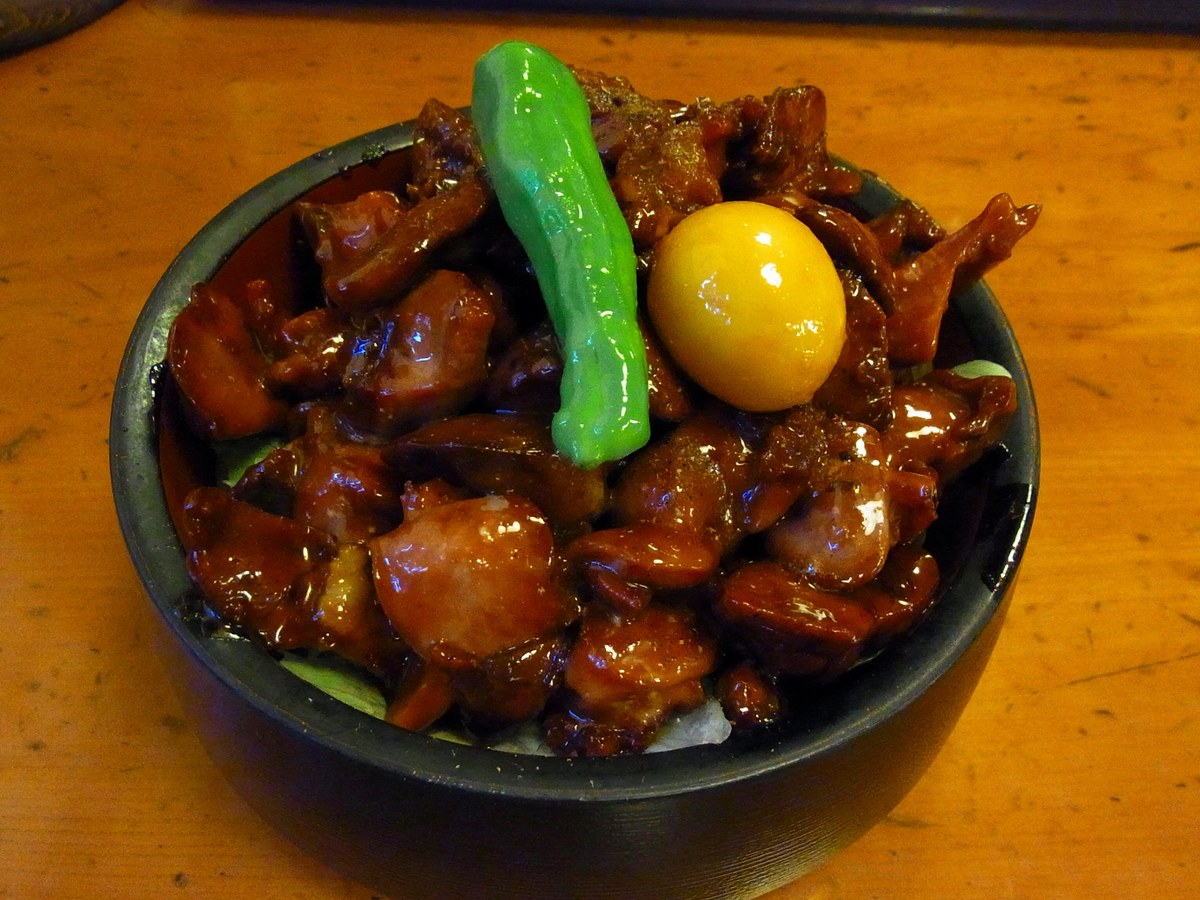
That is the whole argument of the dish. A motsuni simmers its flavour out into a broth; Kofu’s torimotsu-ni has no broth to lose flavour to — the glaze coats each piece and seals the richness in, which is why the ministry calls it a commoner’s taste with a lacquered finish. The textures stay separate inside the shine: liver soft, gizzard snapping, heart dense, and the kinkan a whole small yolk that bursts. This story’s first photograph is the form exactly: a black bowl of lacquered pieces under one green shishito, the kinkan sitting on top like a coin.
The B-1 coronation, 2010
The Torimotsu-tai joined the Ai B League in 2009 and entered the B-1 Grand Prix — the national championship of B-grade local gourmet food — for the first time at the fifth event, held at Atsugi on 18–19 September 2010. Kofu torimotsu-ni won the Gold Grand Prix outright: the first first-entry, first-win since the inaugural event. Queues formed in Kofu, the dish settled in as a sightseeing resource, and the processed forms multiplied — vacuum packs of offal marinated in tare for home glazing, retort packs that only need a hot bath.
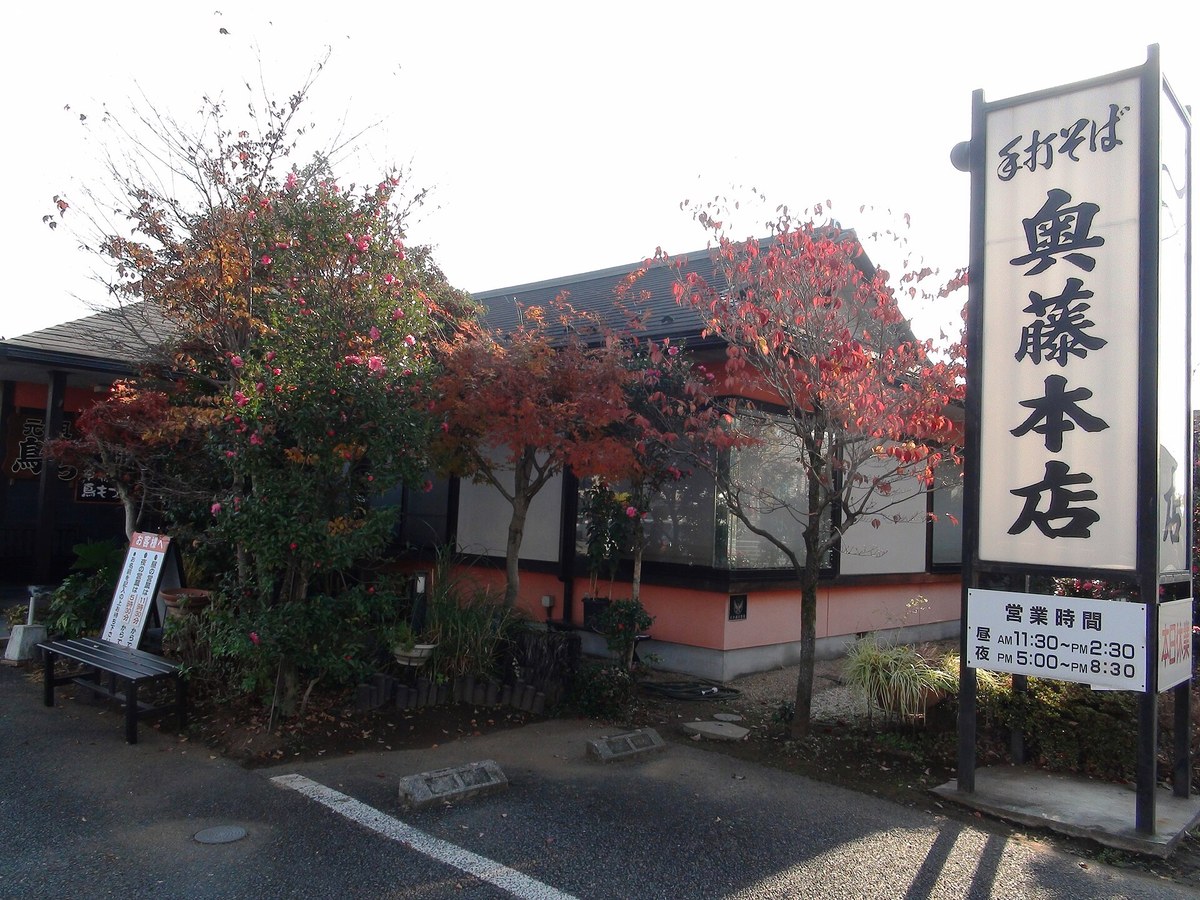
The second photograph is the source itself: Okufuji Honten’s frontage under its tall sign, the soba house where the butcher’s question was asked. The dish is still the house’s signature, served with its hand-cut soba in the sets travellers order first — and the ministry notes it is equally a standing plate at the city’s hoto shops and izakaya, and on supermarket deli counters, which is where Kofu actually eats it.
Packs and prices
The home forms are priced like the commoner’s dish it is. Ogino, Kofu’s own supermarket chain, released its Ogino Select Premium “Kofu Meibutsu Kofu Torimotsu-ni” on 6 November 2025 — the four offal cuts (gizzard, heart, liver, kinkan) glazed in the sweet soy tare, frozen in a 150-gram pack at 430 yen including tax, sold across all Ogino stores, with part of the proceeds funding the Torimotsu-tai’s town promotion. At the bottled end, Yodobashi stocks Kappo Tachiyoshi’s Koshu torimotsu-ni with kinkan, 140 grams at 875 yen including tax, in stock — the Fujikawa Town restaurant’s jarred form of the same glaze.
In Kofu itself, order it the local way: a small bowl beside soba or hoto, eaten hot while the glaze is still glossy, the kinkan saved for the middle. The glaze waits for no one — reheated, it is still good; fresh from the pan, it is the dish that beat Japan.
Sources — checked 14 November 2026
- Ministry of Agriculture (MAFF) Traditional Foods Atlas — Koshu torimotsu-ni
- Kofu torimotsu-ni — the compiled record, with the Yamanashi Prefectural Library reference
- Ogino press release — Ogino Select Premium “Kofu Meibutsu Kofu Torimotsu-ni”
- Yodobashi — Kappo Tachiyoshi Koshu torimotsu-ni with kinkan, 140 g
Checked 14 November 2026 (stored links re-fetched and judged per product): reserved where the page says so, with an editorial review note kept per product. Press, PR and travel use stays outside the grant.
Editorial review 2026-11-14