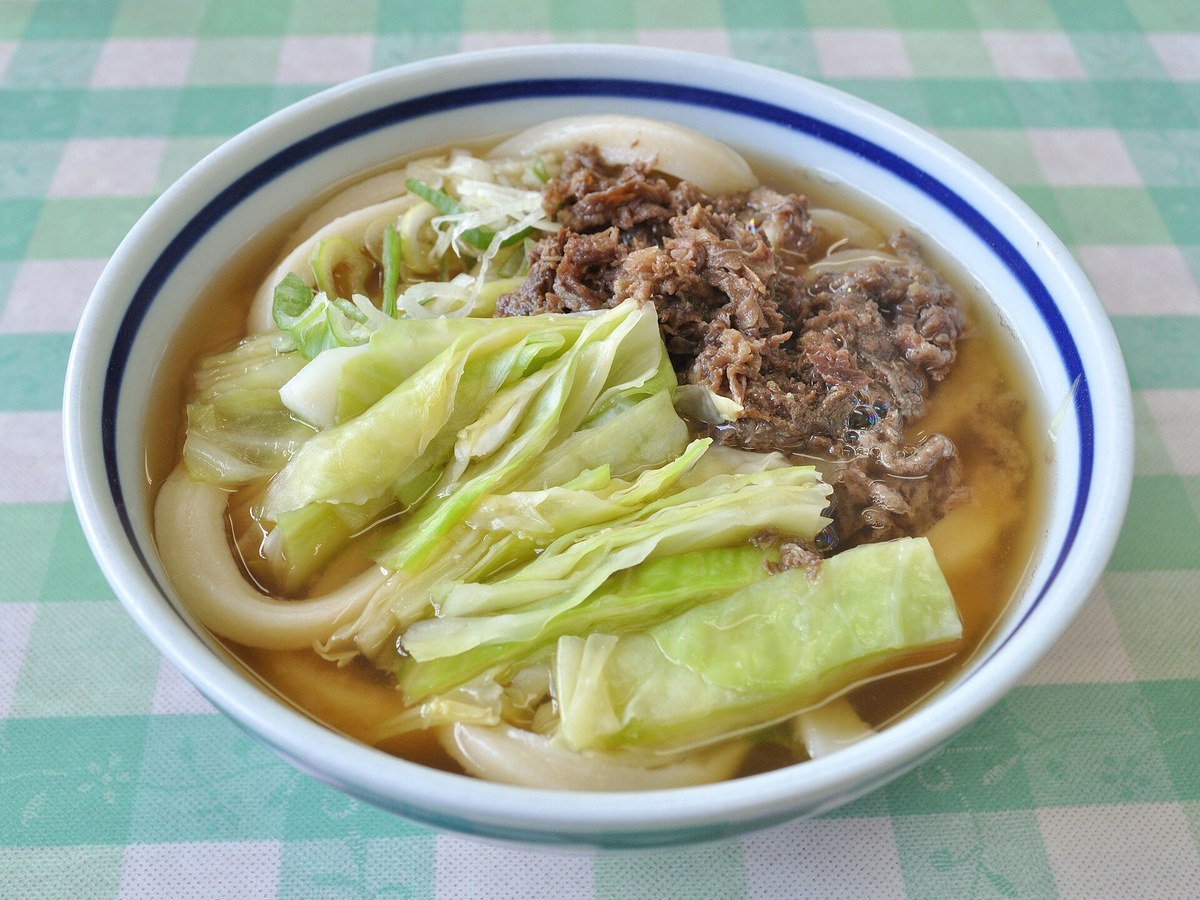
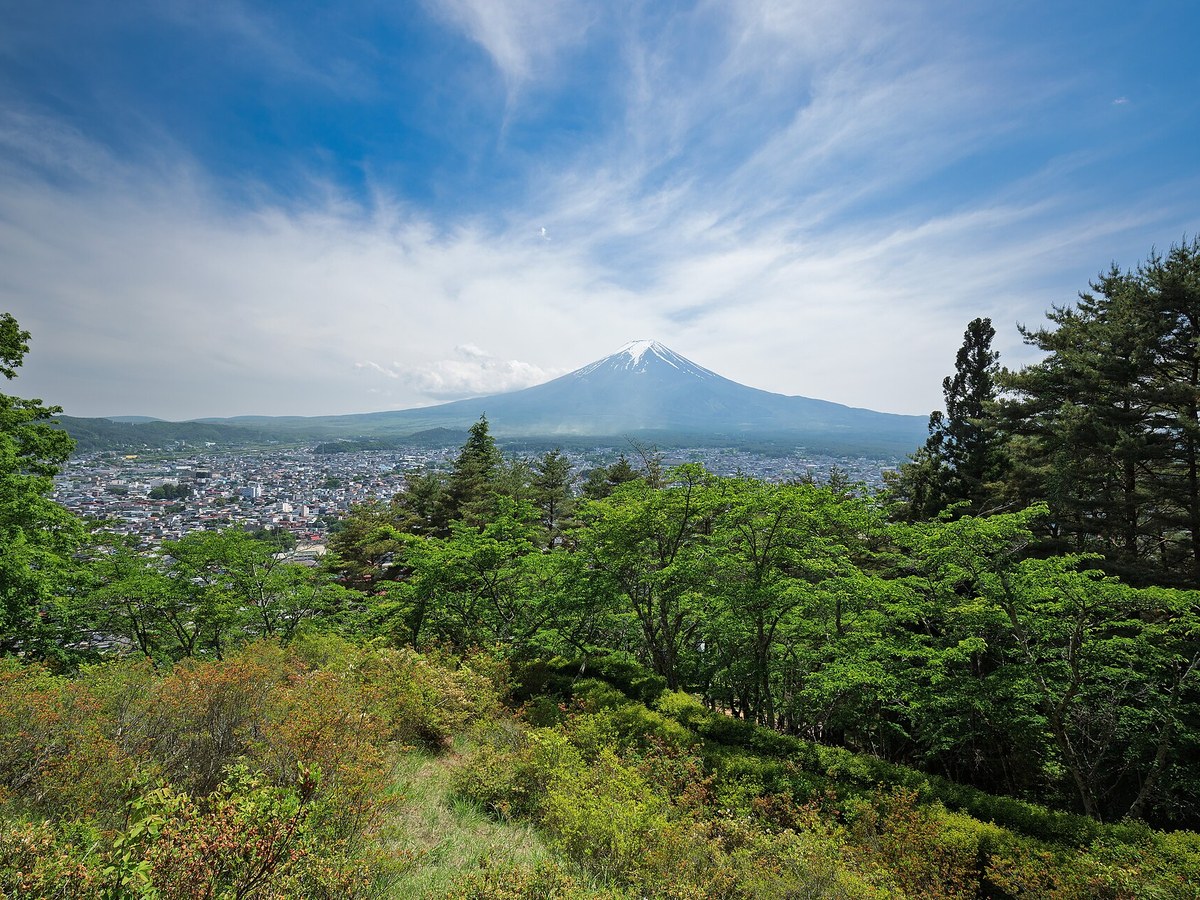
Every udon region claims chewiness. Fujiyoshida claims resistance. Yoshida udon — thick, flat noodles in a dark broth of miso and soy, under a heap of boiled cabbage and slices of horse meat, with a spoonful of fiery suridane paste waiting at the bowl's edge — is routinely called the hardest udon in Japan, and the first bite proves the point: this is a noodle you work at. It is the soul food of a silk-weaving city in the northern lap of Mount Fuji, served by more than sixty small shops, many of them a converted front room in somebody's house, most of them lunch-only, and nearly all of them cash-only.
Firmness as a local standard
The noodle is built to be difficult. Strong flour and a low water ratio make a stiff dough; it is kneaded hard, rolled to about four millimetres and cut into wide strips, then boiled ten to thirteen minutes and still comes out dense, wheaty and unyielding — closer to fresh pasta than to the smooth elasticity of Sanuki udon. Locals are explicit that a softer noodle feels inadequate; firmness is not a side effect but the specification, kept by more than sixty shops across one small city, each with its own slight variation on the theme.
The bowl around it is equally fixed. The broth blends white miso into soy sauce over a dashi base, darker and saltier than dashi-style udon soups. Boiled cabbage — a topping almost no other udon region uses — brings the sweetness; horse meat, simmered tender, is the traditional protein; and suridane, a coarse paste of chili, sesame and oil that every shop blends differently (some with sansho, some with garlic or dried fish), is added spoonful by spoonful as you eat, so the last mouthfuls are hotter than the first. Regulars judge shops by their suridane before anything else.
Pilgrims, looms and strong arms
The geography came first. Fujiyoshida sits on Mount Fuji's northern foothills, where cool temperatures and volcanic soil made rice cultivation difficult; farmers relied on wheat and barley, flour food became the everyday meal, and pilgrims climbing Fuji bought udon from vendors near the mountain entrance, carrying the dish's name outward. One of its forms, yumori udon — plain noodles in their cooking water with dipping sauce — began, the record says, as hospitality for those pilgrims, who ate the white noodles to purify the body before the climb.
The firmness came from the looms. Fujiyoshida's second industry was silk weaving: the women ran the looms and needed smooth hands for delicate thread, so — unusually for the era — the men, who handled sales and peddling, prepared lunch instead. They chose udon, simple and filling, and kneaded it with salesman's arms. After the textile industry declined, weaving families turned that kneading skill into businesses, opening the little home-front shops the city still counts by the dozen. In 2007 the agriculture ministry selected Yoshida udon among its 100 great rural regional cuisines — a working town's lunch, written into the national list.
The horse-meat topping has an inventor
Most regional dishes have no inventor. Yoshida udon's signature topping nearly does. Tsuruya Shokudo, a Fujiyoshida institution of about seventy years now in its third generation, is widely regarded as the originator of the horse-meat topping that is now standard across the city's bowls, on the GOOD LUCK TRIP record; its own noodles are a house variation, made with mineral-rich sea salt at half the salt content of typical Yoshida udon. The shop stands at 2-12-9 Asahi in Fujiyoshida, with a listed budget of ¥600 — a reminder that this whole cuisine operates at prices other noodle towns abandoned decades ago.
Horse meat is traditional, not compulsory. Chikuwa fish-cake slices, wakame, a soft-boiled egg, kakiage fritters and fried tofu all appear across the city's menus, and a first-timer can build a bowl with no horse meat at all. What cannot be skipped is the cabbage and the suridane: they are the style's grammar, the sweet and the heat that the iron-firm noodle is there to carry.
Eating it in Fujiyoshida
The city's prices are the other famous statistic: a regular bowl runs about ¥500 to ¥800, a large size adds ¥100 to ¥150, toppings add ¥100 to ¥200 each, and even a large bowl with toppings rarely passes ¥1,000. Kurechi Udon, at 1-18-22 Kamikurechi, is the traditional benchmark the guides name — miso-soy broth, horse meat, cabbage and suridane exactly as the style intends, in the same ¥500–800 band. Practical rules from the record: many shops use a ticket machine, menus are usually Japanese-only, cards are rarely accepted, seats are often shared, and the good rooms sell out early — arrive before noon.
To take the style home, packaged noodle sets — dried and semi-fresh, most including the miso-soy soup base — are sold at the Q-Sta building by Fujisan Station, at local supermarkets and at roadside stations around the Fuji Five Lakes, and several local makers ship nationwide through their online shops; jars of suridane sit on the same shelves and sell out fastest. The bowl itself, though, belongs to Fujiyoshida: sixty households kneading the same hard dough in the mountain's shadow.
Sources — checked 12 November 2026
- Food in Japan — Yoshida Udon: Fujiyoshida's extra-firm noodles guide (checked 12 November 2026)
- GOOD LUCK TRIP — Tsuruya Shokudo, Fujiyoshida: what to eat, access, hours and price (checked 12 November 2026)
- Japan Activity — Yoshida Udon near Kawaguchiko: where to eat and make it (guide updated August 2026)
Original prose and official links only; no source text or maker media reproduced. Photos are credited Creative Commons works, not product photographs.
Editorial review 2026-11-12