Every other wasabi field in Japan is a copy of a Shizuoka original. Around 1600, in the mountain village of Utogi — now a district of Shizuoka City — farmers took wild wasabi from the valley slopes and planted it beside spring water, and the crop worked so well that, the story goes, the shogun who tasted it ordered the method kept at home. Four centuries later the prefecture's heritage council still calls Shizuoka Japan's top wasabi producing region, MAFF's food-culture record gives it the largest cultivation area in the country, and the FAO has certified the whole traditional system as a Globally Important Agricultural Heritage System. This article explains the stone-built fields that make the quality, and follows the rhizome from a 15-centimetre harvest to a ¥486 tube.
Utogi, about 1600: the first planting
The birth record is unusually specific. SHUN GATE, the agriculture ministry's food-culture project, dates the beginning to the Keicho era (1596–1615), when villagers in Utogi, upstream on the Abe River, gathered the wild wasabi that grew on the slope called Wasabi-yama and replanted it in spring-fed ground; the maker's own history at Tamaruya Honten — a Shizuoka house founded on wasabi preserves — tells the same origin from the same village, noting the first plantings were made in wells fed by spring water before small water fields followed.
What happened next made it a guarded art. Utogi wasabi was offered to Tokugawa Ieyasu at Sunpu Castle, and — SHUN GATE is careful to call this legend — he liked it so much that he forbade the cultivation methods to leave the village, giving Utogi a virtual monopoly for a time, as the heritage council also records. The technique did eventually travel: in 1744 a man named Kanshiro Itagaki carried Utogi's methods over the mountains to Amagi in Izu, the prefecture's second wasabi country.
Fields built like filters
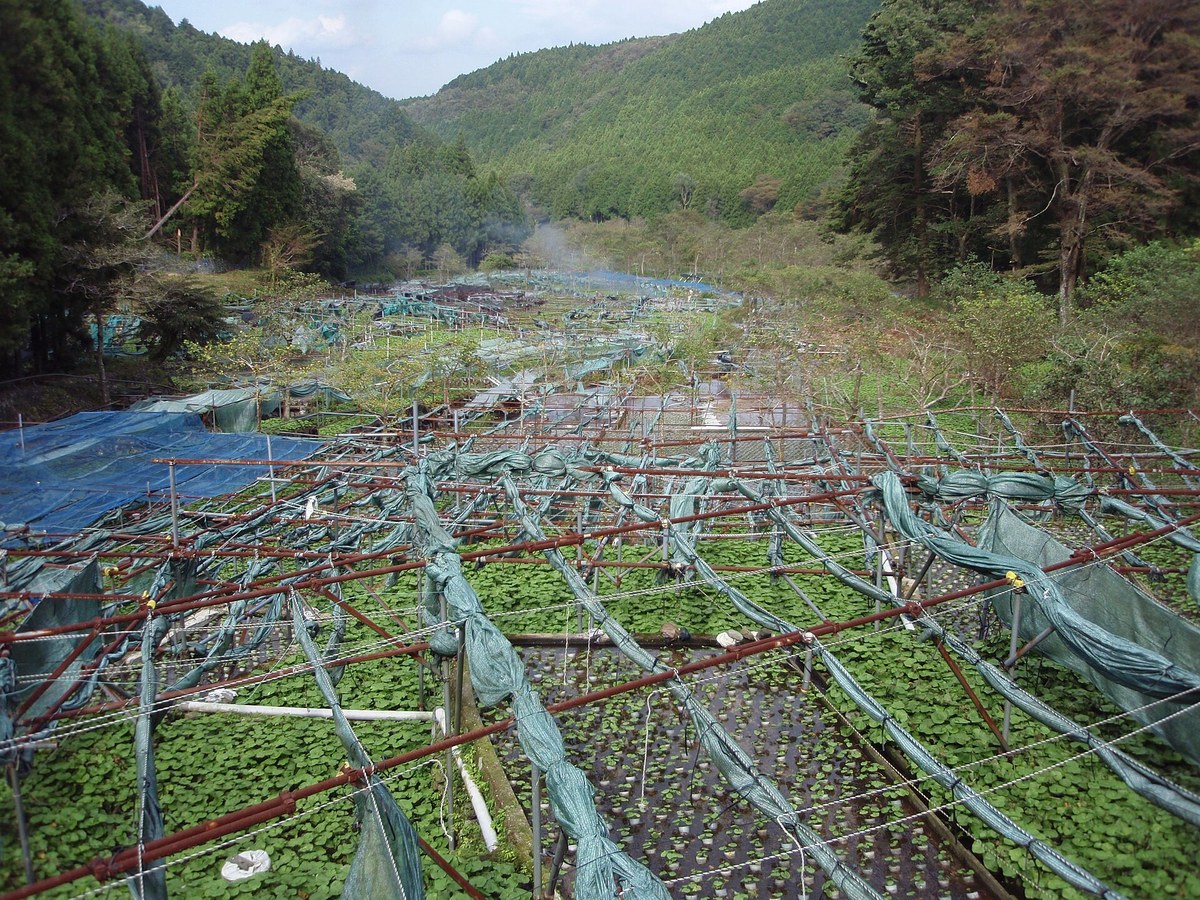
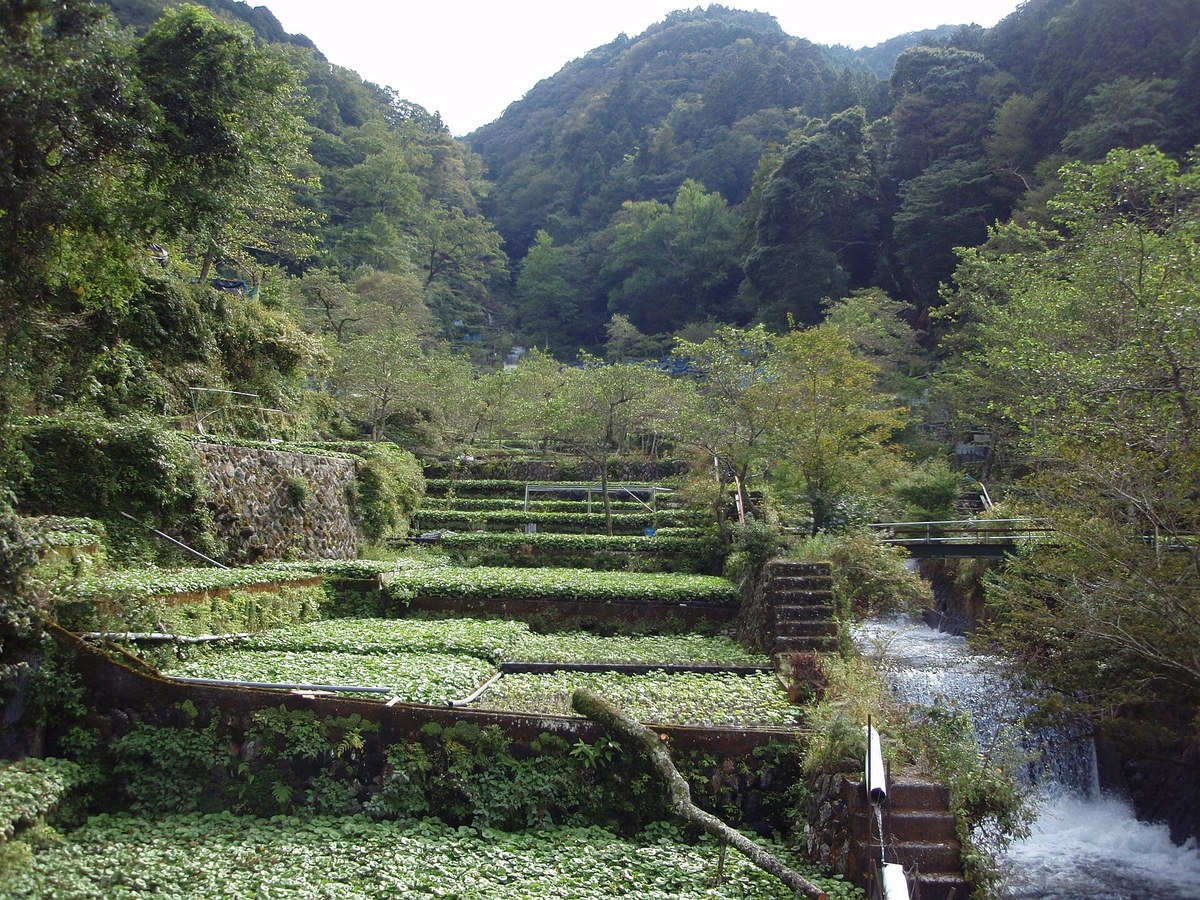
A water-wasabi field is less a field than a machine for holding spring water at one temperature. The heritage council describes the older Jizawa layout — a swamp-like bed built with what the land provides — and then the invention that defined the modern crop: the Tatamiishi style, born in Izu in 1892 (SHUN GATE places its development in Nakaizu), named for the flat tatami-like stones of its surface.
The council's cross-section reads like a waterworks specification: deep in the foundation a great number of large stones, then pebbles, then fine sand at the surface, each layer smaller than the one below. Spring water rises and flows through the stack, which filters it, holds its temperature constant through the seasons, and delivers the nutrients and dissolved oxygen the roots need. That the fields do all this with almost no fertiliser or agricultural chemicals is part of the heritage case — the same clean water keeps rare freshwater species alive in and around the terraces.
The top region, certified as heritage
The standings are stated plainly by the two official records. The heritage council: Shizuoka 'is the top wasabi producing region in Japan', its roots exceptionally thick, its quality reputation the highest in the country, 'evidenced by the consistent top ranking of Shizuoka products at nationwide exhibitions'. SHUN GATE: the prefecture 'boasts the largest cultivation area for wasabi in Japan', with cultivation centred on Shizuoka City — the birthplace district itself still at the core of the producing map.
In 2018 the system behind those standings — Traditional Wasabi Cultivation in Shizuoka — was certified by the FAO as a Globally Important Agricultural Heritage System. The certification is the reason this article treats the fields rather than any single brand as the product: what the world body recognised is a four-hundred-year-old way of farming a mountainside, and the wasabi in the shops below is valuable because it comes out of that system.
From rhizome to tube
The harvest rhythm is slow. SHUN GATE records that seedlings are planted each April and the first harvest comes the following May — over a year in the water — when the rhizomes have reached the standard 15 centimetres; larger roots for the fresh market are the patient end of the crop. Fresh Shizuoka rhizomes are a department-store and specialist-shop purchase in season, grated at the table; the everyday form of the same heritage is the prepared tube, and its honest benchmark is Tamaruya Honten, the Shizuoka maker whose wasabi preserves were first manufactured along the Abe River between 1751 and 1763, and whose name went nationwide in 1889 when its founder won the right to a shop inside Shizuoka Station.
Tamaruya's Hon-wasabi Mizuki — a 70-gram tube built on about 41 percent raw domestic hon-wasabi, with hon-wasabi (domestic) as its first ingredient — sells at ¥486 including tax in the listing checked here: the practical way to taste the difference between field wasabi and the horseradish-based standard. Read tubes the way this one is labelled: the percentage of real wasabi and its origin are printed, and a Shizuoka maker's name on a hon-wasabi tube is the heritage system reaching the supermarket shelf.
Sources — checked 11 November 2026
- Shizuoka Wasabi Association for Important Agricultural Heritage Systems — About Shizuoka wasabi
- SHUN GATE (MAFF) — Traditional Wasabi Cultivation in Shizuoka
- Tamaruya Honten — The history of wasabi preserves and Tamaruya Honten
- Yodobashi — Tamaruya Honten Hon-wasabi Mizuki 70 g (checked 11 November 2026)
Original prose and official links only; no source text or maker media reproduced. Photos are credited Creative Commons works, not product photographs.
Editorial review 2026-11-11