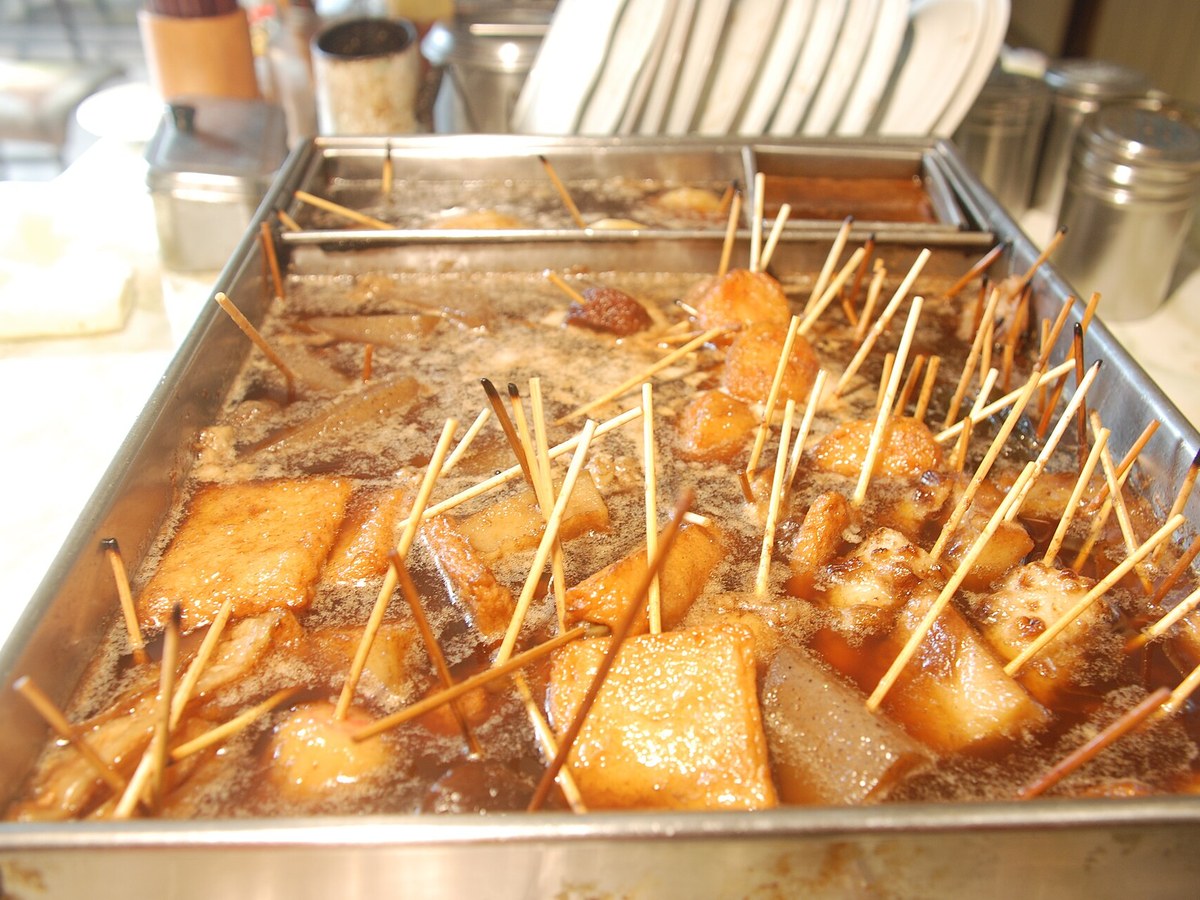
Oden elsewhere in Japan is a pale, gentle pot. In Shizuoka City it is nearly black. The broth is built on beef tendon and dark soy and topped up day after day until it darkens like strong tea; every single ingredient — daikon, egg, konjac, tendon, fish cakes — simmers on its own skewer; and when a piece is lifted out it is dusted with aonori and a powder of ground dried fish before it is eaten. Your bill, at the end, is the pile of bare sticks beside your plate. This is Shizuoka oden, and its signature piece, the grey-black hanpen of Suruga Bay, tells you which city you are in.
Black broth, one skewer each
The prefecture's own account lists the form without decoration: ingredients such as beef tendon, black fish cake, fish paste, daikon radish and eggs are all skewered, simmered in a dark broth, and topped with green laver and fish-broth powder. Three of those choices are Shizuoka's signatures. The broth takes its colour and depth from beef stock and dark soy, kept and replenished rather than thrown away. The skewering is total — one piece to a stick, which is how the dish is sold, served and counted. And the finish is a dusting, not a sauce: aonori and dashiko, dried sardine, mackerel or bonito ground to powder, sometimes with mustard alongside.
The form makes the pot a menu you read with your eyes. Each skewer leaves the broth when its piece is ready, the counter keeps your sticks, and a meal is built piece by piece — two sticks or twelve, at a child's pace or a drinker's. In most of Japan oden is winter food; Shizuoka, which raised generations of children on it at candy stores, eats it all year.

Kuro hanpen, the grey cake of Suruga Bay
Every oden has a local piece, and Shizuoka's is kuro hanpen — black hanpen. Tokyo's hanpen is white, square and airy, whipped from pollock and egg white. Yaizu's is a flat grey half-moon of sardine or mackerel minced with the bone, dense and plainly savoury, made from the catch of Suruga Bay. In Yaizu itself, the prefecture's gastronomy record notes, people simply call it hanpen; the 'kuro' was added (in 1945, on that record) to tell it apart from the white kind. Yaizu produces more of it than anywhere else in Japan.
The cake is a port's invention: fish too small or plentiful for the fresh market, ground whole — bone and all — into a paste that keeps its bite in a long simmer. At Yamashita Shoten, Yaizu's oldest black-hanpen maker, the fish is mackerel landed at Ogawa Port, and the direct-sale prices on the prefecture's gastronomy site read ¥150 for five large cakes, ¥110 for five medium and ¥90 for eight small. Shizuoka homes also grill it, fry it as kurohanpen-furai, or drop it in soup — but the oden pot is where it belongs.
Candy-store food that grew up
The prefecture dates the dish to the Taisho era, and its spread to the years after World War II, when beef tendons and pork offal that had been discarded went into the pot and found their flavour there. Seafood was never scarce — Suruga Bay supplied the fish-paste products, black hanpen among them — so the pot married the cheapest meat to the local fish cakes, and the combination stuck.
Its social home was the dagashiya, the candy store. The prefecture's account stresses it: Shizuoka oden was sold at candy stores in the city, and many people have enjoyed it as a snack since childhood — a skewer or two after school, priced by the stick, within a child's coins. The adult version simply moved the same pot behind the counters of tiny oden shops and izakaya, where the counting of sticks at closing time is still the ritual that ends the night.
Eating it in Shizuoka City
Eat it in Shizuoka City, at the small counters where the pot sits in the middle of the room and the sticks accumulate. Order the signatures first — kuro hanpen and beef tendon — then daikon and egg, and take the dusting of aonori and dashi powder as it comes; a typical counter evening runs to a handful of skewers a person rather than a set menu. For a published per-piece price to plan by: Mizunoo, a specialist serving Shizuoka oden, lists its oden from ¥180 a piece (excluding tax), with a five-kind omakase set at ¥880 including tax, on its menu gallery as read on 12 November 2026 — Shizuoka City's own counters price by the skewer on the wall board, so bring cash and let the sticks be counted.
To take the flavour home, buy the cake, not the pot: kuro hanpen is sold across the prefecture and at its Yaizu makers (Yamashita Shoten's direct prices above), and it grills and fries as happily as it simmers. The broth itself is the one thing that does not travel — each shop's pot is its own, darkened by its own days.
Sources — checked 12 November 2026
- Shizuoka Prefecture (official) — Shizuoka Oden, Shizuoka Food Information Center (checked 12 November 2026; the prefecture's account, sourced to MAFF's Our Regional Cuisines)
- Ministry of Agriculture, Forestry and Fisheries — Our Regional Cuisines: Shizuoka Oden (checked 12 November 2026)
- Shizuoka Prefecture Gastronomy Tourism (official) — Yaizu's kurohanpen: a factory tour report (read 12 November 2026)
- Mizunoo — Shizuoka oden menu gallery (published menu, read 12 November 2026)
Original prose and official links only; no source text or maker media reproduced. Photos are credited Creative Commons works, not product photographs.
Editorial review 2026-11-12