Japan learned the hamburger in Sasebo, about 1950, straight from the men who ate it: US Navy sailors stationed at the base taught local cooks the recipe, and the port city has guarded the lesson ever since by refusing to standardise it. A Sasebo burger has no fixed filling, no house sauce, no chain recipe — the definition is a place and a discipline: handmade, cooked to order, in Sasebo. What the city certifies is not a flavour but a way of working.
About 1950: the recipe crosses the base fence
Sasebo was a navy town twice over — an Imperial Japanese Navy base from 1889, burned flat in the 1945 air raids, then a US Navy station in the occupation years. About 1950, as the city boomed on Korean-War demand, bars and diners serving American personnel multiplied, and on the standing record local cooks learned the hamburger recipe directly from US Navy men. The first shop is honestly not documented: old Sasebo hands name Hikari or Blue Sky as the oldest surviving houses, and the record leaves it there.
What Sasebo did with the recipe was the opposite of franchising. No two houses build the same burger, and that was never treated as a problem to fix. The name itself came late — a Sasebo-trained cook, Yoshimura Yutaka, trademarked “Sasebo Burger” in 2003 when he opened a shop in Tokyo — and the city answered by defining the thing on its own terms.
The definition: handmade, to order, here
The certification system, created in January 2007, is Sasebo’s real recipe document. A committee drawn from the city’s health and welfare department, food professionals and media judges shops on originality and independence, reliability, local sourcing and the handmade principle; certified shops — twenty-five inside the city on the record — hang the certificate bearing the Sasebo Burger Boy, the mascot Yanase Takashi, the creator of Anpanman, drew for the city. In June 2019 “Sasebo Burger” was registered as a regional collective trademark, held by the city’s burger business cooperative.
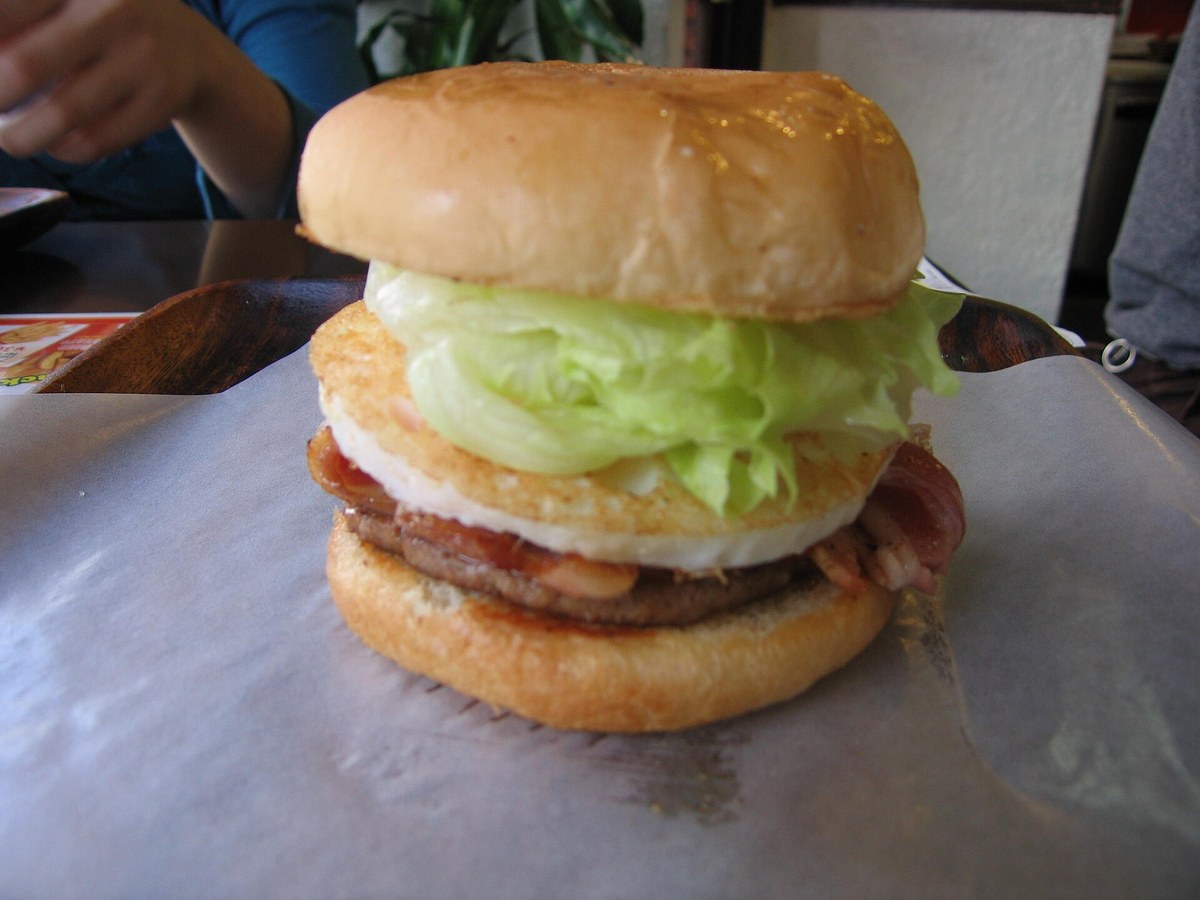
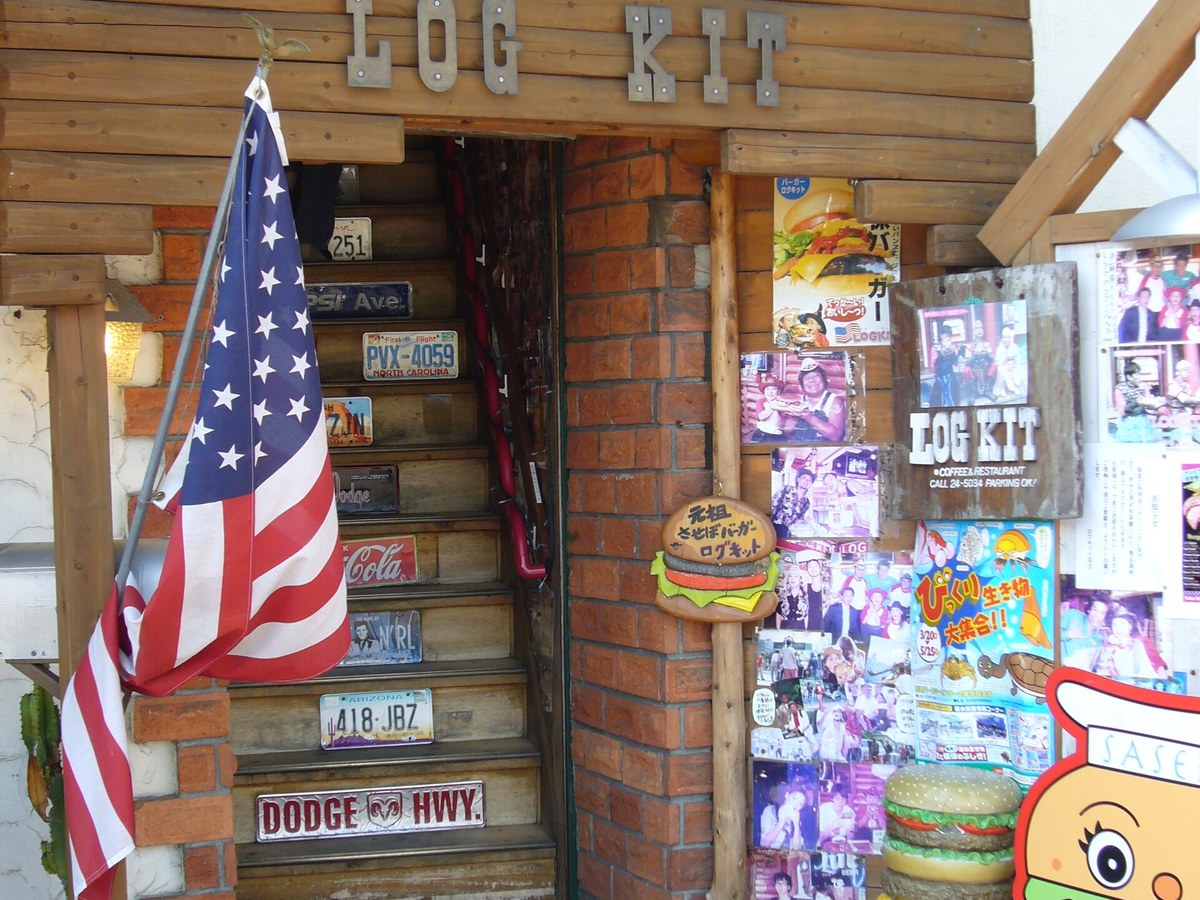
So the tests are three: the shop is in Sasebo, the burger is handmade, and nothing is cooked before you order it. Inside those tests, everything is free — Big Man builds its name on a bacon-egg burger with bacon smoked ten days over cherry wood; Hikari, trading since 1950, on a sweet house mayonnaise; Log Kit on a 100% beef patty its owner developed chasing the taste Americans ate inside the base, its Special running about fifteen centimetres across and five hundred grams.
Two photographs, one argument
This story’s first photograph is the discipline served tall: a bacon-egg burger stacked patty, bacon, fried egg and lettuce in a soft bun — the form Big Man claims to have invented and half the city now builds. The second is the other half of the definition, the place: Log Kit’s entrance under its American flag, licence plates up the stairwell and the Burger Boy grinning at the edge of the frame — a shop that looks like the base fence the recipe crossed.
Eat in that order of understanding. Order, wait — the wait is the certificate working — and eat it two-handed and hot. A Sasebo burger eaten from a warmer would fail its own definition, and the city would be the first to say so.
What a burger costs in Sasebo
Prices are shop prices, read in the city’s guide in November 2026. Big Man’s bacon-egg burger — the signature, at its Jokyo main shop — is 968 yen. Hikari’s special burger, with cheese, bacon and egg, is 780 yen at its Gobangai shop. Log Kit’s special burger, the fifteen-centimetre one, is 1,525 yen at its Nagasaki Airport branch, and Retty’s Sasebo listings record Log Kit’s regular-size Sasebo burger at 900 yen.
Budget a queue into the price: the famous houses cook to order at lunch pace. The airport and station branches (Log Kit has both) are the traveller’s shortcut — same definition, shorter line, and the Burger Boy certificate on the wall to prove the branch kept the faith.
Sources — checked 14 November 2026
- Sasebo burger — the compiled record of the name, the definition and the certification system
- Log Kit (LOG KIT) — the shop’s official site
- Sasebo City hamburger guide — shop menu prices (updated 13 November 2026)
Checked 14 November 2026 (stored links re-fetched and judged per product): reserved where the page says so, with an editorial review note kept per product. Press, PR and travel use stays outside the grant.
Editorial review 2026-11-14