Some regional dishes are discovered. Champon was engineered — deliberately, in 1899, to solve a problem: how to feed a poor Chinese student in Nagasaki a meal that was cheap, filling and genuinely nutritious, all in one bowl. The engineer was a Fujian-born restaurateur named Chen Pingshun, and his solution — noodles simmered in broth under everything the harbour market had that day — became the taste of the city itself.
1899: a bowl built for students
Shikairo's own history, on its official site, is precise about the setting and the intent. The restaurant was founded in 1899 as a Chinese restaurant at Hiromabacho, on the site of Nagasaki's former Chinese residence — the quarter where the port's Chinese community had lived through the centuries when Nagasaki was Japan's one open window. Its founder, Chen Pingshun, from Fujian in Qing-era China, devised champon and sara udon for the Chinese compatriots and Chinese students then in Nagasaki, searching for a menu that was tasty, generous, nutritious and cheap: a noodle dish built on a chicken-bone and pork-bone soup, loaded with the produce of Nagasaki's seas and mountains.
The design brief explains the dish's odd, enduring shape. A student's meal cannot be a course; it must be everything at once. So the protein, the vegetables and the starch share one vessel, the broth carries the nourishment, and nothing is wasted — the same thrift, in the same harbour city, that had already given Nagasaki its layered shippoku cuisine. Champon is shippoku's working-class child: the port's fusion table, compressed into a single bowl a student could afford.
Simmered in the soup, not dropped into it
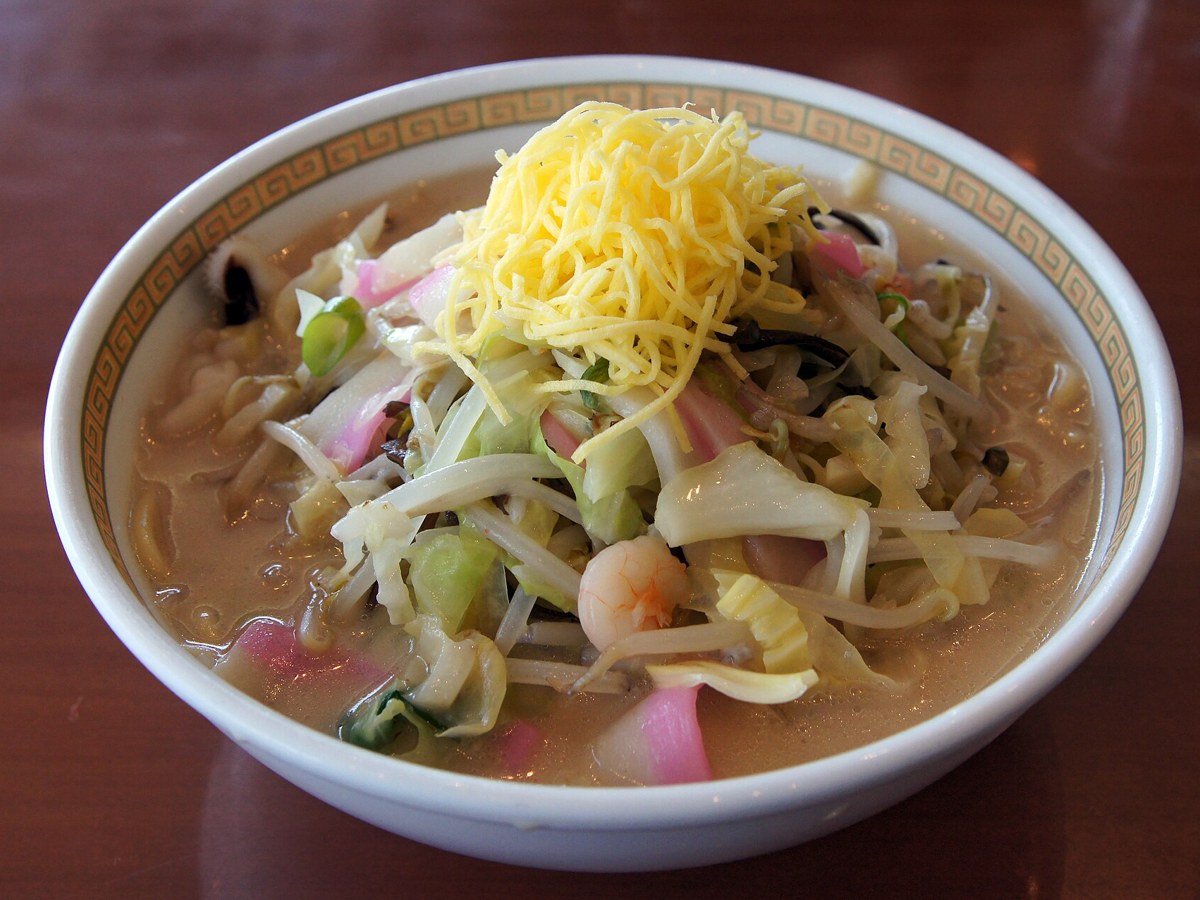
The technique separates champon from ramen at the first step. The thick noodles — their own texture, between ramen and udon — are simmered directly in the broth rather than boiled apart and combined at serving, so noodle and soup finish as one thing; the checked guide notes the practical consequence, which is to eat promptly, because the noodles keep drinking the broth in the bowl. Over the top goes the stir-fry: on the MATCHA guide's count, around nine varieties — cabbage, wood-ear mushrooms, bean sprouts, shrimp, squid, fish cake and savoury meats, wok-tossed before they meet the soup.
At the founding house there is a signature on the bowl: finely shredded egg scattered over the top, a thread of gold no other Nagasaki house claims as its own. And beside champon on every menu stands its sibling — sara udon, which Chen devised as a variation from the same kitchen: the noodles grilled first, the ingredients stir-fried with a little soup and served soup-less on a flat plate. Order carefully; the names are cousins, not twins, and Nagasaki people have been correcting visitors for a century.
What the founding house charges
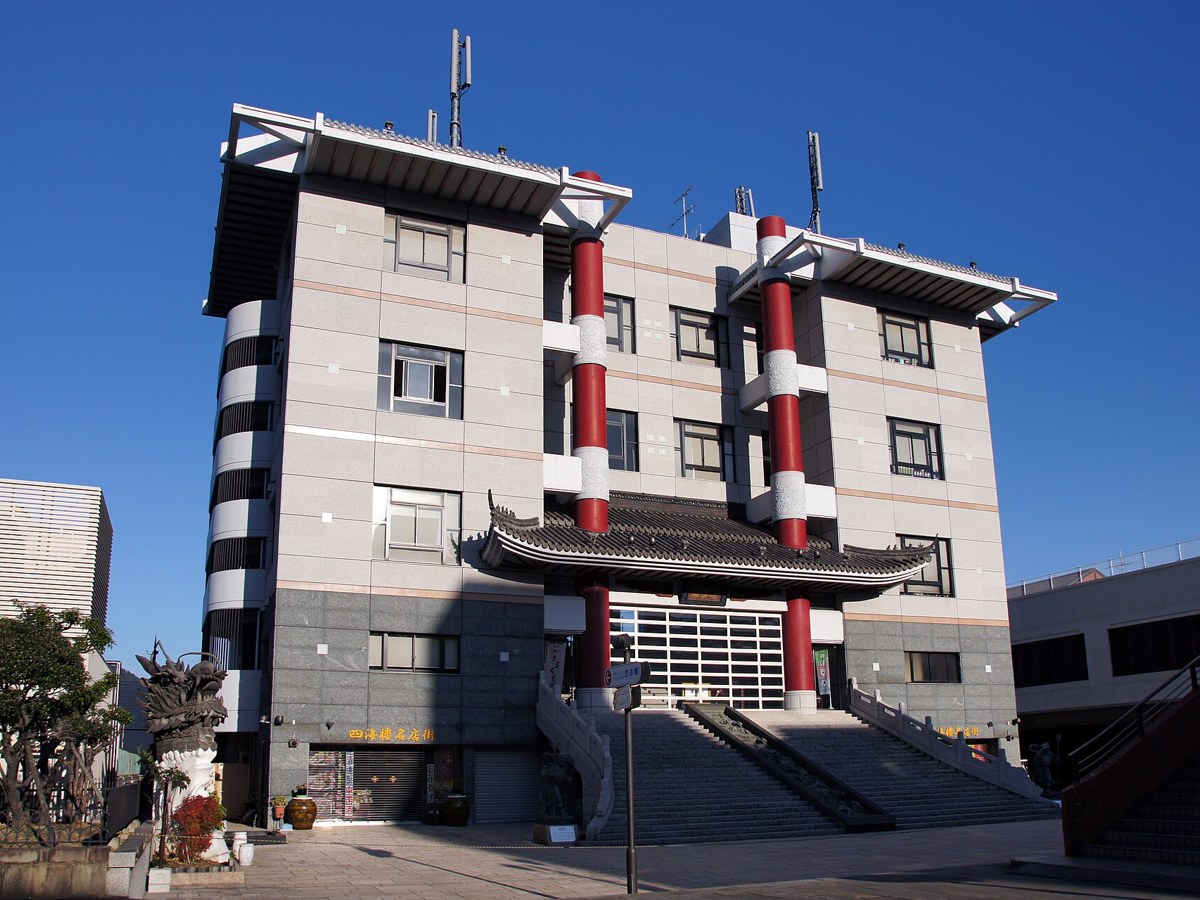
Shikairo today is a five-storey, Chinese-palace-fronted restaurant on the harbour slope near Oura Church, and its champon is approximately ¥1,100 a bowl on the MATCHA guide's current reading — a birthplace premium of, essentially, nothing. The second floor holds a free museum dedicated to the history of champon, including the evolution of the house's own tableware since the founding days: lunch and a museum in one building, the dish and its documentation under the same roof. Across the city, budget bowls run ¥700-900 on the checked guide's readings, and the form's second institution is a chain — Ringer Hut, which originated in Nagasaki in the 1970s and now serves its version at around ¥700-900 across Japan.
Nagasaki's standing stories are a porcelain from its kilns' neighbour, a Portuguese sponge cake and a pork bun from its Chinese quarter. Champon is the prefecture's first savoury main — the meal the city eats rather than the souvenirs it sells — and the only story in this collection that was designed, on the record, as an act of hospitality to foreign students.
Eating it in the city that made it
Start at the founding house if the queue allows, and take the museum stairs before or after — five minutes among the bowls and menus of 1899 will season the bowl in front of you. Then eat a second champon somewhere small in Shinchi Chinatown, Nagasaki's living Chinese quarter, and compare: the broth's weight, the stir-fry's smoke, the noodle's chew. The city's sport is the same as Sendai's with gyutan or Morioka's with jajamen — one grammar, many hands.
Adjust at the table the local way, with the vinegar or chili oil most shops set out, a splash at a time. And do not let the bowl wait for photographs: Chen's noodles were built to be eaten by hungry people, promptly, and they still punish delay. That urgency is the last ingredient, and it has been in the recipe since 1899.
Sources — checked 11 November 2026
- Shikairo: the restaurant's own official site — history and the origins of champon and sara udon (maker's own site, Japanese)
- MATCHA: Must-Visit Nagasaki Restaurants for Champon and Turkish Rice (checked guide)
- Japan Trove: Champon — Nagasaki's hybrid seafood noodle dish (checked guide)
Original prose and official links only; no source text or maker media reproduced. Photos are credited Creative Commons works, not product photographs.
Editorial review 2026-11-11